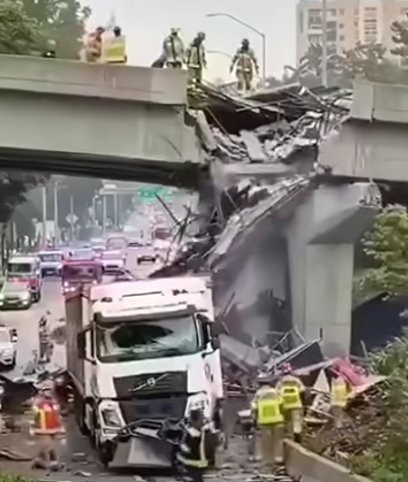
A construction site turned into an emergency scene when part of an elevated highway under development showed signs of severe structural instability. Workers on the project acted quickly, evacuating moments before sections of the structure began to shift and collapse. Safety crews, cranes, and support teams rushed in to secure the area and assess the damage.
Thanks to established safety procedures and the fast response of the crew, the evacuation was successful, and no major injuries were reported. The incident has renewed national conversations about infrastructure safety and the importance of strict inspection protocols.
A Reminder of a Historic Infrastructure Disaster
The event brought renewed attention to one of the most notable structural failures in U.S. history: the 2007 collapse of the Interstate 35W bridge in Minneapolis, Minnesota.
During the evening rush hour on August 1, 2007, the I-35W bridge gave way without warning, leading to a major emergency response effort. According to reports from the National Transportation Safety Board (NTSB) and the Associated Press, the collapse resulted in 13 fatalities and more than 100 injuries. Vehicles were stranded on broken sections of the bridge, and rescue crews worked for hours to bring people to safety.
The disaster prompted a nationwide reassessment of infrastructure conditions and highlighted the importance of proactive maintenance and design review.
What Investigators Found
After an extensive investigation, the NTSB concluded that the primary cause of the Minneapolis collapse was a design flaw dating back to the 1960s. A critical set of gusset plates—important metal components connecting steel beams—had been manufactured thinner than required. This flaw became dangerous when additional weight from renovation materials was placed on the bridge.
At the time, the bridge had been listed as “structurally deficient,” meaning it required close monitoring, although it was still open to traffic.
Recovery, Compensation, and Rebuilding
Following the tragedy, Minnesota and several contractors provided more than $100 million in compensation to survivors and families affected by the collapse. The new I-35W Saint Anthony Falls Bridge was constructed in just over a year, featuring modern monitoring systems, stronger materials, and redundant structural elements designed to prevent similar failures.
The bridge has since become a national model for safety-focused engineering.
Progress in U.S. Infrastructure Safety
Since 2007, improvements have been made across the country. The American Society of Civil Engineers (ASCE) notes that the number of structurally deficient bridges nationwide has decreased from 12% to 9%. Minnesota launched a major improvement program, repairing or upgrading more than 170 bridges identified as high priority.
In response to lessons from past incidents, many states now require independent engineering reviews during the design phase of major projects. New materials, digital monitoring tools, and advanced modeling software are playing crucial roles in modern bridge safety.
Federal agencies such as the Federal Highway Administration (FHWA) continue to update inspection requirements to better identify at-risk structures and allocate resources more effectively.
Infrastructure Investment: A National Priority
Despite progress, the ASCE estimates that over $120 billion is still needed to address the nation’s bridge repair backlog. State and local governments have launched funding initiatives, but experts emphasize the importance of long-term federal investment to maintain and upgrade critical transportation systems.
Honoring the Past, Protecting the Future
Each year, Minneapolis holds memorial events to honor the victims and survivors of the 2007 I-35W collapse. Exhibits at local museums and emergency training centers display structural components from the original bridge, serving as reminders of the importance of engineering precision and public safety.
A Wake-Up Call for Ongoing Vigilance
The recent near-collapse during highway construction highlights how important rigorous inspections, training, and structural reviews remain today. Whether on a construction site or a busy commuter bridge, safety must always come first.
The stories of both the construction crew who escaped danger and the Minneapolis community affected by the 2007 disaster reinforce a shared message: ongoing investment, careful oversight, and engineering excellence are essential for protecting lives.