 Lifestyle
The Hidden Truth in My Grandma’s Postcards Took a Lifetime to Reveal
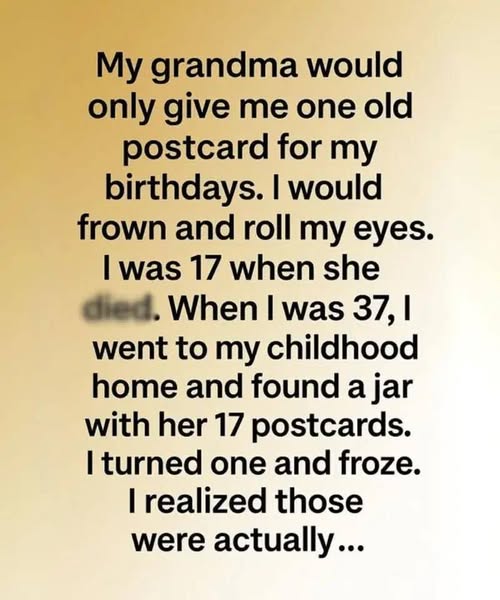
For as long as I can remember, my grandmother had a strange birthday tradition: every year, she gave me a single, old postcard. As a teenager, I thought it was silly—a cheap, thoughtless gift. I would roll my eyes, frown, and toss it aside, never realizing the weight behind her quiet gesture.
When she passed away, I was seventeen. Life moved fast. College, marriage, divorce—it all blurred together. Twenty years later, at thirty-seven, I returned to my childhood home. While sorting through old things, I found a small jar containing seventeen postcards—the ones she had given me every birthday. Curiosity pulled me in. As I examined each card, a strange, electric realization hit me: these weren’t just whimsical notes. They were clues.
Each postcard contained a short, cryptic message—phrases like, “Not every door is locked just because it creaks,” or, “You’ll never find truth where everyone agrees.” I had always dismissed them as quirky ramblings. But now, I noticed something new: certain letters were underlined in different colors of ink. My hands shook as I painstakingly recorded them, one by one, until a message emerged: “LOOK IN THE CEDAR HOPE CHEST. BOTTOM.”
The cedar hope chest had been in her bedroom my entire life, filled with blankets and linens I assumed were mundane. Now, with a mix of dread and excitement, I pried open the false bottom. Hidden beneath was a worn red folder, and atop it, a sticky note in her handwriting: “Read these when you’re ready to know who I really was.”
Inside were photographs, letters, and documents. One photo stunned me: my grandmother, young, standing with a man I didn’t recognize—and clearly pregnant. Letters from 1962 revealed a truth that shattered my world. The woman I had called Grandma Zahra wasn’t my biological grandmother. She was my mother.
The postcards, the cryptic messages, the decades of secrecy—they weren’t games. They were her careful way of revealing my origin story in pieces, only when she knew I could handle it. My mother had fled Iran in the 1970s, escaping a forbidden love and a dangerous regime. She gave birth to me in Greece, arranged my adoption in the U.S., and then stayed nearby, watching over me silently. She became our family’s “nanny” when I was five, blending in while keeping the truth hidden.
 Up Next: Page 2 of 2
Reading those letters, memories flooded back. How she instinctively knew what I...
I eventually called my adoptive parents and shared everything. Tears, long silences, and then understanding. “She loved you harder than we ever...
Continue Reading