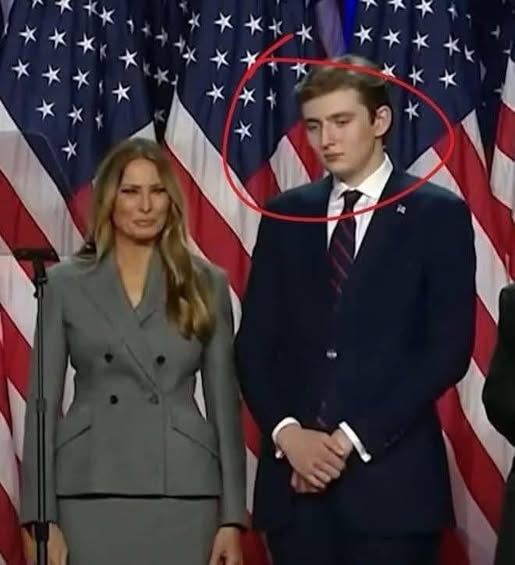
He was never meant to be a spectacle. He was meant to be a child.
For years, Barron Trump existed at the edge of public life—present, but protected. Shielded by distance, tinted glass, and deliberate restraint, he moved through a world carefully designed to keep the noise out. Then, suddenly, the distance collapsed. Cameras lingered. Headlines hovered. A private moment of mourning became a public event, and a child navigating loss found himself examined as if he were an idea rather than a human being.
Every detail was dissected. His height. His posture. His silence. In spaces meant for grief, curiosity rushed in. The funeral setting became content. Childhood was flattened into speculation. Few paused to recognize the obvious truth standing in plain sight: this was not a symbol, a statement, or a storyline—it was a young person enduring loss.
Barron did not choose visibility. He inherited it.
Born into a family defined by exposure, his upbringing followed a different script. While public life surged outside, his world was intentionally quiet. Home-cooked meals. Evenings without spectacle. A mother unwavering in her insistence on normalcy, on boundaries, on the radical idea that not everything needs an audience. Protection wasn’t an afterthought—it was a principle.
That protected space carried other influences, too. Grandparents who brought a different language, different traditions, and a different pace of life into the family. Slovenian phrases woven into daily conversation. Customs that didn’t belong to American headlines. Dual citizenship wasn’t just a legal detail—it was a reminder that identity can be layered, futures can be flexible, and life doesn’t have to follow the loudest path available.
In that environment, childhood was allowed to exist without performance. There were no rehearsed smiles, no expectations of charisma, no grooming for public approval. In a family known for commanding attention, he was raised to move quietly, without spectacle or demand.
Continue reading on next page…