 Curious & Viral
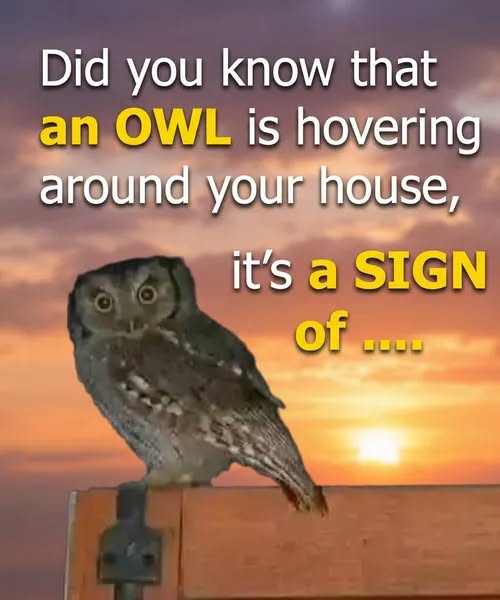
 What It Means When an Owl Is Seen Near Your Home at Night!
When the world sinks into sleep and streets fall quiet, one of nature’s most remarkable hunters begins its work. Gliding through the darkness with wings that barely disturb the air, the owl moves like a living shadow. Its wide span catches moonlight, yet its flight remains almost ghostlike. For centuries, people have looked up at barn rafters and hollow trees, startled by those glowing, unwavering eyes. To spot an owl near your home at night is to witness both evolutionary brilliance and centuries of human myth intertwined. These birds stand at the boundary between light and darkness, observing with a focus that feels ancient, as though they carry knowledge the daylight never reveals.
To grasp what an owl’s presence truly means, it helps to understand how exquisitely adapted these birds are to the night. An owl is not simply awake after sunset—it is built for darkness. Its large eyes are packed with light-sensitive cells that capture even the faintest glow. Unlike human eyes, an owl’s are fixed in place, held by bony rings. Instead of rolling them, the bird turns its entire head, sometimes nearly all the way around, allowing it to scan its surroundings without shifting its body and breaking cover.
Their hearing is just as extraordinary. Many owl species have ears set unevenly on their heads, one slightly higher than the other. This design lets them measure tiny differences in sound, helping them locate prey in three dimensions. A mouse beneath leaves or snow is revealed not by sight, but by the faintest rustle. An owl perched near your home is constantly “listening” to a hidden map of sound that humans cannot perceive.
Perhaps most astonishing is the owl’s silence. Where most birds create a rush of air with every wingbeat, an owl’s feathers are fringed with soft edges that scatter airflow. This design erases noise, allowing the bird to descend without warning. For its prey, there is no hint of danger—only a sudden, precise strike. This mastery of stealth makes owls vital to local ecosystems. By naturally controlling rodents and insects, they protect gardens and crops without chemicals, helping maintain balance in the environment. An owl nearby is often a sign of a healthy habitat.
 Up Next: Page 2 of 2
Beyond biology, owls carry deep symbolic meaning across cultures. In ancient Greece,...
Among many Indigenous cultures of North America, owls were seen as messengers between worlds. Their presence invited reflection rather than fear, urging...
Continue Reading