Thanksgiving was meant to be a day when the chaos of the world stayed firmly outside our home. My vision was simple, maybe even modest: a warm, home-cooked meal, the children in their pajamas, and none of the usual family drama. That morning, the kitchen smelled of melted butter, sage, and the sweet, tangy scent of pumpkin pies cooling on the counter. The house felt alive, almost sacred, with Emma, six, and Noah, four, turning the living room into a fortress of blankets and pillows.
I had been married to Lochlan for nine years, and I thought I understood him completely. He was usually the steady presence, managing the kids while I focused on cooking. But when we finally sat down for our carefully prepared feast—the turkey golden, mashed potatoes mounded high—Lochlan seemed elsewhere. His plate untouched, eyes glued to his phone, jaw tight with tension, he wasn’t the man I knew.
“Everything okay?” I asked, trying to keep my voice light as I passed him the gravy. He mumbled something about work, avoiding my gaze. By the third time I checked, he didn’t respond at all. Then, suddenly, the chair scraped across the floor.
“I need to step out. I’ll be right back,” he said, grabbing his jacket with frantic energy before the front door clicked shut. I stood frozen, spoon in hand, watching the steam rise from a dinner that suddenly felt abandoned.
The silence afterward was heavy and suffocating. I told myself it must be an emergency, something only he could handle. But as hours passed with no word from him, my fears grew. His phone went straight to voicemail, and for the first time, he had disabled his location. I spent the night moving between windows and doors, heart sinking at every passing car.
Friday passed in a haze of panic. Calls to coworkers were fruitless. The police explained that a missing adult without obvious danger wasn’t a priority. And I had to explain to our children why Daddy wasn’t home for leftovers, why he didn’t read bedtime stories, why his side of the bed was empty.
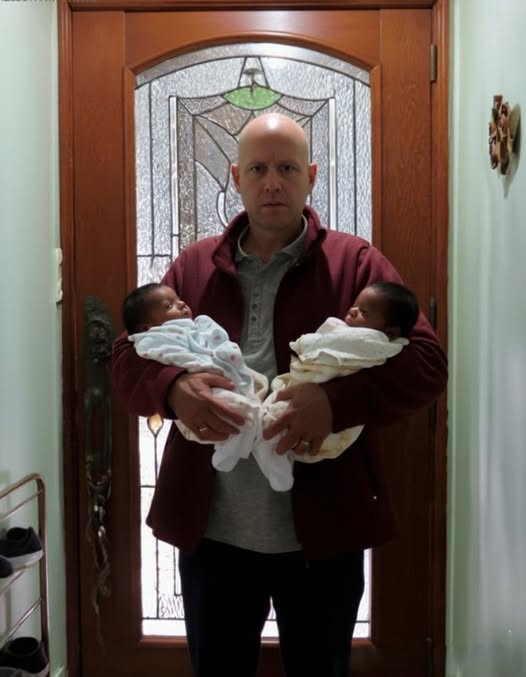
Then, early Saturday morning, the sound of the front door brought both dread and hope. I rushed down the hall, ready for explanations, accusations, or tears. Lochlan entered, disheveled, his clothes rumpled, eyes bloodshot, hair matted. But in his arms were two tiny bundles wrapped in striped hospital blankets, infants twitching lightly in their sleep.
“Lochlan… whose babies are these?” I whispered.
He placed them gently on the sofa before sinking into the cushions, covering his face with trembling hands. Finally, he spoke, voice broken.
“It all started when I got a text from Astrid, my assistant. She said it was urgent—life or death.” He explained how she had handed him the twins and disappeared, leaving him in shock. The babies belonged to her sister, Greer, hiding from a violent ex who had threatened to abduct them. Astrid had sought Lochlan’s help because he was the only person she trusted.
He had panicked, unsure how to act safely or how to call me without sounding insane. He spent hours trying to care for the newborns, getting formula from a gas station, securing a motel room, waiting for it to be safe before bringing them home.
Listening, the anger I felt melted into awe. My husband hadn’t betrayed me—he had tried to be a hero in a situation that required courage he hadn’t anticipated. I had him put Astrid on speakerphone, and she confirmed everything: the threats, the history of violence, the desperate need for help.
“We can’t keep them here,” I said softly, looking at the babies. “We need the authorities.”
That evening, we met Astrid at the police station. The law acted swiftly, moving Greer and the twins to a secure shelter, beginning an investigation into the ex-boyfriend. Within two days, he was caught trying to break into Astrid’s apartment. The danger was gone.
That night, after tucking in our own children, Lochlan and I sat quietly in the kitchen. He apologized again for the fear and silence. I cupped his face in my hands. “You scared me half to death,” I said gently, “but I see who you really are. Next time you play hero, don’t go it alone—take me with you.”
Our Thanksgiving wasn’t the “perfect” holiday I imagined. It was messy, chaotic, and terrifying. But we had protected a family not our own and, in doing so, had strengthened our own. We were safe, whole, and together—and that was all that mattered.