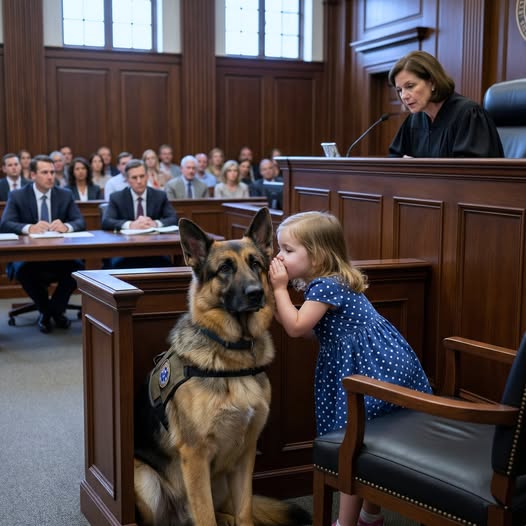
The air in the courtroom wasn’t just tense—it felt almost physical, a thick, oppressive weight that made every person present shift uncomfortably in their seat. In the back rows, the press waited in near-perfect stillness, pens poised, cameras silently recording behind protective glass. This wasn’t an ordinary proceeding. It was the peak of a high-profile domestic abuse case, a story that had gripped the city and exposed its darkest corners. Everything now depended on the testimony of a single, fragile witness: a three-year-old girl named Lily.
From the bailiff to the stenographer, every observer braced for the unpredictable. Veteran prosecutors and sharp-eyed defense attorneys exchanged doubtful glances. Could a toddler truly grasp what was happening? Would she find the courage to speak at all? Judge Holloway, a figure known for both steely resolve and quiet compassion, studied the case file with careful scrutiny, aware that no amount of preparation could account for the human element.
Lily hadn’t spoken a word since the night her mother was found unconscious, beaten, and clinging to life in their cramped apartment. The accused, her mother’s boyfriend, had a defense that seemed airtight. Without Lily’s voice, the truth remained locked away.
Then, the courtroom’s heavy double doors creaked open. All eyes turned. A tiny figure entered, her small hand gripping her foster mother’s tightly. She wore a pale blue dress dotted with white, a ribbon fluttering in her tousled hair. In her other hand, a plush bunny with a torn ear swung gently—a silent witness to countless sleepless nights.
Behind her, the soft tap of claws on linoleum announced the arrival of Shadow.
A collective breath caught in the room as the massive German Shepherd appeared, calm and majestic, amber eyes scanning the courtroom. His police-issued therapy vest marked him as a guardian for young victims. Lily froze, overwhelmed by the towering benches and the imposing presence of the judge, but when she looked at Shadow, a quiet recognition passed between them. The dog sat patiently on the rug before the witness chair, head tilted, as if silently inviting her forward.
Without hesitation, Lily let go of her foster mother’s hand and approached him. She crouched low, burying her face into his thick fur. For a moment, the courtroom seemed to hold its breath. Then, a faint whisper emerged.
Only Shadow could have heard it. Her tiny fingers twisted a lock of fur as if seeking comfort, and then her gaze sharpened. She looked toward the defendant. No pointing, no screaming—just a simple, piercing declaration: “He’s the bad one.”
Gasps erupted. James Elmore, the defense attorney, jumped to his feet, chair screeching against the floor. “Objection!”
“Sustained,” Judge Holloway responded, eyes still on the child. “The jury will disregard the comment.”
But the statement needed no repetition. The jury had seen her face, felt her conviction. Lily had spoken to the only being she trusted, and the truth spilled naturally.
Prosecutor Rachel Torres knelt beside Lily, softening her presence. “Do you know where you are today?” she asked.
Lily didn’t answer her. Instead, she leaned closer to Shadow. “He knows,” she murmured. “He saw.”
“Can you tell us what Shadow saw?” Rachel asked gently.
The little girl looked down at her shoes. “There was a bang,” she said. “Mommy screamed. Shadow wasn’t there yet… but now he knows.”
From her pocket, Lily retrieved a folded piece of paper—a simple crayon drawing. A stick figure girl hid beneath a table while a larger figure, scribbled with angry red lines, loomed overhead. “He broke the table,” she whispered.
In the days that followed, the courtroom shifted from skepticism to awe. Rachel presented recordings from Lily’s therapy sessions with Dr. Aaron Fields, where her small voice could be heard confiding to Shadow: “Shadow, be quiet. He might come back. He got mad. The lamp broke. I hid under the bed.”
The defense faltered. When Elmore attempted to discredit her, suggesting fabrication, Lily’s response was icy and resolute. “I don’t talk to you,” she said. “I only talk to Shadow. Only scary people lie.”
Evidence reinforced her story. Neighbor security footage captured the crash, a man’s angry shout, and a frightened child whispering, “Shadow, hide.”
Though Shadow hadn’t been present during the incident, he was the protector Lily had called for in her fear. In court, he was her courage incarnate, translating trauma into security.
On the final day, Lily handed Rachel one last drawing: herself and Shadow under a bright yellow sun, with the words scrawled in purple: Shadow is not scared.
Rachel looked at the child, then at the dog, whose steady presence anchored the room. “No,” she whispered. “Neither is he. And neither are you.”
The truth needed no theatrics or legal maneuvering. Through crayons, whispers, and the steady companionship of a loyal dog, Lily’s voice was heard. As she led Shadow from the courtroom, the air finally cleared—replaced with clarity, not dread.