In a neighborhood where days tend to blur together in predictable calm, one homeowner’s ordinary morning took an abrupt turn into the bizarre. Suburban life rarely offers surprises beyond weather shifts or overgrown hedges—but this time, something profoundly unsettling had appeared overnight. As is increasingly the case in moments of confusion, the search for answers didn’t begin with textbooks or phone calls to local experts. It began online.
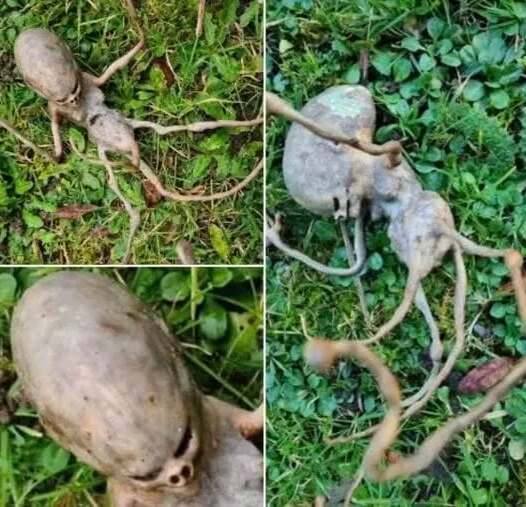
The discovery lay in the middle of an otherwise pristine backyard, resting quietly among damp blades of grass. At first glance, it looked less like something grown or dropped there and more like something deposited—an object whose shape seemed incompatible with anything familiar to local ecosystems. The homeowner would later describe it as “not of this place,” a form that felt more imagined than biological.
What made the object so disturbing was its structure. It bore none of the balanced geometry common to plants or animals. Instead, it rose awkwardly from the ground with a long, narrow central mass topped by a bulbous shape eerily reminiscent of a skull. Thin, stick-like extensions protruded from its sides at unnatural angles, giving the impression of limbs frozen mid-motion. Its color was uniformly pale and weathered, somewhere between bone and rusted metal, catching the light in a way that made it feel both lifeless and engineered.
Her first instinct was to rationalize it. Perhaps it was an unusual fungus—nature, after all, has a long history of producing unsettling designs. But as she examined it more closely, that explanation began to fall apart. The surface didn’t resemble the soft or spongy textures typical of mushrooms. The protrusions appeared rigid, almost architectural. Unease set in, and with it the sense that this wasn’t something to handle casually. She stepped back, took photos, and turned to the internet.
She posted the images to a well-known online community devoted to fungi identification, a place where experts routinely name obscure species from minimal evidence. This time, however, confidence was in short supply. Suggestions ranged from decayed “Dead Man’s Fingers” fungi to badly weathered stinkhorns, but none fully matched the proportions or structure seen in the images. After extended debate, the group admitted defeat. Whatever this was, it didn’t comfortably fit into known fungal categories.
At that point, the investigation took a stranger turn. Acting on suggestions from commenters, the homeowner shared the photos with a community more accustomed to the unexplained—a forum dedicated to alleged extraterrestrial artifacts and anomalies. The tone shifted immediately. Where scientists hesitated, speculation flourished. Some users dismissed the object as a hoax, a prop, or a cleverly staged art piece. Others weren’t so sure, scrutinizing shadows, textures, and proportions with unsettling seriousness.
One comment, in particular, gained traction. A user urged caution, advising the homeowner not to touch the object directly and to treat it as potentially hazardous. Though framed with a touch of sci-fi humor, the warning resonated. Whether it was organic decay, environmental contamination, or something else entirely, few were willing to rule out biological risk. The backyard began to feel less like a garden and more like a containment site.
As the images spread, theories multiplied. Some suggested the form was an illusion—a case of slime mold or fungal growth conforming around buried debris, tricking the brain into seeing a humanoid shape. Others proposed a parasitic organism overtaking a small animal, distorting its remains into something grotesquely unfamiliar. Each hypothesis tried to pull the object back into the realm of known science, but none fully satisfied.
Despite thousands of views and countless opinions, no definitive answer emerged. The strange figure became a symbol of how modern curiosity works: when confronted with something uncanny, we crowdsource meaning, bouncing between expertise, imagination, and fear. What began as a quiet morning discovery transformed into a global guessing game involving scientists, skeptics, and believers alike.
The object itself remains unexplained. It could be an extreme biological oddity, a prank gone too far, or a coincidence shaped by decay and perception. Until someone collects a sample and submits it to laboratory analysis—carefully, and with gloves—the truth remains out of reach.
What this episode ultimately reveals is how fragile our sense of familiarity really is. Even in carefully maintained backyards, the unknown can surface without warning. The internet may offer endless theories, but not every mystery yields to immediate answers. For now, the homeowner watches from a distance, waiting to see whether the strange form will wither away—or whether it has more secrets still rooted