 Curious & Viral
Why Are Some Wall Outlets Installed Upside Down?
The Surprising Reason Behind the Orientation
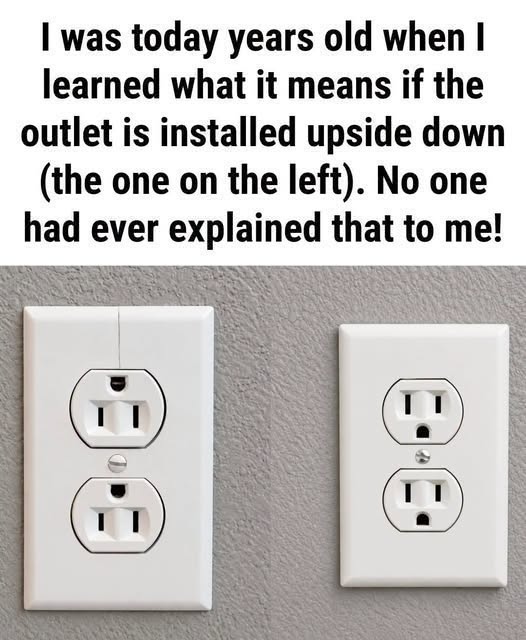
Have you ever noticed a wall outlet with the ground opening facing upward instead of downward?
At first, it can look like the electrician installed it incorrectly. But an outlet in this position may be completely intentional.
In many homes, the orientation of an electrical receptacle can be connected to how the outlet is used, how it was installed, or simply the preferences of the electrician or builder.
It May Indicate a Switched Outlet
One possible explanation involves outlets that are controlled by a wall switch.
In older homes especially, it was common for a wall switch to control a lamp plugged into an outlet rather than a ceiling light. Some receptacles were designed so that one half could be switched while the other remained powered.
This arrangement provided flexibility. A lamp could be connected to the switched portion, while another device could remain plugged into the continuously powered portion.
In some installations, an unusual outlet orientation may have been used as a visual reminder that the receptacle had a special function.
However, orientation alone doesn't prove that an outlet is switched.
There Isn't One Universal Orientation
Many people assume that every electrical outlet must be installed in exactly the same direction.
In reality, outlet orientation can vary.
Depending on local practices, the type of installation, the electrician's preference, and the design of the building, you may see receptacles installed with the grounding opening facing upward, downward, or even sideways.
Electrical requirements can also vary by location and installation type, so it's important not to assume that one orientation has a universal meaning.
An upside-down outlet isn't automatically evidence of faulty workmanship.
Why Would an Electrician Choose a Different Orientation?
There are several possible reasons.
A particular orientation may make the wiring arrangement more convenient. It may help distinguish a specialized receptacle from others nearby. In some cases, it may simply reflect the installer's preferred method.
Some people also believe that a particular orientation can provide practical advantages when a plug or cord is pulled or placed under tension. However, the safety implications depend on the specific receptacle, plug, installation, and applicable electrical requirements.
 Up Next: Page 2 of 2
For that reason, it's better not to treat outlet orientation as a...
Older houses can contain electrical installations that reflect the practices common when they were built or renovated.
Continue Reading