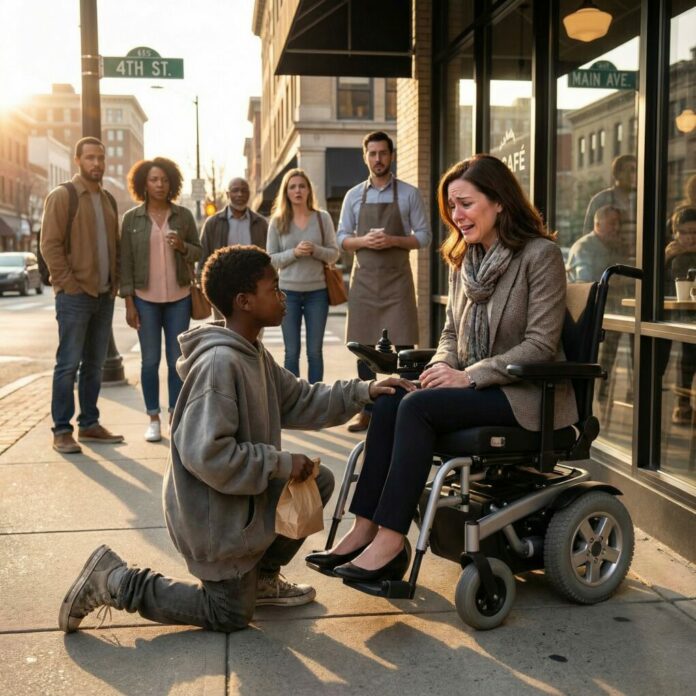
One evening as the café closed, a server placed a small bag of untouched sandwiches near the trash. Before Evelyn could look away, a young boy stepped forward. He was about twelve, thin, wearing worn sneakers and an oversized hoodie.
“Ma’am,” he asked quietly, gesturing toward the bag, “may I have the leftovers?”
Evelyn nodded. “Of course. Take them all.”
The boy paused, then surprised her. “I can help you,” he said carefully. “In exchange.”
She smiled kindly. “I don’t need anything.”
He glanced at her legs. “I think you might be able to walk again.”
The words caught her off guard. Staff nearby fell silent. Evelyn felt a familiar wave of discomfort rise, but she steadied herself.
“And how would you know that?” she asked.
“My mom used to work in rehabilitation,” the boy explained. “I watched her help people every day. The way you sit, the way your foot turns—you still have response. You just stopped trying because people told you to.”
Evelyn shook her head gently. “Take the food,” she said. “That’s enough.”
But before leaving, the boy lightly tapped her calf.
Evelyn inhaled sharply.
It wasn’t pain—but it was sensation. Something she hadn’t felt in years.
“Please,” she whispered. “Do that again.”
He did. And this time, her toes moved—barely, but undeniably.
What followed wasn’t a miracle. It was persistence.
Evelyn invited the boy—Marcus Reed—back the next day. She also called her former physical therapist, Dr. Hannah Klein, who had long believed Evelyn’s recovery had ended too soon.
Over the next weeks, Marcus shared small techniques he’d observed years earlier: focused breathing, minimal movements, patience. Dr. Klein carefully evaluated everything, eventually confirming that Evelyn’s progress had been underestimated.
The work was slow and difficult. Some days were discouraging. Some days Marcus couldn’t come because he was caring for his younger sister at a local shelter. But he always returned, asking only for meals to take home.
Two months later, Evelyn stood between parallel bars for the first time.
Her legs shook. Her arms trembled. Marcus stood nearby—not touching, just encouraging.
“Tell your legs to listen,” he said softly.
She took one step. Then another.
Staff watched in disbelief. Evelyn cried—not because she walked, but because she realized how close she had come to giving up.
As word spread, media attention followed. Articles praised Evelyn’s determination. Cameras flashed. Donations arrived.
But Marcus wasn’t mentioned.
When Evelyn asked why, she was told, “The story is simpler without him.”
The next morning, Evelyn corrected that.
At a live press conference, she told the full story—about the leftovers, the shelter, and the boy who saw potential when others had stopped looking.
“This recovery isn’t just mine,” she said. “It belongs to someone who was easy to overlook.”
She stood, walked forward slowly, and invited Marcus to join her.
The room fell silent.
Evelyn later funded a community rehabilitation center and created education scholarships for young people with limited access to opportunity. Marcus returned to school. His sister moved into stable housing. Both futures expanded.
Months later, Evelyn walked into her café on her own.
Marcus was there, finishing homework.
“You still owe me,” he joked. “For the sandwiches.”
She smiled. “I owe you much more than that.”
Their story spread not because it was perfect—but because it asked important questions:
Who do we overlook?
Who do we dismiss too quickly?
And what happens when we choose to listen?
Sometimes, meaningful change begins with something small—like a simple act of kindness, and the willingness to see someone others ignore.