
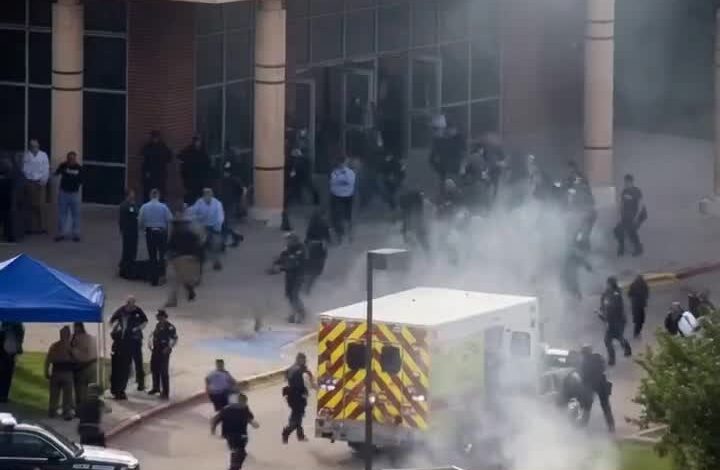

A disturbing headline claiming that at least four people were killed and ten others injured in a mass shooting at a school has been circulating online, alarming readers who may believe another deadly attack has just occurred.
However, the article associated with the headline does not provide the basic information needed to confirm such an event. It does not identify the school, city, state or country where the alleged shooting occurred. It provides no specific date or time, does not identify the police department investigating the incident, and contains no statements from school officials, emergency responders or authorities.
Instead, the page published on June 5, 2026, consists largely of a broader discussion about school violence, prevention, emergency response and the long-term effects of traumatic events. Although the headline uses the word “BREAKING,” the article itself does not provide evidence confirming a new shooting in which four people were killed and ten were injured.
The Missing Details Matter
During a genuine breaking-news emergency, some facts may initially be unknown. Casualty figures can change, the identities of victims may not yet be released, and investigators may still be determining exactly what happened.
But a credible report of a major school shooting would normally provide at least some basic information, such as the approximate location of the incident and the authority responsible for confirming the casualty figures.
Police departments, school districts, hospitals, emergency-management agencies and other public authorities typically issue statements as an investigation develops. Reputable news organizations also identify where their information comes from.
A dramatic headline alone is not evidence.
When a report claims that multiple people have been killed or injured but does not identify where the alleged attack occurred or cite a responsible authority, readers should treat the claim as unverified.
The Numbers Match a Historical Tragedy
The figures used in the viral headline—four people killed and ten injured—closely match a real school attack that occurred at Lindhurst High School in Olivehurst, California, on May 1, 1992.
During that attack, a former student entered the school armed with firearms and killed one teacher and three students. Ten other people were injured, while dozens of students were held hostage during an hours-long standoff.
The historical record confirms the four deaths and ten injuries.
There is no evidence in the linked article, however, that its headline was specifically referring to the Lindhurst attack. The page does not mention Lindhurst High School, Olivehurst, California, or 1992.
That distinction is important.
The similarity in casualty figures raises the possibility that details from a decades-old tragedy may have been separated from their original date and location and presented in a way that makes the incident appear current. But without evidence from the publisher explaining the origin of the figures, it would be irresponsible to state that this is definitely what happened.
The verifiable conclusion is narrower: the article does not establish that a new school shooting occurred, while its casualty figures closely correspond to a documented historical attack.
Why Recycled Tragedies Can Cause Real Harm
Historical incidents are frequently recirculated online without adequate context. An old photograph, video or casualty figure can be paired with language such as “breaking,” “just happened” or “today,” leading readers to believe that a decades-old event is unfolding in the present.
The consequences can be serious.
Parents with children in school may immediately fear that the attack happened in their community. Students may send the post to classmates. Families may contact schools or emergency services seeking information. Communities can become anxious before anyone has established whether an incident actually occurred.
A historical tragedy does not become less important because it is old. But presenting it as a new emergency distorts the historical record and creates unnecessary fear.
The Lindhurst High School Attack
The Lindhurst tragedy remains one of the significant school attacks in California’s history.
On May 1, 1992, a former student entered Lindhurst High School in Olivehurst and began shooting. Four people were killed: a teacher and three students. Ten others were injured, and numerous students were held hostage during the ensuing standoff.
For those who experienced the attack, the casualty figures were never simply numbers. Each victim had family members, friends, classmates and a place within the community. Students who survived without physical injuries were nevertheless exposed to an extraordinarily traumatic event.
That human context is easily lost when historical casualty figures are transformed into clickbait.
Warning Signs in the Viral Headline
Several features of the circulating post should encourage readers to pause before sharing it.
First, the headline makes an extraordinary casualty claim but does not identify the school.
Second, it provides no location.
Third, it does not establish when the alleged shooting occurred.
Fourth, it does not identify the law-enforcement agency responsible for the investigation.
Finally, the article itself does not contain reporting that supports the headline’s specific claim.
The use of urgent language such as “BREAKING” can create a sense that readers must react immediately. But urgency should never replace verification.
Repetition does not establish truth, either. If dozens of social-media accounts copy the same headline, they may all be relying on one original post. Ten accounts repeating an unsupported claim do not constitute ten independent confirmations.
see more…