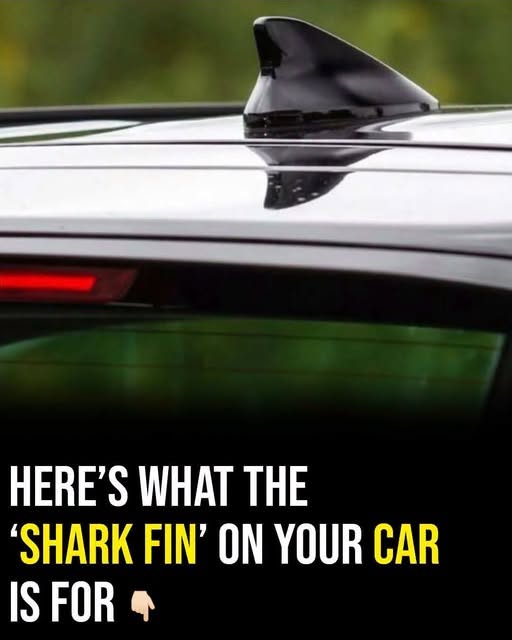
Here’s What the ‘Shark Fin’ on Your Car Is Actually For
If you drive a relatively modern car, there’s a good chance you’ve noticed a small, fin-shaped object sitting toward the rear of the roof.
Most people simply call it the “shark fin.” And because it blends so neatly into the design of the vehicle, it’s easy to assume that it’s there mainly for decoration or aerodynamics.
But that little piece can have a much more important job than you might expect.
It’s Actually an Antenna
The shark fin is essentially a modern version of the long metal antennas that used to stick out from cars.
Older vehicles commonly relied on a visible mast or whip antenna to receive radio broadcasts. As vehicle technology evolved, manufacturers needed antennas for more than just AM and FM radio.
The shark-fin design gave engineers a convenient way to package several communication functions into a small housing on the roof.
Depending on the make, model and equipment fitted to the vehicle, the fin may support systems such as:
- AM/FM radio reception
- GPS and navigation
- Cellular connectivity
- Vehicle telematics
- Satellite-based services
- Wi-Fi or other wireless communication features
Not every shark fin contains all of these systems. A basic vehicle may use it primarily for radio and GPS, while a more connected vehicle may have several antenna elements packed inside the same housing.
Why Put It on the Roof?
There’s a practical reason manufacturers place antennas high on the vehicle.
The roof gives the antenna a relatively unobstructed position for receiving signals. This is particularly useful for satellite navigation systems, which rely on signals coming from above.
It also keeps the antenna away from much of the metal structure surrounding components located deeper inside the vehicle.
Instead of placing several separate antennas around the car, manufacturers can combine multiple functions into one compact roof-mounted unit.
Why Does It Look Like a Shark Fin?
The distinctive shape isn’t accidental.
Traditional whip antennas could be long, visually distracting and vulnerable to being bent or damaged. They could also generate some wind noise while the vehicle was moving.
A shark-fin housing is shorter, sturdier and more streamlined.
It also fits much better with the smooth exterior designs of modern vehicles. Manufacturers can even paint the housing to match the body or roof, making the antenna look like an intentional part of the car’s styling.
There May Be More Technology Inside Than You Think
This is where the little fin becomes surprisingly interesting.
Modern cars increasingly depend on wireless communication.
A vehicle with built-in navigation needs to receive positioning signals. Connected-car features may require cellular communication. Some vehicles can communicate with manufacturer services for emergency assistance, diagnostics or other connected functions.
Rather than giving every system a separate object sticking out of the vehicle, multiple antenna elements can be housed together.
So while the outside may look like a simple piece of plastic, there can be sophisticated antenna hardware underneath it.
Does Every Car Use the Shark Fin for the Same Thing?
No.
This is an important distinction.
Two cars can have nearly identical-looking shark fins but use them for different purposes.
The exact functions depend on the manufacturer, model year, trim level, infotainment system and connected features installed in the vehicle.
Some manufacturers specifically describe their shark-fin antennas as transmitting and receiving AM/FM and GPS signals, while noting that additional signals can be supported depending on the vehicle’s equipment.
That’s why losing one feature after the fin becomes damaged doesn’t necessarily mean another car would experience the same problem.
What Happens If the Shark Fin Is Damaged?
A cracked or loose shark-fin antenna shouldn’t always be dismissed as cosmetic damage.
Depending on what is housed inside, damage to the antenna or its connections could potentially affect radio reception, navigation or other communication features.
There’s another concern: water.
Because the antenna is mounted through or against the roof, its base needs to remain properly sealed. If the housing or seal is badly damaged, moisture getting into the area can create additional problems.
If your shark fin becomes loose, cracked or damaged in a car wash, it’s worth having it inspected rather than simply gluing the plastic cover back into place.
Be Careful With Roof Racks and Car Washes
The shark fin’s low profile makes it tougher than many old-fashioned antennas, but it isn’t indestructible.
Roof boxes, luggage and other cargo should be positioned so they don’t press against the antenna. Vehicle manufacturers may also warn owners to consider the antenna when entering areas with limited overhead clearance or certain automated washing equipment.
If you’re installing a roof rack or cargo box, checking the owner’s manual for clearance recommendations is a good idea.
Can You Replace It Yourself?
Replacement depends heavily on the vehicle.
On some cars, replacing the outer cover may be relatively straightforward. Replacing the complete antenna assembly can be much more involved because wiring typically runs underneath the roof lining.
The replacement unit also needs to be compatible with the communication systems fitted to the vehicle.
This is one reason inexpensive decorative shark fins sold online shouldn’t automatically be considered equivalent to a factory antenna. Some are primarily cosmetic, while an original vehicle antenna may contain several functional components.
Why Did Shark Fins Replace the Old Metal Antenna?
There isn’t just one reason.
The design allows manufacturers to combine multiple antenna technologies while giving the vehicle a cleaner appearance. The housing is compact, protected and more aerodynamic than a long antenna sticking into the airflow.
It also reflects how dramatically cars have changed.
A few decades ago, the antenna’s main job might have been getting your favorite FM station.
Today, the same area of the car can play a role in navigation and multiple wireless communication systems.
A Small Part With a Surprisingly Big Job
So the next time you notice that little shark fin on the roof, you’ll know it isn’t simply there to make the car look sportier.
It’s a clever solution to a modern problem: cars need to communicate with radio towers, satellites and wireless networks without having several antennas sticking out in every direction.
Manufacturers managed to hide much of that technology inside one small, streamlined housing.
And that’s why the humble “shark fin” may be one of the most overlooked pieces of technology on your car.