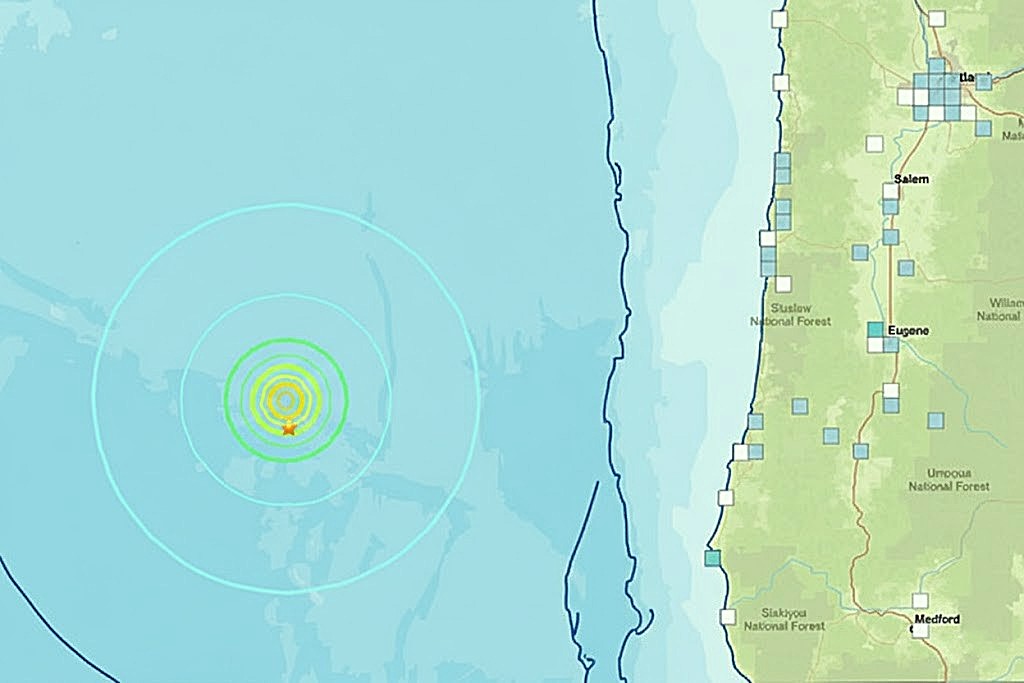
A major earthquake shook the Pacific Ocean off the coast of Oregon Thursday night, sending tremors across multiple West Coast cities and raising concerns about more quakes to come.
The 6.0-magnitude quake struck around 10:25 p.m. ET, roughly 180 miles offshore. Residents reported feeling the shaking as far as Portland—about 300 miles from the epicenter—as well as in Eugene, Salem, Coos Bay, and Dallas. Three hours later, a magnitude 3.1 aftershock hit the same area, and the US Geological Survey (USGS) warns there’s a 65% chance more aftershocks could follow over the weekend.
The earthquake occurred along the Juan de Fuca Plate, the tectonic force behind the Cascadia Subduction Zone (CSZ)—a nearly 700-mile fault line stretching from northern Vancouver Island in Canada down to northern California. Scientists have long nicknamed the CSZ the “Sleeping Giant” due to its potential to unleash a catastrophic quake. Simulations show a magnitude 9.0 event could strike the Pacific Northwest, devastating major cities like Seattle and Portland.
While the tsunami alert system was activated after Thursday’s quake, the National Weather Service confirmed there was no threat to the U.S. coastline and no dangerous waves were produced. USGS estimates the odds of another quake stronger than magnitude 5.0 in the region over the next week at roughly 1-in-50. A massive rupture above magnitude 7.0 is considered extremely unlikely in the immediate term, with less than a 1% chance.
Continue reading on next page…