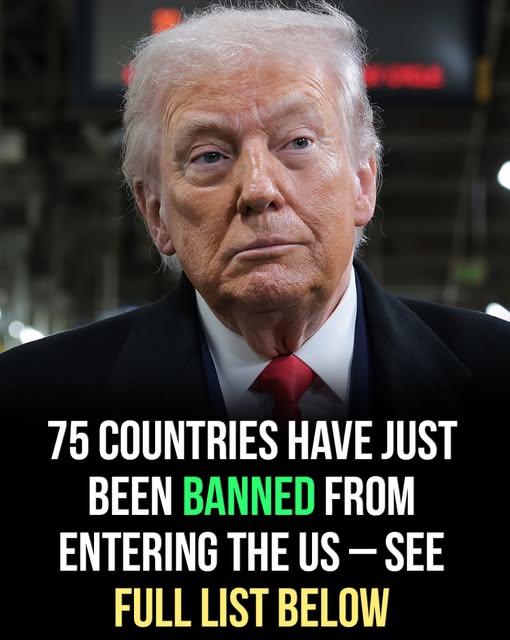
The opening phase of Donald Trump’s second term has unfolded amid sharp geopolitical tremors and sweeping domestic policy changes whose effects are being felt well beyond U.S. borders. Among the most controversial moves so far is a newly announced “review” of immigrant visa procedures—an action that, in practice, prevents nationals from 75 countries from entering the United States. Officially described by the State Department as a temporary safeguard for economic stability, the measure has rapidly sparked legal challenges, diplomatic strain, and humanitarian concern. It also underscores the administration’s renewed commitment to an aggressive interpretation of its “America First” doctrine, reshaping how the United States positions itself on the world stage.
Details of the policy first emerged through internal government correspondence and were later verified by major media organizations. Under the directive, U.S. consular offices worldwide have been instructed to suspend the approval of immigrant visas indefinitely. The breadth of the affected countries is striking, spanning nearly every region of the globe. Large Latin American nations such as Brazil and Uruguay appear alongside African states like Nigeria and Ethiopia, as well as multiple countries across the Middle East and Central Asia. The administration insists this is not a permanent severing of immigration pathways, but rather a mandated pause intended to restructure vetting systems and prevent newcomers from becoming dependent on public resources.
In public statements, Department of Homeland Security officials have emphasized economic justifications for the freeze, arguing that the policy will remain in place until authorities can ensure that new immigrants do not impose financial strain on U.S. taxpayers. The language used—particularly references to “public charge” concerns—has drawn attention. Internal documents cite examples from countries such as Somalia, Haiti, and Eritrea, claiming higher-than-acceptable reliance on public assistance. By framing the issue as economic self-defense, the administration appeals directly to its political base, asserting that longstanding immigration policies have been exploited and require fundamental restructuring.
The abrupt timing of the announcement has amplified its disruptive impact. The suspension is scheduled to take effect on Wednesday, January 21, leaving thousands of applicants—many of whom were nearing the final stages of approval—suddenly stranded in uncertainty. Immigration advocates warn that the human toll will be severe. Years-long legal processes involving family reunification, specialized employment visas, and refugee admissions have been halted with no clear timeline. Opponents argue that the policy unfairly categorizes entire populations as fiscal liabilities, despite extensive research showing immigrants’ significant contributions to labor markets and entrepreneurship.
Beyond domestic implications, the international consequences are substantial. Several nations on the list maintain strategically important yet delicate relationships with Washington. The inclusion of countries such as Brazil, Colombia, and Egypt—partners in regional security and diplomacy—signals a shift toward a more insular and transactional approach to foreign affairs. This move follows other controversial positions, including renewed rhetoric about acquiring Greenland and increased military pressure on Venezuela, reinforcing the perception of a unilateral and confrontational U.S. posture.
One particularly complex fallout involves international sports. The United States is preparing to co-host the FIFA World Cup with Canada and Mexico, an event of immense global significance. Yet the ban encompasses countries that are traditional football powerhouses, including Brazil, Colombia, Iran, and Ivory Coast. Should the restrictions remain in place through the summer, FIFA could face severe logistical challenges. Although officials suggest the policy targets immigrant visas rather than short-term entry, the absence of precise guidance has fueled fears that broader travel restrictions could follow, potentially preventing teams or supporters from entering the U.S.
Within the country, the policy has become a focal point for public dissent. Demonstrations have already erupted in major cities, with critics arguing that the freeze is an attempt to reshape national demographics under the pretext of economic security. These protests coincide with heightened tensions related to intensified deportation efforts and a recent controversial ICE-related incident in Minnesota. For many observers, the visa suspension is viewed not as an isolated administrative adjustment, but as part of a broader effort to sharply curtail immigration from non-Western nations.
Legal challenges are expected to be swift and extensive. Civil liberties groups and immigration attorneys are preparing lawsuits that contend the policy exceeds presidential authority and unlawfully discriminates based on nationality without sufficient security justification. Despite this, the administration shows little inclination to retreat. The rhetoric that dominated the campaign trail now appears to guide governance, with officials interpreting domestic and international backlash as validation of their resolve to dismantle what they view as a flawed system.
As the January 21 start date approaches, uncertainty hangs over the international community. For citizens of the 75 affected countries, America’s long-standing image as an open destination has been abruptly suspended. Whether the current “review” proves to be a short-term interruption or evolves into a lasting barrier remains unclear. What is evident is the administration’s willingness to absorb diplomatic fallout and internal division in pursuit of a more closed and tightly controlled immigration framework.
The list of impacted nations—ranging from Afghanistan and Yemen to Russia and North Macedonia—offers insight into the administration’s strategic concerns. Longstanding economic, cultural, and social ties are now under strain, and the criteria for eventual reinstatement remain undefined. As applications stall and uncertainty grows, the global community watches closely. Other nations may respond with reciprocal measures or economic pressure, reshaping international relationships in response. As the United States reassesses who may enter its borders, the rest of the world may likewise reconsider its engagement with a country increasingly prepared to stand apart.