In the stillness before dawn on every weekday, the kitchen light in our modest apartment flicks on like a quiet signal of routine. My name is Meredith, and preparing my son’s lunch is more than a morning task—it is my small resistance against a world that grows more costly and less forgiving by the day. I have learned how to stretch what others overlook: choosing imperfect apples from discount shelves, selecting granola bars nearing their expiration dates, and making one loaf of bread last far longer than it should. In our household, a packed lunch represents certainty. No matter how tight things become, my ten-year-old son, Andrew, will not go without something to eat.
Andrew has always been observant in a way that feels far beyond his years. Most children his age are blissfully unaware of unpaid bills or the anxiety of watching a bank balance shrink. Andrew notices everything. He never asks for more than what he’s given, never complains when meals repeat, and lately, he has been coming home with a lunchbox so spotless it looks untouched. At first, I laughed it off. Then his requests began to change.
“Could I take two granola bars today?” he asked one morning, lingering by the pantry. A few days later, he wondered aloud if we had any extra crackers—specifically the peppered ones. Eventually, he asked for a second sandwich. “Just in case,” he said, avoiding my eyes. There was something hesitant in his voice, as if he were asking for permission to carry a burden rather than extra food.
At the time, my bank account held exactly twenty-three dollars, and payday was still several shifts away. That evening, I stared at my mother’s old gold locket—the final item of value I owned—and knew I would need to part with it to keep meeting Andrew’s unspoken needs. The next morning, I skipped breakfast, poured the last of our soup into his thermos, and slipped a chocolate bar into his pocket as a quiet treat. I watched him hurry down the stairs, unaware that his lunch was being held together by sacrifice and determination.
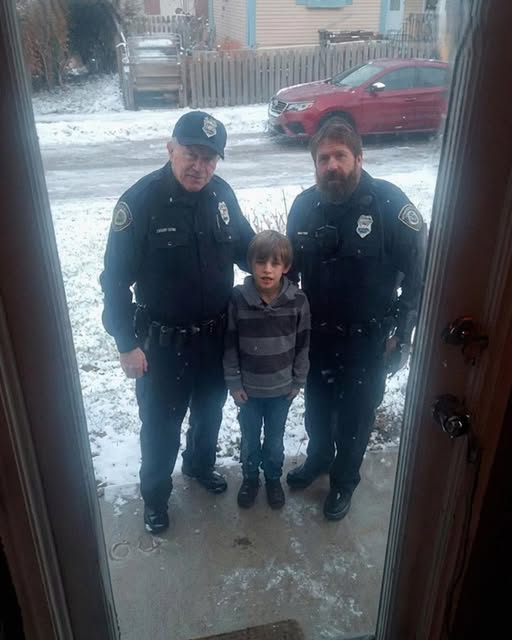
Not long after, a knock at the door shattered the calm. Two police officers stood outside. The sight of their uniforms in the early morning light sent panic racing through me. I began speaking before they could—asking about Andrew, certain something terrible had happened on his way to school. They assured me he was safe and asked me to come with them, offering little explanation beyond, “This concerns your son.”
The drive to the school passed in a haze of fear. Every possible scenario played through my mind. When we arrived, I was led into an empty classroom where Andrew’s teacher, Mr. Gellar, and the school counselor, Ms. Whitman, were waiting. Their expressions were serious but kind.
“You’re not in trouble,” Ms. Whitman said gently. “We wanted to show you something your son has been doing.”
They told me about a classmate named Haley—a quiet girl raised by her single father, who was struggling much like I was. Haley had been coming to school without lunch for weeks. She had grown withdrawn and unfocused. Then, something changed. She began eating daily. She smiled more. Her teachers noticed her coming back to herself.
“She said Andrew was sharing his lunch with her,” Mr. Gellar explained. “He told her he always had enough and that she deserved to eat, too. He’s been bringing extra snacks—especially the ones he thought she’d like—and skipping his own when necessary.”
I sank into a chair, my chest tightening. I thought of the empty pantry, the skipped meals, the locket now gone. I realized Andrew had seen our hardship and still chosen generosity.
The classroom door opened again, and a man in plain clothes entered. He looked exhausted but deeply emotional. “I’m Ben,” he said. “Haley’s father. I’m also a police officer.”
Ben explained that he had been working nights and overtime, unaware his daughter was hiding her hunger to avoid worrying him. “She told me about the granola bars,” he said quietly. “The ones with the wrappers that looked cheerful. I didn’t know how bad things were until your son helped her.”
We stood there as two parents brought together by children who understood more than we did. I admitted that when I saw his uniform, I assumed he had stability—that he couldn’t possibly know what it meant to struggle. He shook his head softly. “Seems like we’re all just trying to stay afloat.”
That evening, Andrew and I sat together at the kitchen table. I told him how proud I was—not just of his kindness, but of his courage to give quietly. He shrugged. “She was really hungry, Mom. It didn’t seem right that I had food and she didn’t.”
A few days later, a plain box arrived at our door. Inside were grocery gift cards, coffee, snacks, and a note explaining we had been enrolled in a local assistance program. There were no forms to fill out, no explanations required—just help.
I still pack Andrew’s lunch every morning. The routine remains, but now I always include extras. Another sandwich. Another apple. The granola bar with the brightest wrapper. Not because we are overflowing with resources, but because my son reminded me that kindness isn’t reserved for abundance. Sometimes, it’s the very thing that keeps everything from breaking apart. The police came to my door over a lunchbox—but they left behind something far greater: the reminder that even the smallest generosity can return in ways you never expect.