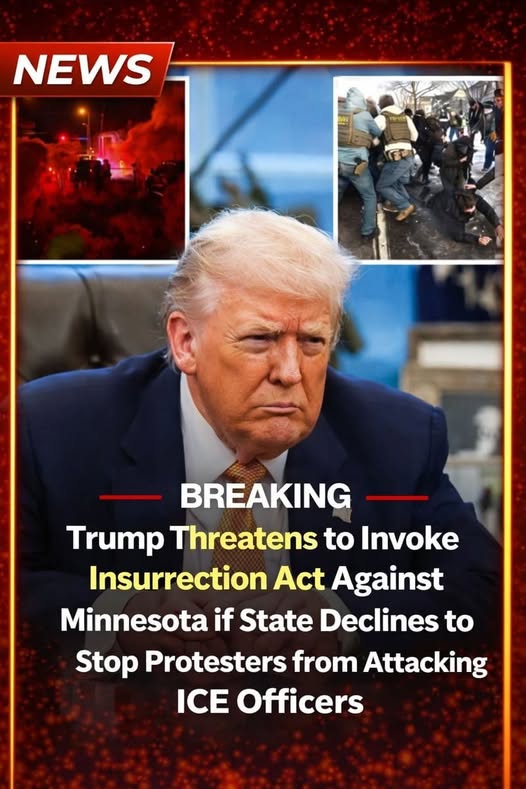
In mid-January 2026, Minnesota became the center of an intense national political crisis after President Donald Trump publicly suggested he could invoke the Insurrection Act—a rarely used federal statute—in response to unrest tied to a major immigration enforcement operation.
The developments that unfolded across the state during the opening weeks of 2026—including fatal shootings, mass demonstrations, legal confrontations, and escalating rhetoric from federal leaders—quickly transformed Minnesota into a focal point of debate over immigration enforcement, civil liberties, state sovereignty, and the limits of presidential authority.
1. Expanded Federal Immigration Operations in the Twin Cities
At the start of January, the Department of Homeland Security (DHS) and Immigration and Customs Enforcement (ICE) initiated what officials described as a large-scale enforcement surge in the Minneapolis–Saint Paul metropolitan area. The operation ranked among the most extensive ICE actions carried out in recent years.
Thousands of federal agents were deployed across residential neighborhoods, public areas, and federal facilities with the stated objective of enforcing immigration law, detaining undocumented individuals, and apprehending those suspected of immigration violations.
Federal authorities defended the operation as lawful and necessary, while local officials, advocacy groups, and residents criticized it as excessive, destabilizing, and unnecessarily aggressive.
2. Fatal Shooting of Renee Nicole Good and Escalation of Violence
Tensions intensified sharply on January 7, 2026, when Renee Nicole Good, a 37-year-old Minneapolis resident and U.S. citizen, was fatally shot by an ICE officer during an enforcement encounter. The killing immediately sparked widespread outrage and drew national attention.
Federal officials stated that the officer discharged his weapon after alleging that Good’s vehicle posed an imminent threat. However, community leaders and local authorities disputed key aspects of that account, fueling accusations of excessive use of force.
In the days that followed, a second ICE-related shooting occurred in north Minneapolis, where a Venezuelan national was wounded during an enforcement stop. This incident further heightened tensions and intensified public protests.
Demonstrations grew rapidly, with daily marches, rallies, and confrontations involving law enforcement. Some encounters escalated to the use of tear gas, flash-bang grenades, and arrests.
3. Public Demonstrations and State Leadership Response
Following the shootings, thousands of Minnesotans—including immigrant advocates, students, civil-rights organizations, and local residents—mobilized in Minneapolis and St. Paul. While many protests remained peaceful, others became volatile near federal enforcement sites.
Governor Tim Walz and Minneapolis Mayor Jacob Frey publicly criticized the federal operation, calling for de-escalation and raising concerns about civil-rights violations. Both officials accused federal agencies of undermining local public safety and inflaming tensions.
State leaders reiterated support for peaceful protest and rejected federal intervention in Minnesota’s law-enforcement responsibilities.
In response to public pressure, the Minnesota Bureau of Criminal Apprehension initiated an independent investigation into the January 7 shooting, while the Federal Bureau of Investigation assisted with evidence collection.
4. Legal Confrontation Between Minnesota and Federal Agencies
As unrest continued, the State of Minnesota, along with the cities of Minneapolis and St. Paul, filed a lawsuit against the federal government seeking to halt or restrict the ongoing enforcement operation.
The lawsuit alleged violations of constitutional protections, including free speech rights, and argued that federal actions created unsafe and unlawful conditions. The case marked a major escalation in conflict between state authorities and federal immigration agencies, with Minnesota accusing DHS and ICE of overreach.
5. Presidential Warning Regarding the Insurrection Act
On January 15, 2026, President Trump issued a public warning that he could invoke the Insurrection Act if Minnesota officials failed to restore order and ensure the safety of federal agents.
Enacted in 1807, the Insurrection Act grants the president authority to deploy active-duty military forces or federalize National Guard units within a state during extreme circumstances, including domestic unrest or obstruction of federal law—without the consent of state leaders. Its use is both rare and legally contentious.
The president’s statement marked a significant escalation, raising the possibility of military involvement in domestic law enforcement. Federal officials characterized some protest activity as “insurrectionist” and framed the unrest as interference with federal authority.
6. National Political and Legal Reaction
The prospect of invoking the Insurrection Act prompted immediate national debate.
Democratic lawmakers condemned the idea as an abuse of executive power and warned against militarizing civil protest.
Several Republican lawmakers also expressed concern, urging restraint and emphasizing reliance on state and local law enforcement rather than federal troops.
Legal scholars noted that deploying the Act over state objections would almost certainly face rapid constitutional challenges in federal court.
On January 16, 2026, the White House appeared to ease tensions slightly when President Trump stated there was “no immediate reason” to invoke the Insurrection Act, while maintaining it remained an option if conditions worsened.
7. Impact on Daily Life Across Minnesota
The combination of federal enforcement and sustained protests disrupted daily life throughout the Twin Cities region.
Some school districts transitioned temporarily to remote learning due to safety concerns.
Local businesses reported declines in activity and widespread anxiety among residents.
Community leaders warned that aggressive federal tactics were damaging trust between law enforcement agencies and vulnerable populations.
8. Ongoing Legal and Constitutional Stakes
With protests continuing and multiple investigations underway—including Minnesota’s lawsuit, independent reviews of law-enforcement conduct, and reports of Justice Department inquiries into state officials—the situation remains unresolved.
Legal experts emphasize that any actual deployment of federal troops under the Insurrection Act would almost certainly trigger immediate judicial intervention.
Summary
The events in Minnesota during January 2026—from intensified federal immigration enforcement and fatal encounters, to mass protests and a presidential threat to invoke the Insurrection Act—represent a convergence of major issues in contemporary U.S. politics:
the scope and methods of immigration enforcement,
the balance between state and federal authority,
the limits of executive power, and
the role of public protest in a democratic society.
As legal proceedings advance and political responses continue to evolve, Minnesota’s experience is likely to influence national discussions on immigration, civil rights, and constitutional governance for months to come.