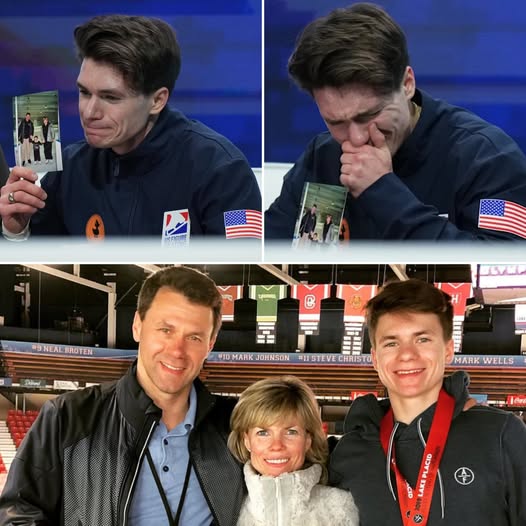
ST. LOUIS — At first glance, it was nothing more than a gentle family moment frozen in time: a small child balanced on white ice skates, smiling brightly while gripping the hands of two adults beside him on a modest rink in Connecticut.
The photograph radiated warmth and innocence—an image that could have belonged to any family album. Yet years later, it would come to represent something far deeper: endurance in the face of unimaginable heartbreak.
More than twenty years after that picture was taken, the child in the frame—now 24-year-old figure skater Maxim Naumov—sat alone inside an arena in St. Louis, gazing at the same image. Shortly afterward, he stepped onto the ice and delivered one of the most moving performances of his career, skating not just to compete, but to honor a life forever changed by loss.
A Loss That Altered Everything
Less than a year earlier, Maxim’s world was irrevocably shaken by a devastating aviation accident that claimed 67 lives. On January 29, 2025, American Eagle Flight 5342, en route from Wichita, Kansas, to Washington, D.C., collided midair with a U.S. Army helicopter above the Potomac River.
Among the victims were Maxim’s parents, Evgenia “Zhenya” Shishkova and Vadim Naumov—former world champion pair skaters and the guiding forces behind his skating career.
The couple had been returning from a developmental training camp for young skaters, a routine event held after the U.S. Figure Skating Championships in Wichita. Maxim, who had also competed at the nationals, had departed earlier and narrowly avoided being on the same flight.
The tragedy sent ripples through the figure skating community. Coaches, athletes, families, and supporters mourned the loss of not only respected professionals, but also young skaters and parents who had shared the journey.
The impact extended far beyond the immediate loss, casting a somber shadow over national competitions and the sport as a whole.
The Champions Behind the Legacy
Shishkova and Naumov were not only parents—they were icons. As a pair, they captured the 1994 World Figure Skating Championship and represented their country at multiple Olympic Games before transitioning into coaching.
After relocating to the United States in the late 1990s, they became influential figures within elite training circles, including the Skating Club of Boston. Their reputation was built on discipline, expertise, and a deep commitment to developing young talent.
Colleagues and former students often described their coaching style as demanding yet compassionate, blending traditional Russian training methods with genuine care for their skaters’ personal growth.
For Maxim, skating was inseparable from family. From his earliest memories, the ice rink was both classroom and home. The photograph he later held so tightly captured that bond—three lives intertwined before tragedy reshaped their path.
Navigating a Year of Mourning
In the aftermath of the crash, the skating world came together in remembrance. Tribute events and fundraisers, including “Legacy on Ice” in Washington, provided both support and solidarity for grieving families.
Maxim participated in several of these tributes, skating before audiences that responded with prolonged applause—an acknowledgment not only of his skill, but of his strength.
Beyond performance, he assumed new responsibilities. He stepped into a leadership role within the Skating Club of Boston’s Youth Academy Program, continuing work his parents had helped establish. The decision served as both tribute and continuation of their vision.
Throughout interviews, Maxim has spoken openly about the encouragement his parents gave him in their final conversations—words of pride and love that became an anchor during his darkest moments.
Returning to the Ice
By early 2026, the U.S. Figure Skating Championships in St. Louis had taken on deeper meaning. For Maxim, competing again—especially in a venue connected to his parents’ final season—was a test of resolve.
During the men’s short program at the Enterprise Center, he paused before beginning his routine and lifted his hand toward the sky. The gesture needed no explanation.
Skating to Chopin’s Nocturne No. 20, he combined precise execution with visible emotion, transforming the program into a personal tribute. Each movement carried intention, each jump infused with meaning.
The crowd responded with a standing ovation. Plush toys fell onto the ice as his score—85.72—briefly placed him at the top of the standings.
In the kiss-and-cry area, Maxim held the childhood photograph, kissed it, and acknowledged the audience once more. The moment captured grief and gratitude coexisting in silence.
Competition and Community
Maxim ultimately finished third overall, earning a bronze medal and securing a spot on the U.S. Olympic team for the 2026 Winter Games in Milan–Cortina.
He will be joined by teammates such as Ilia Malinin and Andrew Torgashev, marking a milestone achieved under extraordinary emotional circumstances.
Malinin, the event’s champion, spoke openly about the collective support surrounding Maxim, emphasizing the unity within the skating community during such a difficult return.
For his long program, Maxim selected “In This Shirt” by The Irrepressibles—a haunting composition that mirrored the emotional weight of his past year and reinforced the deeply personal nature of his performances.
Strength Shaped by Adversity
In reflecting on his journey, Maxim has described hardship as a catalyst for growth. He speaks of asking himself whether it is still possible to skate—to move forward—despite overwhelming pain.
That mindset has defined his approach. His accomplishments, he says, are not individual victories, but shared ones, shaped by the presence and influence of his parents.
When informed of his Olympic selection, his response was simple and telling: “We did it.”
Carrying the Legacy Forward
Maxim’s story now resonates beyond the rink. It has become a symbol of resilience for fans and for anyone confronting profound loss.
His parents’ influence endures through the athletes they coached, the programs they helped build, and the values they instilled. Their legacy is reflected not only in medals, but in the lives they touched.
For Maxim, the Olympic Games represent more than competition—they represent continuity. One of his final conversations with his parents centered on that very dream.
Reaching the Olympics, he has said, fulfills a promise that transcends sport.
As he looks ahead, Maxim Naumov carries with him a rare blend of determination, humility, and remembrance. His skating is no longer defined solely by scores or placements, but by a deeply human story of love, loss, and perseverance.
The photograph of a smiling child in white skates has gained new meaning—not as a relic of the past, but as a reminder that even through tragedy, purpose can endure.