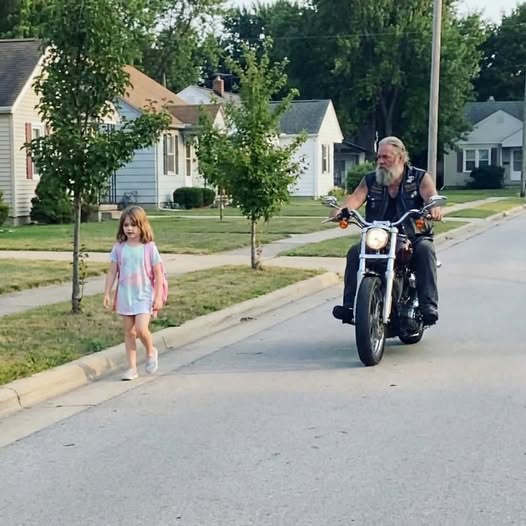
For nearly a month, an unsettling tension lingered over our normally peaceful Riverside neighborhood. It began with a sound I couldn’t ignore—the deep, mechanical hum of a motorcycle engine, steady and deliberate, always nearby. Each afternoon, like clockwork, I noticed the same sight: a large man on a black Harley-Davidson riding slowly behind my eight-year-old daughter, Lily, as she walked the short distance home from school.
He never rode too close. The gap was always measured, intentional. When Lily paused to tie her shoe or became distracted by something along the sidewalk, the motorcycle would slow or stop altogether. He never spoke to her. He never left until she was safely inside our house.
Fear crept in fast.
My neighbor Karen noticed him too. One afternoon she rushed over, her voice hushed and urgent. “That biker is back again,” she whispered. “He gives me a bad feeling. He follows Lily every day. You need to call the police before something terrible happens.”
As a single mother, I didn’t need convincing. Lily’s father had disappeared from our lives years earlier, and I had learned to trust my instincts. Waiting for authorities felt unbearable. I wanted answers—and I wanted them immediately.
That Thursday, I left work early and parked near the school. At exactly 3:00 p.m., Lily came through the gates, her pink backpack bouncing behind her. Moments later, the motorcycle roared to life across the street.
The man riding it looked intimidating in every way: tall, broad, wearing a worn leather vest covered in patches. His gray-flecked beard and heavy boots made him look like someone straight out of a crime movie. My heart raced as I followed them from a distance.
When Lily stopped to pet a neighbor’s cat, the biker pulled over and took out his phone. That was enough. I sped forward, cut him off, and jumped out of my car.
“What do you think you’re doing?” I shouted, my voice shaking. “Why are you following my daughter?”
I expected anger—or worse. Instead, he looked exhausted. Deep lines marked his face, and his eyes held something closer to sorrow than menace. He didn’t move aggressively. He didn’t try to leave.
“I can explain,” he said calmly.
I pulled out my phone. “You’ve been tailing an eight-year-old for weeks. I’m calling the police.”
“Please,” he replied, raising his hands slightly. “Give me two minutes. If you still want to call them, I’ll wait right here. But your daughter is in danger—and not because of me.”
Something in his voice stopped me. I didn’t hang up, but I hesitated.
He slowly reached into his vest and showed me a photo on his phone. It was a professional portrait of a smiling man in a suit.
“Do you recognize him?” he asked.
My stomach dropped. It was David Chen, a teacher’s aide who had recently started at Lily’s school.
“That’s not his real name,” the biker said. “He’s actually David Carpenter. He’s a convicted sex offender from Minnesota. He changed his identity and falsified documents. The school checked the new name—nothing came up.”
He showed me another image: a mugshot. Same face. No doubt.
I felt dizzy. “Who are you?” I asked.
“My name is Marcus Thompson. I’m with Bikers Against Child Abuse—BACA. We were tipped off by someone who recognized him. We contacted police weeks ago, but until his identity was confirmed, they couldn’t act. We weren’t willing to wait.”
Marcus explained that his group had been monitoring several children Carpenter seemed focused on. Lily was one of them.
Then he showed me the last photo.
It was my house.
Lily’s bedroom window was circled.
“He’s been tracking your routine,” Marcus said quietly. “He planned to act on Monday, when the school dismisses early.”
This time, I called 911—and didn’t stop shaking.
Marcus stayed, calmly providing officers with the evidence his group had collected. Within an hour, police surrounded the school. “Mr. Chen” was arrested. A search of his apartment uncovered restraints, drugs, and detailed notes about my daughter.
An officer later told me that without intervention, Lily likely wouldn’t have made it home the following week.
That night, at the police station, I saw Marcus sitting alone, shoulders slumped. I thanked him through tears.
He told me about his own daughter—how she had been abducted years earlier, how the trauma never released its grip, how she died at fourteen. “I couldn’t save her,” he said. “So I promised I’d protect others.”
I understood then how wrong my assumptions had been. I had feared the man who followed my daughter—while the real danger smiled in a classroom.
A few days later, Marcus and several bikers came to our home for lunch. Big men, covered in tattoos, sat on the floor playing board games with Lily and drinking juice. She gave them a drawing of a motorcycle with wings.
Our community changed after that. The school now works with BACA on safety programs. Marcus is no longer a shadow—he’s a familiar face at the park.
I learned something powerful: protection doesn’t always wear a uniform. Sometimes it rides a motorcycle and keeps a careful distance, refusing to let another child walk alone into danger.
Every night when I tuck Lily into bed, I think of the man who followed her home—and I’m grateful for the guardian who looked frightening, but chose to be brave.