The lessons I learned as a child were never delivered in bedtime stories or gentle whispers—they were etched into our home with relentless precision. My mother, Margot, treated vulnerability as a weakness. When my father left, she didn’t shed a tear. Instead, she removed his presence with the same cold efficiency she might discard unwanted mail, tossing our wedding portrait into the fireplace without a flicker of regret. She turned to me, her five-year-old son, and smiled with the chill of midwinter. “Now it’s just us, Jonathan,” she said. “And we don’t break. We succeed.”
Margot didn’t just raise me—she constructed a monument. Every piano lesson, starched shirt, and etiquette class was another brick in her fortress, designed to mold me into someone untouchable. By the time I reached twenty-seven, I had achieved the polished milestones she prized, yet I had long since given up trying to earn her approval. For her, completing one task well was simply the entry point for the next expectation.
When I told her I was seeing someone, I picked one of her favorite upscale bistros, a space as rigid and formal as her standards. Margot sat across from me in her navy blazer, eyes sharp and calculating. I told her about Anna, a nurse dedicated to her work, and saw the slightest glimmer of approval. Nurses, in Margot’s eyes, were “brave” and “respectable.” But when I added that Anna was a single mother to a seven-year-old boy named Aaron, the room seemed to freeze. She took a deliberate sip of wine, her silence louder than any words. “That’s a lot of baggage for someone with your potential, Jonathan,” she said, calm but cutting.
A few weeks later, a meeting at a coffee shop made the divide clearer. Anna arrived late, hair loose from a long day, Aaron trailing behind. Margot’s gaze swept over them clinically. She asked Aaron one polite question, rolled her eyes at his mention of art, and left without paying attention to anything else. In the car, Anna said softly, “She doesn’t just dislike me, Jon. She sees me as a mistake in your ledger.”
The breaking point came two years later in a grand piano showroom, a place Margot considered her personal temple. Surrounded by gleaming Steinways, I told her I had proposed to Anna. Margot’s hand fell from the lid of a grand piano, her voice cold and precise. “If you marry her, Jonathan—if you choose that ready-made family—you are abandoning everything I built. You are choosing mediocrity.” I didn’t argue. I didn’t seek her blessing. I walked out, embracing the life I truly wanted.
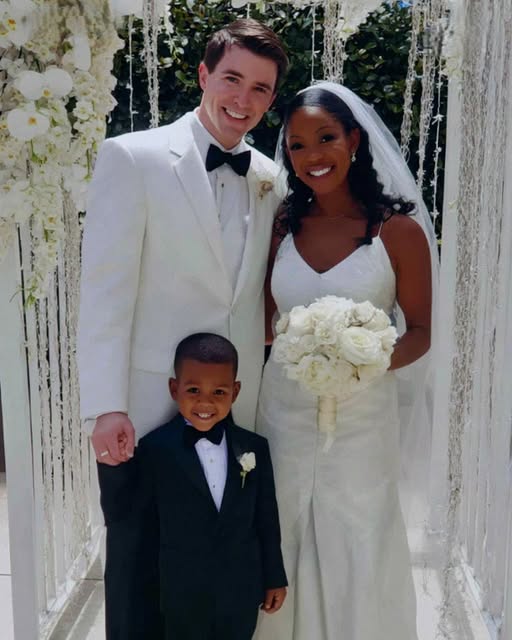
Anna and I married in a backyard under strings of golden lights, surrounded by friends who valued laughter over lineage. Our home was modest, imperfect—drawers that stuck, a lemon tree in the yard—but full of life. Green handprints appeared on walls, mismatched mugs crowded the kitchen, and Saturday mornings echoed with cartoons. Three months in, Aaron asked in a grocery aisle, “Can we get the marshmallow kind, Dad?” It was an unthinking, natural slip of the tongue that felt like coronation. I went home and cried into the laundry, realizing love didn’t require perfection.
Three years of silence passed, until one day Margot called. “I’m in town,” she said. “Send me your address. I want to see what you gave up everything for.”
The next day she arrived, looking like she had stepped from another world, her camel coat sharp, heels clicking. She moved through our home like it were a crime scene, eyes scanning our secondhand sofa, the scuffed coffee table, and finally, the green handprints Aaron had left on the wall. I watched her tighten with horror, expecting judgment at every corner.
Then, she heard the music.
In the living room, Aaron sat at an old upright piano I had bought for a few hundred dollars. Its finish was peeling, pedals squeaked, but as he played a Chopin nocturne—the same piece Margot had drilled into me—he poured tenderness and intent into every note.
“Who taught him that?” Margot whispered, her voice cracking.
“I did,” I replied. “He wanted to learn. He plays because he loves it, not because he fears the teacher.”
Aaron finished the piece and handed her a drawing of our home, depicting me, Anna, and him on the porch. He included Margot in an upstairs window, surrounded by flowers. “I didn’t know what flowers you liked,” he said earnestly. “So I drew them all. We don’t yell here, Grandma. Daddy says yelling makes the house forget how to breathe.”
Margot sat at our kitchen table, staring at the drawing like it was a map of a country she’d never seen. Her old defenses faltered. “You could have been great, Jonathan,” she said, though the conviction had gone.
“I am great, Mom,” I said firmly. “I stopped performing for an audience of one. I stopped being bulletproof to finally feel alive.”
She didn’t reply. She looked at Anna, then back at the drawing, finally sharing a memory of her own father, a man even colder than herself. “I thought control meant safety,” she admitted.
“You gave up connection for control,” I said. “And still, you lost us.”
Margot left as quietly as she arrived, leaving no dramatic scene. Later that night, I found an envelope under the door. Inside was a gift card to the music shop and a note: For Aaron. Let him play because he wants to.
In that moment, standing in the quiet of our imperfect, lived-in home, I felt a weight lift. This wasn’t the legacy Margot had planned—it was something better. It was a beginning.