The morning air was a wall of cold white as I opened the front door. Each inhale felt sharp, biting my lungs with winter’s force. I sighed, watching fresh snow settle over the remains of yesterday’s storm. I grabbed my shovel and stepped outside. Upstairs, my son Micah remained cocooned in the deep, rhythmic sleep of childhood, the soft hum of his white noise machine filling the room.
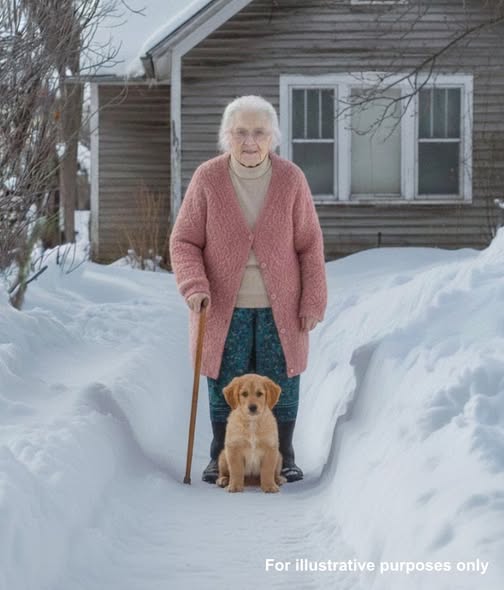
I worked with quiet precision, counting each stroke like I counted tips at the diner. As a single mother, I had learned early that life was a constant exchange of effort for time. Once my own walkway was clear, I leaned on the shovel, breath curling into the cold morning. Three houses down, the porch light at Lois’s home flickered. The door cracked open just enough for a cane to emerge, followed by Benny, her tiny white terrier, barking sharply at the cold before retreating inside. The snow piled too high for Lois to tackle alone.
Without hesitation, I crossed the yard and began clearing her path. No knock, no permission—just action. Over the next week, it became a quiet routine: clear my walkway, clear hers, and return home to the comforting aroma of coffee and shortbread. Lois never offered speeches of thanks, but sometimes I’d catch her silhouette behind lace curtains, a small nod acknowledging our unspoken agreement.
One morning, the pattern shifted. A thermos, wrapped in a checkered towel, sat on my doorstep. Steam curled from the lid, carrying the warm scent of cloves and cinnamon. Spiced tea, a silent thank-you that warmed my hands before it reached my mouth. Micah, perched at the kitchen table with a blue crayon in hand, asked if it was from the “dog lady.”
“She did, sweetie,” I replied. “It’s for the snow work.”
Inspired, Micah spent the morning drawing. When he finished, he handed me a scene: Benny, Lois waving from her porch, and a massive blue snow angel stretching across the street. I appeared in bright green, shovel in hand. The next day, I slipped the drawing into Lois’s mailbox, feeling a rare sense of connection in our frozen world.
Two days later, that warmth vanished. I returned from a shift to a frost-stiffened note on my doorstep, jagged letters scrawled across it: “NEVER COME AGAIN OR YOU’LL REGRET IT!! LOIS.”
Shock froze me. Trembling, I checked my doorbell camera. At 5:14 a.m., there was no elderly woman. Instead, a younger woman in a sharp brown coat stepped onto my porch, left the note, and vanished.
I walked past Lois’s house that afternoon. Curtains drawn tight, silence absolute. On the third day, a man was outside fiddling with the porch light. My heart pounded as I approached. He introduced himself as Paul, Lois’s great-nephew, explaining that he and his sister, Alexa, had moved in to help their aunt “transition.”
“She needs family right now, Dako,” he said, polite but patronizing. “You’re not family.” I caught Alexa’s watchful gaze from the window—the same woman from the camera. Their “transition” felt less like care and more like displacement.
A week passed. Snow continued to fall, and I stayed away, intimidated by the note and the hostile energy. Then a moving truck arrived, followed by a “For Sale” sign. A young couple, Daniel and Leah, moved in. When I brought them banana bread, Leah seemed saddened. “The nephew said she fell and had to move to a care facility. It all happened fast,” she said.
That night, I scoured the internet for any trace of Lois in local facilities. Twelve days later, a blue envelope arrived, penned in the elegant cursive I recognized from her spice jar labels.
The letter was both a revelation and heartbreak. Paul and Alexa had isolated her and sold the house quickly. “They don’t act like family, but I remember what’s real,” Lois wrote. “I remembered the sound of your shovel and Micah’s drawing. I kept it in my nightstand.”
She had arranged for Benny to be rescued and set up a small trust for Micah. “Enough to remind him that kindness is worth something,” she wrote. “Tell him I miss the snow angels.”
I took Micah to the shelter. Benny, frantic with recognition, leapt into his arms, wagging his whole body. The cold suddenly felt manageable.
A week later, we found Lois at the care home listed in her letter. Room 302. She sat by the window, pale but eyes bright. Benny trotted to her, resting his head on her lap. She exhaled, a weight lifted.
“You came,” she whispered, touching Micah’s cheek.
“I told you,” I said, kneeling. “I don’t just do it when it’s easy.”
Lois smiled genuinely. She didn’t want conflict or lawyers—just peace, knowing Benny was safe and Micah had a start in life. Walking back through fresh snow, Micah held my hand on one side, Benny’s leash on the other. I glanced back. Lois waved. The note had tried to drive me away, but her heart had shown the way. In the end, the snow didn’t bury our bond—it revealed who was willing to dig for it.