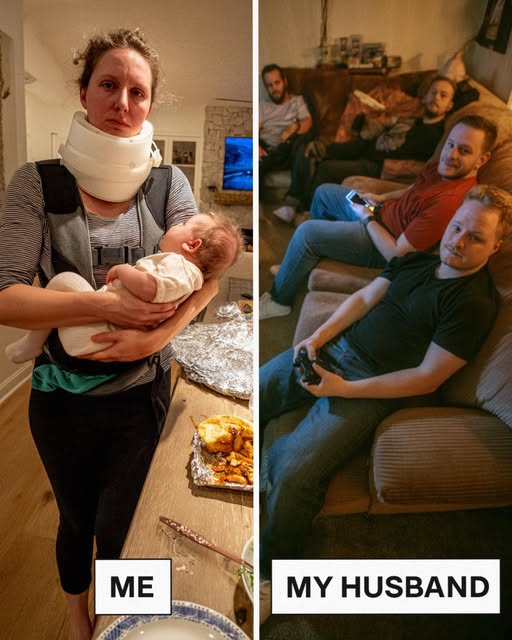
I’m thirty-three, a new mother to six-month-old Emma, and right now, I feel trapped in my own home, confined by a rigid neck brace. Everything changed two weeks ago because my husband, Jake, couldn’t resist scrolling Instagram while stopped at a red light. I was in the passenger seat, twisted halfway back trying to soothe Emma after her shots, when the crash happened. I didn’t hear it—I only felt the whip of my spine and a surge of searing pain radiating from the base of my skull.
At the hospital, lying on a backboard and staring at the harsh fluorescent lights, Jake paced the hallway. He wasn’t remorseful—he was texting, calling it a “minor fender bender.” The doctor’s verdict was grim: severe cervical strain with nerve compression. I was ordered to stay in a neck brace for weeks, possibly months, with strict instructions: no lifting, no twisting, no bending. For someone used to managing her own career and finances, suddenly being unable to pick up my own child or even shower alone was a crushing loss of independence.
Jake’s version of caregiving in those early days was begrudging at best. He heated frozen meals, brought Emma to me for feedings, but every diaper change was a reminder of my “inconvenience.” The real test came with his thirty-fourth birthday. He treated it like a national holiday, usually relying on me to clean, prepare, and host the perfect celebration. I assumed this year would be different—my broken body begged it. I was wrong.
A week before, while I rested on the couch with ice packs and a breast pump, Jake dropped the bomb: “The guys are coming over Friday for game night. Already told them.”
I froze. “Jake, I can barely move. I’m in a brace. I can’t host a party.”
He rolled his eyes, sighing as if I were being difficult. “It’s just snacks and a little cleaning. You’re home all day anyway.”
His words cut deeper than the accident. “I’m on maternity leave and injured! One wrong move and I could be paralyzed,” I shot back.
Then he crossed a line. Jaw tight, he spat out, “If you don’t handle this, don’t expect me to keep giving you money. I’m not paying you to lie around.”
The phrase “giving you money” hit me like another crash. We had agreed I’d take six months off, supported by shared savings. In one sentence, he reduced our marriage to a transactional relationship where my value was measured by my ability to serve him.
That night, fueled by panic and defiance, I accessed my secret savings. I hired a cleaning crew and ordered a mountain of wings, pizza, and beer—nearly $600 of my emergency fund—so he could have his party without me lifting a finger.
Friday arrived. The house gleamed. Jake didn’t ask how I was—he whistled at the floors and patted my hip like a manager inspecting an employee. His friends came, filling the house with laughter, slapping cards, and rolling dice. I sat on the couch, baby monitor glowing, feeling invisible. At one point, he laughed, “She’s on leave. Must be nice, just hanging with the baby all day.” I stared at the ceiling, humiliated and exhausted.
Then the doorbell rang. Jake expected pizza, but it was his mother, Maria.
She stepped in, her gaze piercing straight past the snacks to me, sitting in my brace, and the baby monitor. “You’re coming with me,” she said quietly, dangerously.
Jake tried to dismiss her. “Mom, it’s my birthday—”
She silenced him with a look. “Gentlemen, enjoy the evening. My son is leaving.” His friends scrambled out as she focused on him. “You threatened your injured wife with financial ruin because you couldn’t put your phone down. You told her she was lying around while recovering from an injury you caused. This is the house I helped you buy. You either step up as a husband, or you leave.”
She handed him his coat and sent him out. Silence returned. She sat beside me, and I finally let go, sobbing the tears I had been holding back since the accident.
“I’m sorry,” I whispered.
“I raised him better than this,” she said, rubbing my shoulder. “This isn’t on you.”
Maria spent the night cleaning, tending to Emma, and restoring a sense of order and care I hadn’t felt in weeks. Before leaving, she looked me in the eyes. “You’re not alone. My son will either change, or he won’t. But you and Emma will be fine because you have me.”
Jake is still staying with his mother. He has called, crying apologies that may be sincere, but I’ve told him I need time and therapy. I don’t know if our marriage will survive, but for the first time since the crash, I don’t feel trapped. Karma didn’t just knock—it came in the form of a mother-in-law who knew exactly how to handle a man who forgot his responsibilities.