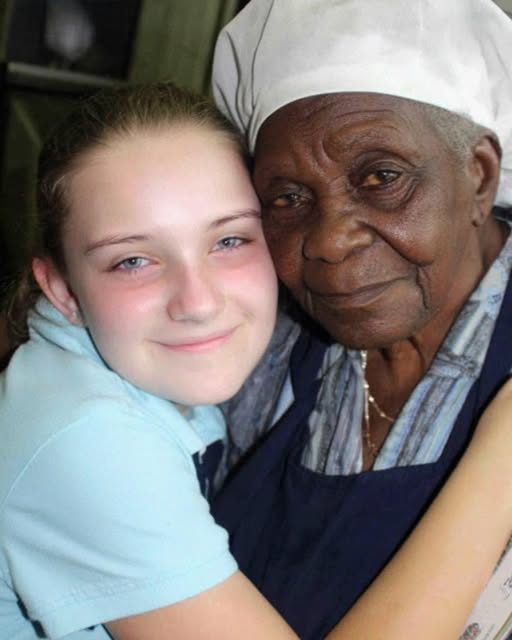
I finished high school last week, but I can’t shake the feeling that I haven’t really graduated. Everyone keeps asking me about what comes next, about the “future,” but I can’t seem to answer. It feels like the world hit pause and forgot to press play. Even now, in our quiet house, everything still smells like her—a mix of warm bread, industrial cleaner, and the faint floral trace of her Sunday lavender soap. Sometimes, I swear I hear her footsteps on the kitchen floorboards, and for a moment, I forget that silence is permanent.
My grandmother, Lorraine, wasn’t just family; she was my everything. When my parents died in a car accident while I was still a toddler, she became my mother, my father, my anchor. At fifty-two, already working forty hours a week as a school cafeteria cook, she took me in and built a life for us in a house older than she was. To the town, she was “Miss Lorraine,” or more often, simply the “Lunch Lady.” But to me, she was a miracle wrapped in a sunflower apron.
Every morning, long before sunrise, she would prepare meals for hundreds of children—yet she never missed making mine. Each brown paper bag had a sticky note: “You’re my favorite miracle” or “Eat your fruit or I’ll haunt you.” We didn’t have much, but she had a way of making scarcity feel like an adventure. When the heater broke one winter, she lit candles everywhere and called it a “Victorian spa night.” For prom, she turned a thrift store dress into a shimmering gown, sewing rhinestones by hand while humming Billie Holiday. “I don’t need riches,” she’d say, eyes bright with love. “I just want you to be okay.”
High school was cruel to those who were different. The teasing started in freshman year—quiet whispers in the hall about my grandmother, nicknames like “Lunch Girl” and the “PB&J Princess.” Kids I’d grown up with mocked her Southern accent, imitated her “sugar” greeting, and once, Brittany—sharp-tongued and cruel—asked if my grandmother “packed my panties with my lunch.” Laughter exploded around me, and I froze, every snicker cutting deeper than words could say.
I tried to protect Lorraine from the cruelty. She was seventy then, worn from years of work and life, yet she stayed gentle. She remembered every student’s name, slipped extra fruit to those without lunch money, and loved with a quiet persistence that most didn’t appreciate.
I buried myself in books and scholarships, dreaming of graduation. Lorraine would tell me, “One day, you’ll make something beautiful from all this.”
That spring, her health faltered. A tightness in her chest she called “spicy chili” turned out to be a heart attack. She passed away before sunrise, leaving me with a grief too heavy for words.
People suggested I skip graduation, but I couldn’t. I wore the dress she had chosen, pinned my hair the way she liked, and walked into the gym with bones made of sorrow.
When my name was called to give the valedictorian speech, I didn’t recite the prepared metaphors. I spoke from my heart: “Most of you knew my grandmother,” I began, and the room went still. “She fed you thousands of meals, and tonight, I’m here to tell you the truth you didn’t want to hear.”
I shared her kindness, her attention to detail, her endless patience, and her unwavering love—even in the face of mockery. “She was my polar star,” I said. “She died last week, but she gave me everything that made this moment possible. Remember this: when someone shows you kindness, don’t laugh. One day, you’ll realize it was the strongest thing you’ve ever known.”
The gym remained quiet for a heartbeat, then applause slowly began—not loud, not boisterous, but steady, a collective acknowledgment.
Later, Brittany and the others approached me, eyes red, humbled. They had started a plan: a tree-lined path to the cafeteria, to be named “Lorraine’s Way,” honoring her memory. Something inside me softened. They weren’t just feeling guilty—they were determined to change.
“She would have fed you anyway,” I told them.
That night, in our empty house, I sat at the kitchen table, looking at her coffee mug and the empty hook for her apron. I whispered to the silence, “They’re planting trees for you.” I like to believe she heard me. She taught me how to endure, forgive, and love openly. And maybe, if I try hard enough, I can become someone else’s polar star too.