At fifty-eight, I’ve spent decades teaching high school English, dissecting hidden meanings in literature, yet somehow I failed to notice the subtext of my own life. My routine was predictable: grading essays, drinking far too much coffee, and coexisting peacefully with my husband, Mark, a practical electrical engineer—the dependable anchor of our family. We thought we were sliding into the quiet, empty-nest years, but life, as it often does, had a surprise in store.
The disruption came from my eighty-two-year-old mother, Margaret. Sharp as ever in mind, but increasingly fragile in body, she’d fractured her hip earlier this year. After decades of independence, the woman who once mowed her own lawn was now confined to a recliner. My father had passed ten years prior, leaving her well-provided for, and to ensure her safety while I worked, I hired a caregiver.
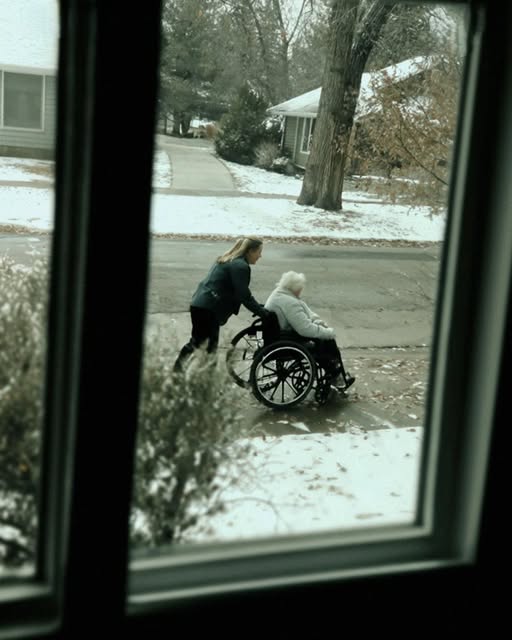
Her name was Alyssa. At twenty-six, she was calm, capable, and respectful. She treated my mother as a person, not a patient, revitalizing her diet and ensuring she followed her physical therapy. Their Sunday walks became a cherished ritual. For a while, it felt like a blessing.
But after a few months, something changed. Mom started returning from walks looking tense, her eyes occasionally puffy. When I asked, she offered the same scripted response every time: “It was fine.” My mother was never one for repetition.
Last Sunday, the tension peaked. Mom arrived home visibly shaken, her hand trembling as she went straight to her bedroom. Alyssa gave me a bright but hollow smile. Something urged me to check the video from our doorbell.
Sitting at the kitchen table that night, I watched the footage. My mother’s voice, small and hesitant, came through: “I can’t keep this from my daughter. She deserves to know what you told me.”
Alyssa’s voice followed, calm but firm: “You’re not ready to tell her yet. This could change everything.”
My mind raced. Was Alyssa manipulating her? Trying to take advantage? Sleep eluded me. The next Sunday, I told Alyssa to step out for the afternoon. The flash in her expression wasn’t guilt—just apprehension.
Alone with my mother, I asked, “Mom, I heard the recording. What could possibly ‘change everything’?”
Her answer hit me harder than I could have imagined. “It’s about your father,” she said softly. “He wasn’t faithful, about twenty-seven years ago. There was a child—a daughter.”
My world shifted. “A sister?” I whispered.
“Not just a sister,” Mom said, tears forming. “Alyssa.”
I laughed, sharp and disbelieving. The caregiver I had welcomed into our home was my half-sister. Mom explained that Alyssa had approached her carefully, secretly running a DNA test with a strand of my hair she’d taken from a brush.
“She knew it was risky,” Mom said. “But she needed to be certain before revealing the truth. The tests confirmed it—you are sisters.”
I stared at the family photos on the wall. My father, whom I had trusted implicitly, had kept a hidden life. Alyssa, having grown up without him, had found her way to us only after her own mother’s death.
Initially, I was angry—at my father, at the secrecy, at the violation of privacy. But guilt soon followed. While I had stability, Alyssa had wondered if she was even deserving of love.
Mom assured me, “I’m giving her a portion of what your father left me. It’s not yours to lose, just a way to right an old wrong.”
I instructed Mom to call Alyssa. That evening, she arrived in plain clothes, young and vulnerable, apologizing for the DNA test and the secrecy.
“I didn’t come for money,” Alyssa said. “I just wanted to know the life he chose. I wanted to understand.”
A second, official DNA test confirmed the truth: we are indeed sisters.
Integrating her into our lives has been messy but real. Mark, initially upset, softened as he saw the genuine connection forming. My children were stunned to discover an aunt so close to their own age, but bridges are being built.
Now, the house feels different. Alyssa is no longer just a caregiver—she is family. She joins dinner, helps Mom with crosswords, and listens to stories of a father whose life was far more complicated than we realized.
I still wrestle with anger at my father and unease over Alyssa’s entrance into our lives. But watching her laugh with my mother, seeing the bond grow, I realize that some cracks in a family aren’t failures—they are openings for light. My life didn’t break—it expanded in ways I never could have imagined.