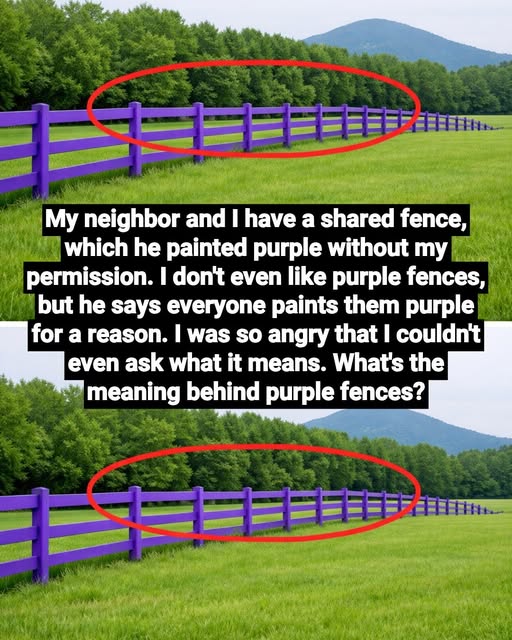
Across rural backroads and suburban edges, the markers of property ownership usually follow familiar patterns. White picket fences, weathered wooden boards, or the familiar red-and-white “No Trespassing” signs dominate the landscape. Yet in recent years, a striking new visual signal has appeared in the countryside: a bold, unmistakable purple. To casual observers, a purple stripe on a fence or tree might seem like an eccentric decorating choice. In fact, it is far more than aesthetic—it is a legal symbol with clear authority. Known as the “Purple Paint Law,” these marks silently communicate a single message: private property begins here, and trespassing is forbidden.
The shift to painted markers emerged from practical necessity. Owners of large plots or forested land have long battled the fragility of conventional signage. Metal or plastic warnings fade, crack, or fall victim to weather and wildlife. Vandalism is also common, leaving property lines unclear and creating potential liability. Painting a visible, long-lasting purple stripe proved a low-maintenance, durable alternative, capable of withstanding sun, snow, and wind far better than a nailed sign ever could.
Purple was chosen deliberately, not arbitrarily. While orange or red are often associated with warnings, they are heavily used in forestry and construction, creating potential confusion. Purple, in contrast, is rare in nature and stands out sharply against greenery, autumn leaves, and winter snow. It is also more easily distinguishable to people with red-green color blindness, ensuring the message is broadly visible.
Yet the color alone is not enough. In states that recognize these laws, the markings must follow precise rules. The paint is applied as vertical stripes, usually at least one inch wide and eight inches tall, to distinguish them from graffiti or natural discoloration. Placement is carefully considered: stripes are positioned three to five feet above the ground, high enough to remain visible above brush or snow, but low enough to be within eye level. Additionally, spacing is deliberate, often repeated every 100 feet along property lines to prevent any claim of “missed” warnings.
Originating in states like Arkansas and Texas, the law addresses the challenges of marking expansive hunting and ranch lands. Since then, more than a dozen states—including Missouri, Illinois, Indiana, and North Carolina—have passed similar legislation. In these areas, a purple stripe carries the same legal weight as a traditional “Keep Out” sign. Trespassing across these markers can result in criminal charges. In states without formal legislation, the paint functions more as a courtesy, but it still signals a clear boundary that should be respected.
The psychological effect of a purple stripe is notable. Unlike a printed sign, which can feel impersonal or bureaucratic, a hand-painted mark conveys a deliberate, human presence. It causes passersby to pause, processing the intent behind the color. It communicates property lines in a visually striking yet low-cost way, preserving the natural aesthetic while asserting control.
As communities grow and public and private spaces increasingly overlap, purple markers illustrate how a simple symbol can solve complex problems. They protect landowners from unintentional trespassers and provide clarity to visitors, combining practicality with a subtle visual warning.
Next time you wander a trail, visit a rural lake, or drive through rolling farmland, watch for flashes of purple on a tree or post. They are not merely decorative—they are a boundary, a statement of ownership, a call for respect. In this modern interpretation of an age-old need, one streak of paint can communicate everything a traditional sign might, and more: in the language of contemporary property law, purple unmistakably means “stop.”