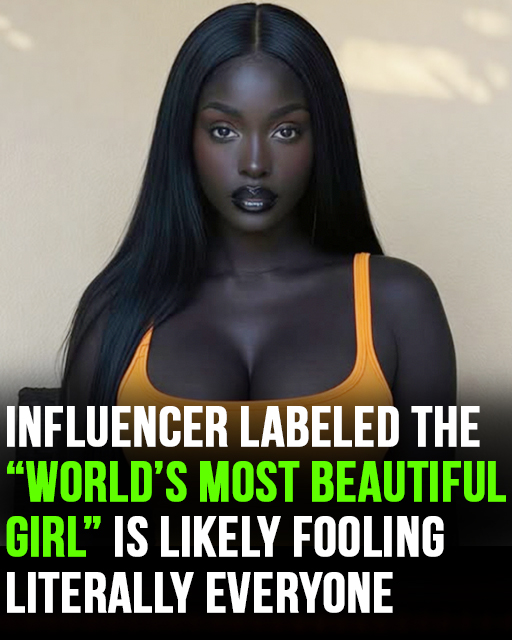
Nia Noir, an influencer hailed by fans as the “world’s most beautiful girl,” is now facing scrutiny as viewers question whether she is a real person or a computer-generated creation.
With over 2.7 million followers on TikTok and growing audiences on Instagram and Facebook, Nia has become a viral force online. Her flawless dark skin, piercing gaze, and enigmatic tagline — “Just a girl with a dark side” — have captivated millions, fueling social media buzz and endless admiration.
Yet, despite her massive popularity, some fans are beginning to notice odd inconsistencies in her content, leading to speculation that she may not be human at all.
Fans Spot Strange Details
Supporters have long praised Nia for her beauty and poise, describing her as “otherworldly,” “perfect,” and “unreal.” But eagle-eyed viewers have started pointing out unusual details in her videos.
From fingers that appear miscounted to smartphones missing their usual logos, and overly airbrushed skin that looks almost too perfect, these subtle signs have raised questions about whether Nia Noir is entirely AI-generated.
Viral TikTok Raises Eyebrows
A TikTok creator recently went viral for breaking down inconsistencies in Nia’s posts, highlighting features such as unnaturally short video clips, silent content, and oddly rendered clothing. The video, which quickly gained hundreds of thousands of views, suggested that these patterns could indicate digital manipulation rather than real-life authenticity.
The creator warned viewers: “If every video is under 15 seconds, there are no brands, no talking, and the clothing looks strange — that’s a red flag.”
Suspicious Engagement Patterns
Beyond visuals, some observers have noticed unusual patterns in the engagement under Nia’s posts. Repetitive, nearly identical comments across multiple videos point to the possible use of bots to boost popularity — a strategy often associated with AI influencers.
This growing skepticism has sparked a debate over authenticity and the line between real influencers and digital creations.
AI Influencers Are Already Dominating Social Media
Nia Noir wouldn’t be the first AI influencer to make waves online. Lil Miquela, one of the earliest virtual personalities, debuted in 2016 and has since collaborated with top global brands like Prada, Calvin Klein, Samsung, and BMW. In 2023 alone, Lil Miquela reportedly earned around $10 million in revenue.
AI influencers are carefully crafted with distinct aesthetics, personalities, and stories to appeal to specific audiences — making them powerful tools for social media marketing and branding campaigns.
The Rise of Virtual Models
Industry experts say these digital influencers are no longer just experimental. OnBuy, an online marketplace, notes that AI-powered influencers are transforming the influencer marketing industry, providing brands with content that’s predictable, perfectly curated, and highly engaging.
“Virtual influencers are rapidly becoming a dominant force across platforms like Instagram,” the company said. “Brands are eager to collaborate with these digital personalities because they offer control and consistency that human influencers cannot always guarantee.”
Blurring the Lines Between Real and Artificial
What makes Nia Noir especially intriguing — and concerning for some — is how convincingly real she seems. With AI advancing rapidly, it’s increasingly difficult for audiences to tell whether a social media star is genuine or digitally created.
So, is Nia Noir a living, breathing influencer, or a sophisticated AI persona designed to capture attention and engagement?
The debate continues to heat up across social media, leaving fans and marketers alike wondering just how far artificial intelligence will reshape the future of online influence.