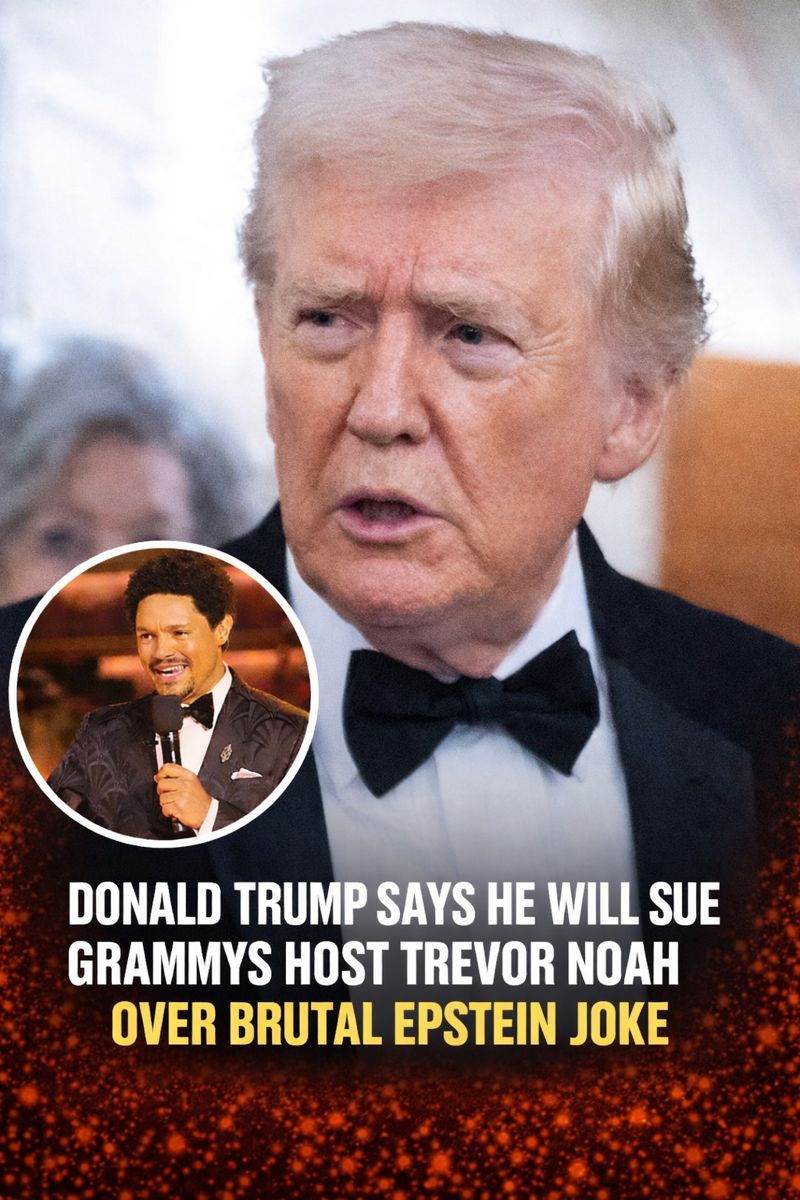
The latest headline involving Donald Trump and comedian Trevor Noah didn’t originate from a courtroom filing or a campaign rally. Instead, it emerged from one of the most-watched entertainment broadcasts of the year—under bright stage lights, punctuated by laughter, and powered by a single punchline.
While hosting the Grammy Awards, Noah delivered a joke that quickly escaped the confines of comedy and entered the national political conversation. Referencing renewed public discussion surrounding the Jeffrey Epstein case, Noah remarked that Trump might “need a new island.” The comment lasted only a moment, but the fallout has continued to build ever since.
Trump reacted almost immediately. He denounced the remark as “false” and “defamatory,” announcing that he planned to pursue legal action against Noah and those involved in airing the broadcast. He framed the joke not as satire, but as a malicious misrepresentation presented to millions of viewers, vowing to seek significant financial damages.
This response followed a familiar pattern: a forceful counterattack, strong language, and an insistence that humor had crossed into deliberate falsehood. But the intensity of the reaction was not just about the joke itself—it was about timing.
The Grammy moment coincided with renewed attention on thousands of Epstein-related documents that were recently unsealed. Although many of the names and references contained in those files have circulated for years, their release reignited online speculation. Social media quickly filled with excerpts, screenshots, and interpretations—often stripped of context and amplified without verification.
Against that backdrop, Noah’s joke landed differently. Comedy does not exist in isolation, and what might have once been received as generic political satire was perceived by Trump and his supporters as a pointed insinuation delivered at a moment of heightened scrutiny.
Trump has repeatedly denied any wrongdoing connected to Epstein and has cited statements from federal authorities indicating that many viral claims lack evidentiary support. From his perspective, the Grammy remark blurred an already sensitive issue, transforming unresolved public curiosity into implied guilt on one of the world’s largest entertainment platforms.
In Trump’s view, this was not harmless humor—it was reputational harm.
At the same time, the Grammy Awards have long served as more than a music celebration. The ceremony has a decades-long history of political commentary, cultural critique, and pointed statements about power. From protests against war to speeches on social justice and direct criticism of political leaders, the stage has often been used to challenge authority.
Trevor Noah’s career fits squarely within that tradition. Known for blending political analysis with comedy, he operates on the principle that influential public figures are subject to satire. In that framework, strong reactions are often interpreted as confirmation that a joke struck its intended target.
From this angle, Trump’s threat of a lawsuit becomes part of the broader spectacle—a powerful figure responding to ridicule with legal force, reinforcing the imbalance comedians frequently claim to spotlight.
The core issue, however, lies in the uneasy space between satire and defamation.
Under U.S. defamation law, liability generally requires a false statement of fact that causes reputational damage. Satire and comedy are typically granted broad protections, especially when the context clearly signals exaggeration or humor. Awards shows and comedy monologues are widely understood by audiences as interpretive—not factual—expressions.
Still, context is everything. When jokes reference real allegations, real victims, and real investigations, the margin for misunderstanding narrows. What one viewer perceives as metaphor may feel like accusation to another—particularly when public trust is already strained.
Trump’s legal threat reflects more than personal offense. It aligns with a broader strategy he has used repeatedly: challenging critics not only in the media but through the legal system, positioning himself as a target of coordinated defamation rather than routine public scrutiny. Whether such a lawsuit will ever materialize—or succeed—is uncertain. Historically, similar threats have often functioned as deterrents rather than courtroom battles.
Even so, the message is clear. Entertainers, networks, and advertisers are reminded that political jokes can carry legal and financial implications. Institutions are forced to weigh creative freedom against risk management, humor against potential litigation.
Notably, Noah has remained silent since the incident. He has neither apologized nor escalated the dispute. That restraint may be deliberate. In controversies like this, comedians often allow public debate to unfold without direct engagement, letting audiences and commentators argue the broader principles at stake.
And the debate has been loud.
Trump supporters view the joke as irresponsible and emblematic of what they see as a hostile entertainment industry willing to imply wrongdoing without evidence. To them, it reinforces concerns about reputational harm driven by suggestion rather than fact.
Trump critics, meanwhile, interpret his response as predictable and overly aggressive—another example of a public figure attempting to chill speech through legal threats. They argue that satire is a cornerstone of democratic discourse and that no leader should be insulated from it.
Between these perspectives stands a wider audience watching yet another collision between politics and pop culture. For many, the issue is less about a single joke and more about what it reveals: a media environment where comedy, unresolved scandal, and political polarization intersect so tightly that even humor becomes combustible.
Federal officials have stated that some of the most sensational narratives circulating online are unsupported. But in the digital age, speculation often travels faster than clarification. A punchline can spread further than a press release, and laughter can echo longer than footnotes.
That reality is what this episode ultimately highlights. A brief comedic line can become a flashpoint for deeper anxieties—about trust, accountability, and the boundaries of free expression. A lawsuit threat becomes less about legal outcomes and more about asserting control over public narratives.
Whether Trump proceeds with legal action remains unclear. Whether Noah chooses to address the backlash is equally uncertain. What is undeniable is that the Grammys once again demonstrated that entertainment platforms are no longer just stages for celebration—they are arenas where politics, media law, and cultural power collide in front of a global audience.
In the end, this is not simply a story about a comedian or a former president. It is a snapshot of a moment in American public life where satire feels risky, outrage feels automatic, and every word spoken into a microphone can carry consequences far beyond the applause.