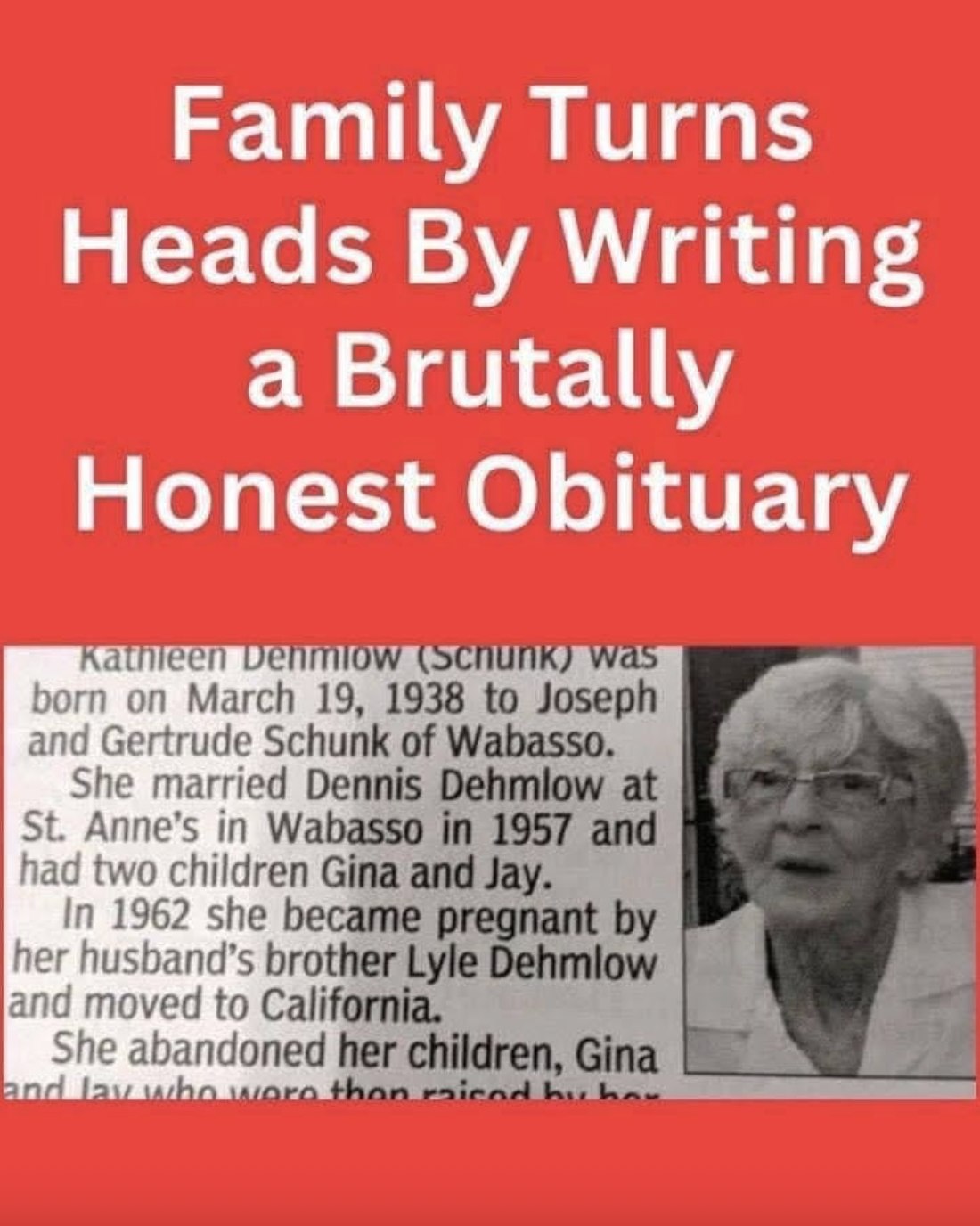
What began as a routine obituary quickly became an international talking point after readers noticed its unusually blunt and emotional ending. The obituary, published in a Minnesota newspaper, shocked audiences and sparked a global conversation about family conflict, truth-telling, and unresolved trauma.
The notice appeared in the Redwood Falls Gazette and detailed the life of Kathleen Dehmlow. It stated that she was born in Springfield, Minnesota, to Gertrude and Joseph, and that she died on March 31, 2018, at the age of 80.
The obituary went on to note that Kathleen married in Minnesota in 1957 and later had two children, Gina and Jay—details typical of most death announcements.
However, the tone shifted dramatically in the final section.
According to the obituary, Kathleen became pregnant in 1962 by her brother-in-law and subsequently moved to California. The notice stated that she left her two children behind, and they were raised by their grandparents.
The final lines stunned readers. It stated that Kathleen would not be missed by Gina and Jay and suggested that they believed the world would be better off without her.
The strong language triggered swift backlash. Following public criticism and widespread sharing on social media, the Redwood Falls Gazette reportedly removed the obituary from its website within a day.
After the controversy erupted, Kathleen’s son Jay Dehmlow spoke out to explain why he and his sister chose to include such candid language. He said that people outside the family could not fully understand the emotional pain they endured growing up and that writing the obituary allowed them to finally express feelings they had carried for decades.
Jay explained that his mother had minimal contact with him and his sister after leaving. According to reports citing the Daily Mail, Kathleen later had two more children with her brother-in-law.
He said that birthdays, holidays, and even simple messages went unacknowledged. He recalled one visit in which she spoke openly about her life and other children while failing to recognize Gina and him at all.
“It felt like we were invisible,” he said, describing the experience as emotionally devastating.
Jay added that family dysfunction was deeply rooted and rarely discussed, explaining that writing the obituary served as a form of emotional release and closure for both siblings.
Not everyone agreed with their approach. Kathleen’s surviving sister, Judy, told DailyMail.com that the obituary caused significant pain within the extended family and described it as cruel and unnecessary.
Jay responded by saying that many relatives were unaware of what he and his sister experienced as children, noting that difficult topics were avoided and never openly addressed.
The obituary has since fueled debate about whether death notices should strictly honor the deceased or acknowledge complicated family histories. Some readers criticized its harshness, while others defended the siblings’ right to tell their story.
Ultimately, the viral reaction highlights how deeply personal experiences can clash with public expectations. While opinions differ, few can truly understand the emotional impact of abandonment and silence endured over a lifetime.
The story remains a powerful example of how even traditional spaces like obituaries can become platforms for truth, healing, and long-delayed voices.