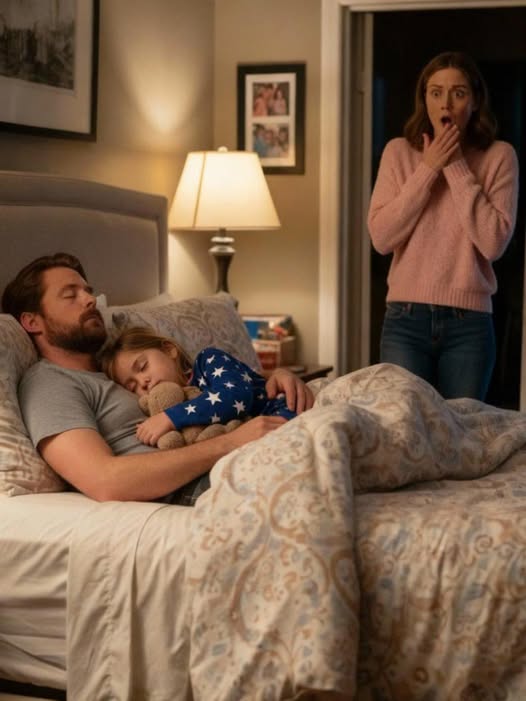
Serious family challenges rarely announce themselves loudly. More often, they arrive quietly, disguised as ordinary moments that are easy to dismiss. In our case, it started with a simple comment over breakfast in our San Jose home.
Our eight-year-old daughter, Emily, stood at the kitchen counter one morning, still half-asleep, and casually said, “Mom, my bed felt really small last night.”
I smiled and brushed it off. Kids say strange things. We’d always encouraged Emily to be independent and confident, and her bedroom reflected that philosophy — warm lighting, shelves of books, and a bed that was more than big enough for her growing frame. At the time, I assumed it was nothing more than an unusually vivid dream.
But the comment didn’t go away.
Day after day, Emily repeated it. Sometimes she said the blankets felt tight. Other times, she mentioned not having enough room to stretch out. Then one morning, she asked something that stopped me cold:
“Did you come into my room last night? Because it felt like someone was sleeping next to me.”
She wasn’t scared. She was genuinely confused — and that’s what unsettled me most.
I brought it up to my husband, Daniel, who works long hospital shifts as a physician and was running on constant exhaustion. He suggested it was probably just normal childhood dreaming. Still, my instincts as a parent wouldn’t let it go.
To ease my worries, I installed a small indoor security camera in Emily’s room — discreet, quiet, and meant only for peace of mind. The first night showed nothing unusual, and I felt slightly embarrassed for overreacting.
Then, the second night, at exactly 2:14 a.m., I woke up with an unexplainable urge to check the live feed.
On my phone screen, in the muted glow of night vision, I saw Emily’s bedroom door slowly open.
A figure entered.
They moved carefully, almost uncertainly, as if navigating a space they didn’t fully recognize anymore. My heart raced as the person approached the bed and gently pulled back the covers.
It was my mother-in-law, Margaret.
Margaret was seventy-eight, a woman who had spent her entire life sacrificing for others. Widowed early, she had worked exhausting jobs to give Daniel stability and opportunity. Strength and self-denial defined her. But recently, we had noticed changes — memory lapses, confusion, moments where she seemed unmoored from time.
What I was watching wasn’t intentional intrusion. It was cognitive decline unfolding in real time.
Margaret carefully lay down beside Emily, curling into the smallest possible space. Emily shifted in her sleep, instinctively making room. The two lay side by side — grandmother and granddaughter — connected by something deeper than awareness.
Standing alone in the dark kitchen, phone trembling in my hands, I cried.
The next morning, I showed Daniel the footage. He said nothing at first. Then he broke down.
He understood immediately what his mother was doing. She wasn’t wandering randomly. She was searching for comfort — returning to the only place her mind still recognized as safe. She was reliving the years when she found reassurance lying beside her own child, anchoring herself against loneliness and fear.
Emily’s bed hadn’t felt “small” because of imagination. It felt small because someone else was there — someone clinging to connection.
That moment forced us to confront a reality many families face but struggle to name: the progression of dementia and nighttime confusion, often called sundowning.
We made changes right away. Margaret’s room was moved closer to ours. We installed motion sensors to alert us if she wandered at night. But more importantly, we changed how we showed up emotionally.
Every evening, I began sitting with her before bedtime. We talked. Or rather, she talked. The same stories often repeated, but I stopped correcting her. I realized that what mattered wasn’t accuracy — it was presence.
She wasn’t looking for a bed. She was looking for belonging.
Emily adapted without complaint. In her quiet, childlike wisdom, she understood that nothing was wrong with her room — it was simply holding more history than she realized.
This experience reshaped how I think about independence, parenting, and family caregiving. I had focused so much on teaching my daughter to stand on her own, but aging taught us the opposite lesson: that dependence isn’t failure — it’s human.
As memory fades, what remains is the need for safety, touch, and recognition.
Our home is still quiet at night now, but it’s a different kind of quiet. It’s the peace that comes from paying attention — from responding to subtle signs, protecting vulnerable family members, and choosing compassion over convenience.
No one wanders alone anymore.
We are no longer just individuals sharing a house. We are a family circle, holding steady for those slowly letting go, making space — even when the night feels long and the bed feels too small.