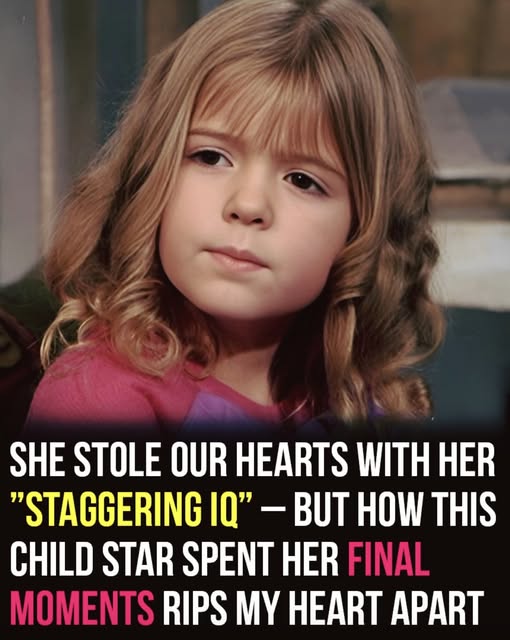
When Savannah Smiles premiered in the early 1980s, audiences instantly fell in love with its bright young star. Bridgette Andersen’s natural charm, intelligence, and emotional depth made her unforgettable, and many believed she was destined for a long and successful Hollywood career.
Sadly, her story took a devastating turn. Andersen’s life became a cautionary tale about the pressures of early fame and the challenges faced by child actors behind the scenes.
A Lucky Birthday and a Bright Beginning
Bridgette Andersen was born on July 11, 1975, in Inglewood, California, and raised in Malibu. As a child, she believed her birthday — 7/11 — carried special meaning. Whenever she noticed the time 7:11 on a clock, she would kiss her fingers and tap the screen, a small ritual she felt brought good fortune.
From an early age, it was clear she was extraordinary. As an infant, she appeared in television commercials for major brands like Bank of America and Mervyn’s. By the age of two and a half, she was already an avid reader, impressing adults with her advanced vocabulary and intellect. According to reports at the time, she demonstrated an exceptionally high IQ, and by six years old, her favorite book was The Old Man and the Sea by Ernest Hemingway.
Neighbors were fascinated by the “little girl who talked like an adult,” often stopping by just to hear her speak.
A Natural Performer
Inspired by popular television shows of the era, Bridgette set her heart on acting. Her father, Frank Andersen, later emphasized that her talents came naturally — she was never pressured into the industry.
During a 1983 appearance on The Tonight Show Starring Johnny Carson, a young Andersen recalled attempting to climb into the television as a toddler because she wanted to join The Little Rascals. Her quick wit and confidence charmed audiences nationwide.
She soon signed with a talent agent and began working steadily as a child model and commercial actress, later landing television roles on shows like King’s Crossing and Washington Mistress.
Breakthrough With Savannah Smiles
In 1982, Andersen landed the role that would define her career: Savannah Driscoll in Savannah Smiles. After auditioning nearly 150 children, filmmakers chose Andersen for her authenticity and emotional intelligence.
During her audition, she told the folk story of Br’er Rabbit so vividly that the filmmakers incorporated it directly into the movie.
“We’re like twins,” Andersen said at the time, describing her connection to the character.
That same year, she also appeared as a young Mae West in the biographical film Mae West, starring alongside James Brolin. To prepare, she taught herself to tap dance by practicing nonstop and studying Gene Kelly films — mastering the choreography even before professional training began.
A Promising Career That Slowed Too Soon
Andersen continued acting throughout the early 1980s, earning a Youth in Film Award nomination for her work on The Mississippi. She later starred in the CBS sitcom Gun Shy and was even considered for a role in Steven Spielberg’s E.T. the Extra-Terrestrial, which ultimately went to Drew Barrymore.
As she grew older, however, roles became harder to find. Like many former child stars, Andersen struggled with the transition into adulthood. She worked outside the entertainment industry while attempting to rebuild her life and maintain sobriety.
Her final on-screen appearance came in 1996 — poignantly, as a character named “Drew” in a dream sequence.
A Tragic Ending and Lasting Legacy
On May 18, 1997, Bridgette Andersen passed away in Los Angeles at just 21 years old due to a heroin overdose. She was laid to rest at Fir Grove Cemetery in Lane County, Oregon.
Though her life was tragically short, her impact remains. In 2015, actress and writer Amber Tamblyn honored Andersen in her poetry collection Dark Sparkler, which pays tribute to young performers lost too soon. One poem is dedicated directly to Andersen, while another reflects on the fleeting nature of early fame.
Remembering Bridgette Andersen
Bridgette Andersen’s story continues to resonate as a powerful reminder of the vulnerabilities faced by young performers and the importance of mental health support in the entertainment industry.
Her talent, intelligence, and warmth are still remembered decades later — proof that even brief careers can leave a lasting mark.
Rest in peace, Bridgette. Your light is not forgotten.