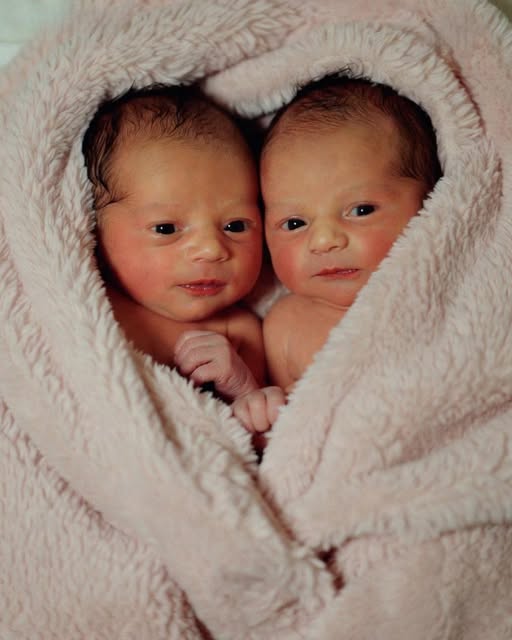
There was no note. No explanation. Just two infants left to the mercy of winter.
I called 911, shielding them from the wind until help arrived. When the police and a social worker finally took them away, the silence that followed felt heavier than the cold. Watching that car disappear down the street left a hollow ache I couldn’t shake.
That night, I told Steven everything. I admitted what scared me most—not the money, not the responsibility—but the thought that those girls would be separated, lost in a system that rarely makes room for tenderness. Steven didn’t hesitate.
“You already love them,” he said quietly. “Let’s try.”
What followed was anything but easy. The foster process was relentless—home inspections, interviews, psychological evaluations. Then came the conversation that makes many people walk away.
“The twins are deaf,” the social worker told us. “They’ll need specialized care. Lifelong support. Most families stop here.”
We didn’t.
We named them Hannah and Diana.
Raising them meant learning an entirely new language—American Sign Language—often at two in the morning, exhausted and overwhelmed. Our house was quiet in ways other homes weren’t, but it was alive. We learned to communicate with light, movement, and touch. We learned patience. We learned humility.
Money was always tight. But our home felt full for the first time.
As the girls grew, so did their confidence. We fought for interpreters at school. We corrected strangers who asked what was “wrong” with them. There was nothing wrong. They were deaf—not broken.
By twelve, they were unstoppable. Hannah poured herself into art and fashion design. Diana was obsessed with engineering and problem-solving. When a school contest challenged students to design adaptive clothing for children with disabilities, they knew exactly what to do.
“We’re a team,” Diana signed.
“My ideas. Her designs,” Hannah added.
They created clothing that actually made sense—hoodies with space for hearing devices, magnetic closures for easy dressing, fabrics chosen for comfort, not trends. They didn’t expect to win. They just wanted to be seen.
Months later, my phone rang while I was cooking dinner.
A major children’s clothing brand had reviewed their project. Not only did they love it—they wanted to build an entire line around it. A real collaboration. With royalties.
When they told me the projected value—over half a million dollars—I had to sit down.
That evening, I told Hannah and Diana everything, signing slowly so they could feel every word. I told them their experiences were not limitations—they were the reason this happened. That empathy was their superpower.
They cried. I cried. And when Diana signed, “Thank you for not saying we were too much,” my heart broke and healed at the same time.
People say I saved those girls on a cold morning twelve years ago.
But the truth is simpler—and bigger.
They gave my life purpose.
They taught me how to listen without sound.
And they showed me that what the world calls a weakness can become a legacy.