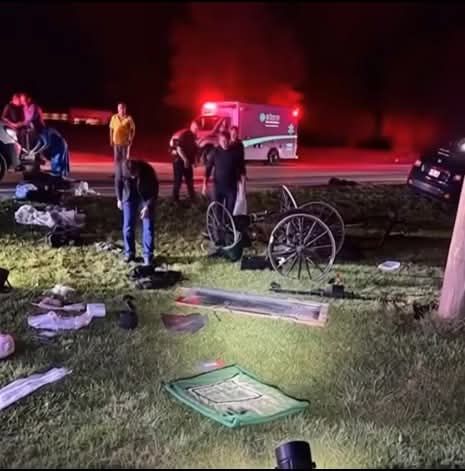
On a desolate stretch of State Road 218 near the outskirts of Berne, Indiana, the profound quiet of the rural landscape was shattered by a collision that serves as a grim metaphor for the friction between tradition and modernity. Late at night, under a sky devoid of urban light, a way of life that has remained steadfast for centuries collided with the high-velocity realities of the 21st century. A Jeep, traveling at highway speeds, plowed into the rear of an Amish buggy carrying nine occupants. The impact was not merely a vehicular accident; it was a violent disintegration of wood, glass, and bone. In an instant, a family’s rhythmic ride home was transformed into a chaotic scene of wreckage, where the steady clip-clop of horse hooves was replaced by the deafening roar of helicopter rotors and the harsh, artificial glare of emergency floodlights cutting through the Indiana dark.
The aftermath of the crash revealed a heartbreaking census of the vulnerable. Of the nine passengers huddled within the fragile wooden carriage, seven were injured. The majority were children, whose lives are now defined by a “before” and an “after” marked by this singular moment of trauma. The father, the pillar of the household, had to be airlifted from the scene, his condition a focal point of anxiety for a community that measures its strength through its interconnected families. As first responders worked to stabilize the wounded, the wreckage of the buggy lay strewn across the asphalt—shards of timber and twisted metal standing as a testament to the lopsided physics of a collision between a two-ton SUV and a horse-drawn vehicle.
Continue reading next page…