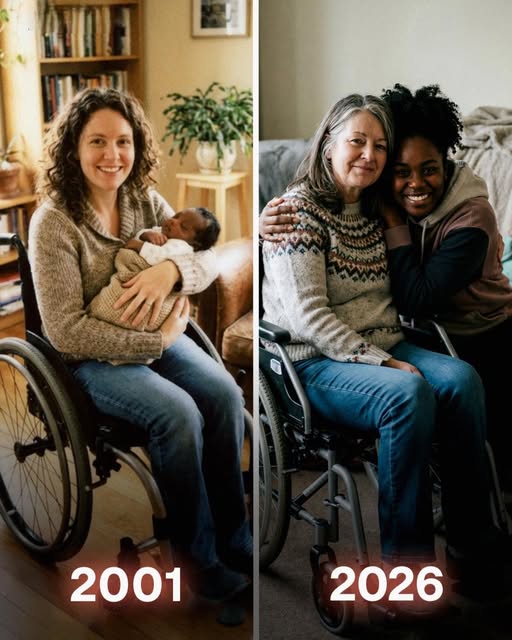
Family is often defined by DNA, but my life proved that love, commitment, and responsibility matter far more than biology. My name is Isabel, and my story didn’t start with a family tree—it began on a doorstep.
Twenty-five years ago, the woman who would become my mother was rebuilding her life after a devastating accident. In her early twenties, a drunk driver caused injuries that left her paralyzed from the waist down. Doctors told her she would never walk again and would never be able to carry a child. She allowed herself one moment of grief, then made a decision: her future was still hers to shape.
She adapted her apartment for accessibility, learned to drive using hand controls, and built a stable career as a paralegal. She believed motherhood was no longer an option—until one quiet morning when she heard a newborn crying outside her door.
When she opened it, she found a baby carrier placed carefully on the doormat. Inside was a tiny infant, cold and wrapped in a thin blanket. A short note rested beside me: “I can’t keep her. I have no choice. I’m sorry.”
Where others might have seen abandonment and hardship, my mother saw purpose. Despite being a single woman with a disability, she fought through skepticism, legal hurdles, and social service resistance. She refused to accept that she wasn’t “qualified” to raise a child. Her determination paid off, and the adoption was finalized. She named me Isabel. To me, she was never my “adoptive” mother—she was simply my mom.
Growing up, it was just the two of us. No extended family, no safety net—only her constant presence and support. She attended every school performance, advocated for accessibility wherever we went, and taught me independence, confidence, and perseverance. She showed me that obstacles are meant to be challenged, not accepted.
When I left for college, she helped me settle into my dorm and reminded me that I was capable of building something meaningful. Those words became reality during my junior year, when my best friend Lena and I launched a small clothing brand focused on high-quality, minimalist essentials.
We ran the business from our dorm room, balancing coursework with entrepreneurship. We named the brand Doorstep—a subtle nod to where my life truly began. My mom became our unofficial third partner, helping with inventory, quality checks, and late-night packaging after long workdays. Her belief in me never wavered.
By the time I was 25, the business had grown beyond anything we imagined. Doorstep became a profitable small business, allowing me to achieve financial independence and buy my first car with my own earnings. It felt like a milestone we had earned together.
Then one Tuesday morning changed everything. As I opened my front door, a well-dressed woman stood on the porch. She smiled politely and asked my name. When I confirmed it, she introduced herself as Karen—my biological mother.
She didn’t offer an apology or explanation for disappearing for 25 years. Instead, she referenced my business success and lifestyle. She claimed that by giving birth to me and leaving me where I’d be “taken care of,” she had played a role in my achievements. Then she made a demand: half of my business and my car as compensation for her “sacrifice.”
In that moment, I understood she didn’t see me as a daughter—she saw me as an investment. I stayed calm and invited her inside, telling her we should talk in front of my mother.
Karen greeted my mom with casual detachment, thanking her for “raising me well.” My mother remained composed. I placed a large photo album on the table and made one request: before any discussion about money or ownership, Karen needed to find a single photo proving she had been part of my life.
She flipped through years of memories—birthdays, school events, graduations. In every photo, my mom was there. Karen wasn’t. Her frustration grew as the reality became undeniable.
She eventually closed the album and insisted that carrying me for nine months should be enough. That’s when I stood up and spoke clearly. Giving birth was biology. Being a parent was everything that followed—the late nights, the sacrifices, the unwavering presence. My success was built on consistency, love, and hard work, all of which came from the woman sitting at that table.
I opened the door and asked Karen to leave. She accused me of being ungrateful and insisted that blood ties mattered most. I told her that love isn’t automatic—it’s proven by showing up. Then she walked out.
After the door closed, the tension lifted. My mom admitted she’d always feared this moment, worried I might wonder about the life I didn’t have. I reassured her that she was the one who chose me, stayed, and believed in me when it mattered.
That night, we looked through the album together. It told the real story—one of resilience, intentional family, and unconditional love. DNA may start a story, but it doesn’t define its outcome.