Dennis seemed “fine” at first—and that’s what worried me later
I met Dennis briefly during my senior year. He wasn’t openly cruel. He wasn’t especially charming either. He smiled too much, talked too loudly, and somehow every conversation drifted back to him. But he held doors, complimented my mom, and shook my hand like he was trying to sell me on the idea that he was a “good guy.”
Most importantly, my mom looked hopeful around him. That made me want to believe it would work.
They got married a few months after I moved away. It felt fast, but my life was loud and busy—classes, internships, late shifts, rent, stress. I told myself my mom was an adult. If she was happy, that was what mattered.
The phone calls sounded normal… until they didn’t
I called her often. She’d talk about Dennis’s fishing trips, plans to go see fall colors, little bits of neighborhood drama. Her voice sounded steady. She laughed. She sounded like herself.
And then, gradually, that changed—not in one dramatic moment, but in tiny, unsettling ways. A pause where there used to be ease. Short answers that felt rehearsed. A rush to end the conversation before I could ask the wrong question.
Whenever I asked if she was okay, she’d say, “I’m fine,” too quickly—like she’d practiced it.
One Sunday morning I called, like always.
“Oh, I’m fine,” she said immediately. “Just a lot of work lately.”
It wasn’t what she said. It was how she said it—tight and sharp, like the word “busy” hurt.
That night I barely slept. The next morning, I called in sick, threw a bag in my trunk, and drove straight to her house without warning.
I walked into a nightmare: my mom was cleaning in a full cast
It had snowed heavily. The whole neighborhood looked buried in white. I parked at the end of the street because the driveway was packed, and my small car wasn’t going to make it up.
I told myself I was being dramatic as I crunched up the icy path.
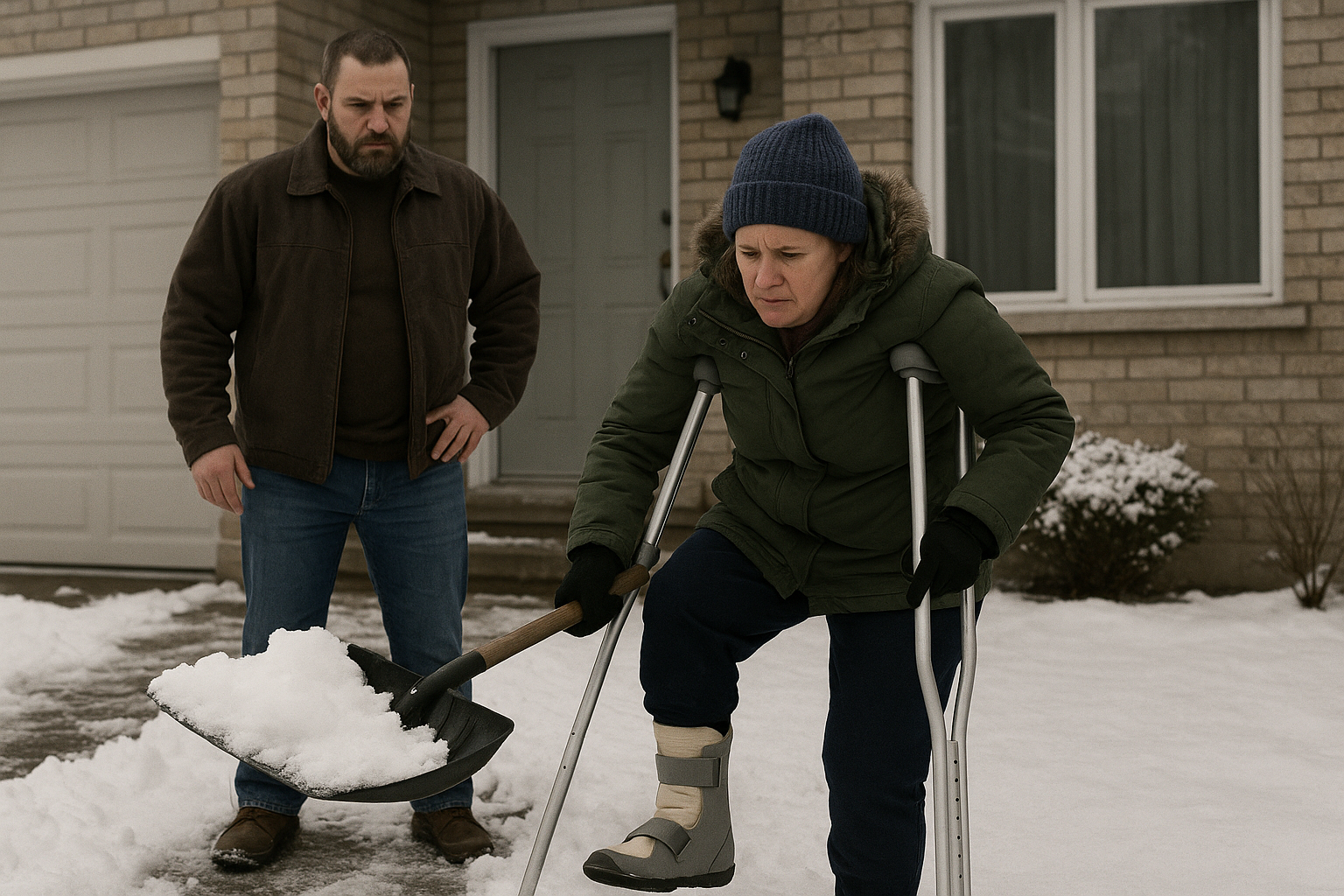
Then I opened the door and saw my mom moving slowly across the kitchen—her leg in a full cast.
Not a brace. Not a limp. A cast that went high enough to make my stomach drop.
And she wasn’t resting. She was working.
She leaned on counters and furniture to balance herself, hauling laundry and moving room to room in a two-story house like stopping wasn’t allowed. The floors were spotless. A vacuum sat in the hallway like it had just been used. A mop bucket waited by the stairs. The air smelled like strong cleaning chemicals and something worse—panic.
“Mom?” My voice rose before I could stop it. “What happened?”
She startled, then tried to smile. Sweat shone at her hairline. Her face was pale in that exhausted, forced-into-function look.
“Oh… honey,” she said. “I slipped a few days ago. I broke my leg.”
“Why didn’t you tell me?”
She looked away. “I didn’t want to worry you.”
I stared at the cast. “You’re cleaning with a broken leg. That’s not something you keep to yourself.”
Then she told me the reason—and I saw the truth
Eventually she lowered herself onto the couch and carefully propped her injured leg up. She was quiet about her pain, like she didn’t feel entitled to take up space with it.
“Dennis’s daughter is coming tonight,” she said. “He wants the house to look perfect.”
I couldn’t believe what I was hearing. “He’s making you clean because she’s visiting?”
My mom didn’t answer. She didn’t have to.
She explained that Kylie was “particular,” and that Dennis insisted everything had to be spotless so his daughter would feel welcome. Then my mom said the part that made my vision blur with anger:
Dennis had told her she needed to shovel the snow all the way to the garage—so Kylie could park comfortably. He didn’t want to be embarrassed.
He even told her it was “just snow” and that she could use the shovel to support herself.
I asked where he was.
She hesitated, and that hesitation said everything.
“He went ice fishing,” she admitted. “With Greg and Neil. He said he’d be back before dinner. He told me to handle everything.”
My mom was injured, alone, and still being treated like unpaid labor—while he went fishing.
I stopped arguing and started taking action
I didn’t scream. People like Dennis don’t respond to yelling. They respond to consequences—especially the kind they can’t talk their way out of.
I took my mom’s hand. “Put on your coat. You’re coming with me. Now.”
She tried to protest, but I didn’t give her room to negotiate. I wrapped her in blankets, helped her down the steps, got her into my car, and turned the heat up full blast.
Then I made calls.
First, I contacted a private snow removal company. I didn’t ask for a basic driveway clearing. I asked for something very specific: relocation. I wanted snow from the surrounding area pushed onto one property.
The guy on the phone hesitated. “Ma’am… that’s a lot of snow.”
Next, I called the city and reported an unsafe situation—an injured resident being forced to do physical labor in hazardous conditions. I provided my mother’s name, her doctor’s name, and sent photos: her cast, the snow, the cleaning setup. Documentation matters. People who mistreat others count on there being “no proof.”
Then I called my mom’s physician’s office and requested a nurse visit—not for drama, but for records. For a neutral professional to document her condition and what she’d been doing.
The snow didn’t just get cleared—it got moved
A big truck arrived with plows, pushers, and salt spreaders.
The crew didn’t simply clear the snow. They relocated it.
They piled it along the edges of the property like a petty glacier. They buried the driveway. Blocked the garage. Packed snow against the porch steps and ground-floor windows until the house looked swallowed by winter.
It was ridiculous on purpose—a loud, visible monument to what happens when someone treats a woman’s body like free labor.
Dennis came home to chaos—and an audience
Not long after, I heard tires crunching through slush. Dennis’s old gray pickup crept up the street. The second he saw the wall of snow, he slammed the brakes and just stared.
Then he jumped out and started shouting.
“What is this? What happened to my house?”
I leaned against my car, calm on the outside. My mom sat bundled in the passenger seat, watching quietly.
Dennis stomped forward, slipped twice, caught himself, and kept going.
“Who did this? Call the police!”
“You might want to pause before you do,” I said, stepping into view.
He froze when he saw me. “Elsa? What are you—”
Before he could finish, two city vehicles turned the corner and parked behind his truck. An inspector stepped out with a folder. A woman with a clipboard followed.
And then a black SUV pulled up.
Kylie arrived—and the story fell apart
Kylie stepped out dressed like she was arriving at a photo shoot: expensive coat, perfect hair, sunglasses like the weather didn’t apply to her. She took one look at the property and stopped cold.
Then she saw my mom in the car.
“Paula?” Kylie moved fast, shock breaking through her polished look. She crouched by the passenger door and stared at the cast. “Oh my God. What happened to your leg?”
My mom tried to smile. “I slipped a few days ago.”
Kylie’s expression tightened with anger. “And you’re out here? In the cold? Like this?”
Dennis shoved himself between them, talking fast. “It’s not what it looks like. She insisted on doing things. I told her to rest.”
Kylie stood slowly, eyes locked on him. “Are you seriously saying she chose to scrub floors and shovel snow with a broken leg?”
Dennis stammered. “She said she could handle it.”
“Don’t,” Kylie snapped. “Don’t put this on her.”
The city inspector stepped in
The inspector opened his folder. “Sir, we received a report about unsafe conditions and potential neglect. We have photographic documentation and a witness statement. We need to assess the situation.”
Dennis turned on me, furious. “You did this? You little—”
“Careful,” I said. “You left your injured wife alone and went fishing. If you want to keep talking, do it in front of the inspector.”
Dennis started pacing, trying to turn outrage into control.
“This is insane! Everyone shovels snow!”
“Not everyone shovels snow with a broken leg,” I said.
Kylie looked at my mom again, and her anger shifted into something like shame. She took my mom’s hand gently.
“I’m sorry,” she said. “I didn’t know. I swear I didn’t know.”
My mom’s voice was small. “You didn’t do anything wrong.”
Dennis threw out one last line, like it was the only thing that mattered to him: “You embarrassed me.”
And there it was—his image, louder than her pain.
Kylie didn’t even blink. “You embarrassed yourself.”
We left—and for once, he wasn’t in control
We didn’t stay to argue. The inspector had what he needed. The nurse had what she needed. Kylie had seen enough to stop playing along.
I helped my mom into the backseat and tucked blankets around her like armor. Kylie helped me settle her carefully and closed the door gently.
Dennis was still shouting when we drove away, but nobody was listening anymore.
Healing looked like quiet mornings and zero demands
That night, my mom stayed with me. I made soup. I helped her into soft pajamas. I watched her fall asleep without flinching at footsteps.
Dennis tried digging out the snow himself. I heard he slipped on the porch and twisted his back. The neighborhood joked about karma. I didn’t. I wasn’t interested in jokes.
I was interested in my mother getting her life back.
In my small apartment, she healed slowly—hot tea with honey, long naps, quiet mornings where nobody barked orders at her. Every Friday, I brought her flowers. Not because she needed flowers, but because she needed the reminder: she mattered.
One night she looked at me and said, “You saved me.”
Then she smiled—really smiled. “Not everyone would’ve seen through me,” she said. “You did.”
I squeezed her hand. “You’re a terrible liar,” I told her.
And for the first time in too long, she laughed like herself.
Conclusion
If you’ve ever had that gut feeling that a loved one is “fine” in a way that doesn’t sound fine—listen to it. Control and neglect often hide behind normal conversations, polite smiles, and the pressure to keep up appearances.
- Pay attention to small changes: rehearsed answers, rushed calls, and sudden hesitation can be warning signs of emotional abuse or neglect.
- Document and report unsafe situations: photos, professional records, and official reports can protect vulnerable family members when manipulation is involved.
- Real support is practical: safe housing, medical follow-up, and clear boundaries matter more than arguments with someone who thrives on control.