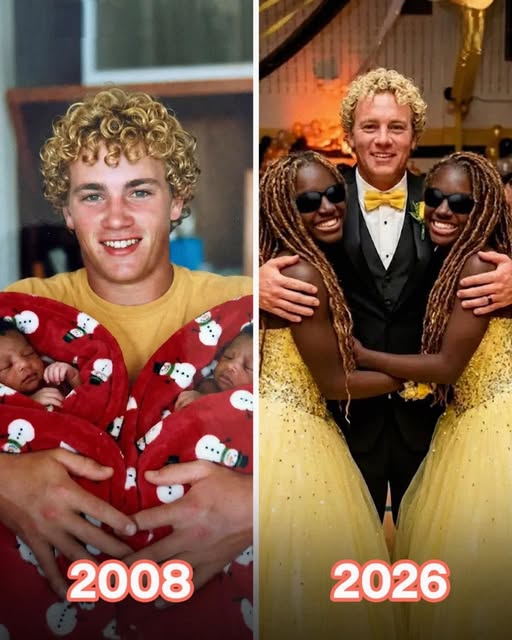
Eighteen years ago, my life changed with the discovery of a single note left on the kitchen counter. I woke to an empty bed and a house that felt hollow, stripped of the hope it once held. My wife, Lauren, had disappeared, leaving behind our newborn twin daughters, Emma and Clara. Both girls were blind—a reality doctors delivered gently, but one Lauren refused to face. Her note was short and cutting: “I can’t do this. I have dreams. I’m sorry.”
At twenty-four, I suddenly became a single father to two children who would never see me. The early years were grueling and relentless. I didn’t just learn diaper changes; I learned how to narrate the world for them. I studied Braille late into the night, arranged our modest apartment so every object was a landmark, and taught the girls to navigate safely with canes while fostering independence and self-worth. Surviving wasn’t enough—I wanted them to flourish.
When they turned five, I introduced them to textiles. What began as a way to strengthen fine motor skills evolved into a shared language. Emma developed an uncanny ability to identify fabrics by touch, while Clara visualized intricate designs in her mind. Our living room became a workshop of sewing machines and colorful threads. Blindness was never a limit—it was just another way to see.
The girls grew into confident, talented young women. They never asked about the mother who abandoned them; I made sure they understood her absence was a choice, not a void. We thrived in our small, creative world, fueled by determination, coffee, and mutual respect.
Then, last Thursday morning, everything changed. The doorbell rang while the girls debated the hemline of a new gown. I opened the door to find Lauren standing there, polished, expensive, and uninvited, her designer sunglasses hiding her eyes. Her heels clicked aggressively on the worn floor as she stepped inside.
“Mark,” she said, voice sharp, judgmental. She looked around at our humble home, the fabric-strewn tables, the well-worn rugs, and sneered. “Still living like this? You were supposed to be building an empire.”
Before I could respond, Clara asked quietly, “Who’s there, Dad?”
“It’s your mother,” I said, feeling the air thicken around us.
Lauren tried to soften, her voice syrupy. “Girls! Look at you. You’ve grown so much.”
Emma didn’t look up from her sewing. “We can’t see, remember? Isn’t that why you left?”
Lauren hesitated only briefly. Then she set down two designer garment bags and a thick envelope of cash. “I’m here to give you the life you deserve. The gowns, the money—it can all be yours.”
“Why now?” I asked quietly.
She smiled triumphantly. “I want my daughters back. But there’s a catch.” She placed a legal document on top of the envelope. “You can have all this—but you must choose me over your father. You must sign, acknowledging that he failed you, that I was right to leave.”
The room felt suffocating. My daughters, whom I had guided through every stitch and step, were being asked to betray me for wealth. Emma touched the envelope, feeling the weight of it. My chest ached.
“Let me speak,” Emma said firmly. “This money… it’s more than we’ve ever seen. But we’ve never needed it. We had a father who stayed. Who taught us we weren’t broken. Who gave us everything we needed.”
Clara stood beside her. “We don’t want your money, Lauren. We don’t want the gowns. And we don’t want you.”
Emma tore open the envelope and scattered the bills across the floor. “We’re not for sale,” she said. “We’re not your props.”
Lauren’s façade collapsed. She yelled, accusing me of brainwashing them, of keeping them in a “seamstress prison.” I responded calmly, “You’re only here because your career stalled. You needed a story to redeem yourself. That’s your plan, isn’t it?”
Her silence spoke louder than words. She hurriedly gathered her money and stormed out.
The aftermath was immediate. Emma’s best friend had recorded the confrontation on a silent video call. The footage went viral under the caption: “What Real Love Looks Like.” Lauren’s carefully crafted image crumbled overnight—agents dropped her, projects were canceled, her reputation destroyed.
For my daughters, though, the truth opened doors. A respected costume house reached out, impressed not by the drama, but by their skill. Yesterday, I watched Emma adjust a lead actress’s collar and Clara pin a complex hemline on set. They were confident, respected, and thriving.
The director turned to me: “Your daughters are remarkable. We’re lucky to have them.”
I shook my head, pride blurring my vision. “No. I’m the lucky one.”
Lauren had sought fame and found emptiness. We had built a life in the quiet and the dark, and in that world, we had everything that truly mattered.