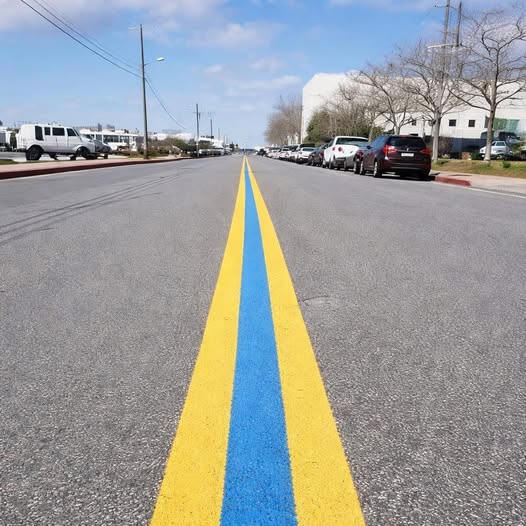
Across the changing landscape of American infrastructure, roadway markings have long existed for one primary reason: function. Yellow centerlines, white lane dividers, and solid shoulders quietly regulate movement, guiding drivers with precision and consistency to maintain safety and order. Recently, however, an unexpected visual element has begun appearing on roads in certain U.S. towns—one that moves beyond pure function and into symbolic expression. Motorists in several communities have noticed a narrow blue stripe placed carefully between the traditional double yellow lines. Though it may initially resemble a construction remnant or maintenance anomaly, this blue marking is intentional. It represents a growing civic effort to visually acknowledge the role of law enforcement within the communities they serve.
This concept emerged from a broader push by local leaders to create lasting, visible gestures of appreciation for public safety workers. One of the earliest and most notable implementations occurred in Ocean City, Maryland—a coastal town known for dramatic seasonal population shifts. While home to only a small number of year-round residents, Ocean City hosts hundreds of thousands of visitors during peak summer months. This seasonal surge places intense demands on municipal services, particularly the police department. Seeking a permanent way to recognize that burden, city officials chose a tribute designed to endure both traffic and time.
The location of the blue line was chosen with deliberate care. In Ocean City, it was painted along 65th Street, the main route leading directly to police headquarters. Mayor Rick Sheehan, who publicly supported the initiative, described it as more than a visual enhancement. To him, it represented a public affirmation of the city’s priorities. Safety, he argued, is central to Ocean City’s success as a tourist destination, and that safety depends on the consistent work of its officers. By placing the marking on a road officers travel daily, the city embedded appreciation into their routine—a simple message of gratitude reinforced through repetition and visibility.
The “thin blue line” has long existed as a symbolic image, commonly seen on flags, decals, and uniforms, where it traditionally represents law enforcement as a stabilizing presence between order and disorder. Transferring this symbol onto public streets integrates that meaning into the physical structure of the town itself. Supporters believe that at a time when conversations around policing are often complex and emotionally charged, a visible sign of respect can help strengthen trust. Community leaders frequently describe the goal as fostering civic unity—reinforcing the idea that cooperation between citizens and public servants is essential for a functioning society.
Beyond symbolism, planners have also pointed to a practical benefit. Even in an era dominated by digital navigation, physical cues remain important. The blue line functions as a subtle wayfinding tool, offering a clear visual route to the police station for residents or visitors who may need assistance. For those unfamiliar with the area, the distinctive color creates an intuitive guide toward a place of help. This combination of meaning and utility has made the concept appealing to other municipalities looking for low-cost ways to enhance both identity and function.
Interest in the idea has spread. In city council discussions across the country, Ocean City’s approach is increasingly referenced as a model. Advocates emphasize that the blue stripe does not replace or interfere with existing traffic markings. Instead, it fits neatly within established road standards, allowing communities to personalize their streets without violating transportation regulations. The result is a standardized roadway with a distinctly local voice.
Urban design experts note that this development aligns with a wider trend toward making public spaces more expressive. Cities are increasingly using infrastructure to reflect shared values, history, and appreciation. In this context, the roadway becomes more than a transit surface—it becomes a medium for acknowledgment. The blue line subtly reminds drivers that public safety is upheld by real people who live and work within the same community.
The long-term effects of such initiatives are still being observed, but early optimism is strong. Some researchers suggest that visible appreciation may contribute to improved morale among public safety workers, while others argue it encourages residents to think more consciously about essential services. Whether viewed as symbolic, practical, or cultural, the blue line represents a thoughtful departure from purely functional municipal design.
As 2026 continues, similar markings are likely to appear in more towns across the country. These blue paths demonstrate how even a small change can carry significant meaning. When patrol car headlights reflect off the blue paint late at night, the message is unmistakable: the community recognizes the work being done. It is a quiet statement, but a lasting one.
Ultimately, the story of the blue road marking is about connection. It reflects a decision by a town to let its streets communicate values, not just directions. By weaving this symbol into everyday travel, communities like Ocean City ensure that respect for public service remains visible—mile by mile. In doing so, they remind residents that safety, order, and gratitude are not abstract ideas, but foundations built into the very roads they travel each day.