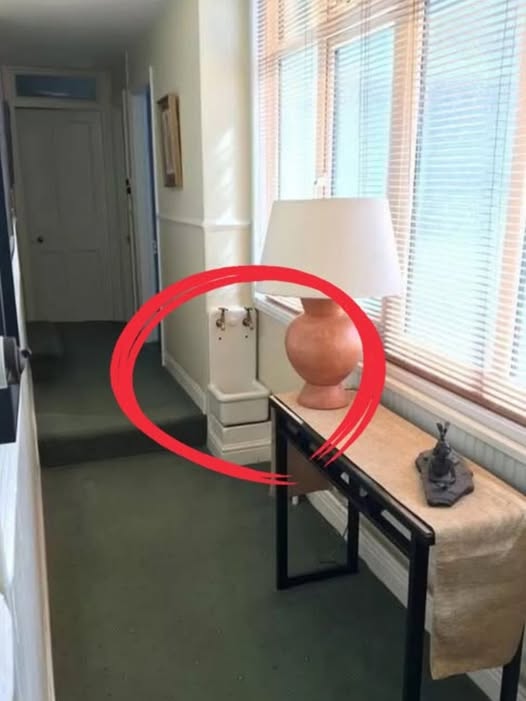
Older houses often carry traces of long-forgotten habits, preserved in architectural details that can feel confusing to modern residents. A century-old home may meet expectations with creaking floors or ornate trim, yet still surprise visitors with something far less intuitive: a porcelain sink mounted openly in a hallway. Positioned between bedrooms or near a rear entrance, these fixtures can look oddly misplaced—more like remnants of an infirmary than elements of a private residence. Despite appearances, hallway sinks were neither errors nor afterthoughts. They were deliberate, practical solutions born from a pivotal moment in domestic history, when sanitation and indoor plumbing were redefining daily life.
To understand why these sinks existed, it is necessary to revisit the realities of household living in the late nineteenth and early twentieth centuries. Indoor plumbing was still a relatively new development, gradually shifting from a luxury for the wealthy into a standard of middle-class comfort. At that time, the modern bathroom had not yet taken its familiar form. Many homes were built with just one bathroom, typically located upstairs near the bedrooms. This arrangement posed challenges for families whose routines were shaped by physical labor, outdoor work, and unpaved surroundings.
The hallway sink emerged as a response to two growing pressures: convenience and hygiene. As scientific understanding of disease transmission expanded, handwashing became increasingly important, not merely a matter of appearance but a measure of health and survival. Expecting residents to climb stairs repeatedly to wash their hands was inefficient and impractical. The hallway sink functioned as an intermediate cleansing point, allowing people to wash up immediately after returning home. In effect, it acted as an early version of the modern mudroom, intercepting dirt and germs before they spread through the house.
These sinks were especially useful in households with children. At a time when play often involved soil, coal dust, and unpaved streets, quick access to running water was invaluable. Parents could oversee a brief cleanup without committing to a full bath, preventing muddy trails through the home. The design of these fixtures reflected their purpose: simple, durable, and focused on function. Many offered only cold water and minimal fittings, reinforcing their role as tools for rapid washing rather than grooming or comfort.
They also helped ease congestion during busy mornings. In homes where several people shared a single bathroom, competition for the sink could delay the entire household. A hallway basin allowed multiple family members to wash their faces or brush their teeth simultaneously, easing daily routines. In this way, the hallway sink represented an early attempt to distribute plumbing more efficiently—an ancestor of today’s en-suite bathrooms and shared-access designs.
Their seemingly random placement was largely dictated by the limitations of early plumbing technology. Installing pipes was expensive and invasive, so sinks were often located near existing water lines or drainage stacks. What now appears awkward or visually intrusive was, at the time, a clever use of available infrastructure. These installations reflected practical engineering decisions rather than aesthetic ones.
As plumbing technology advanced and social preferences evolved, the exposed hallway sink gradually fell out of favor. The rise of dedicated half-bathrooms offered greater privacy, and by the mid-twentieth century, architects had largely abandoned open sinks in shared spaces. Over time, these fixtures became misunderstood. Some modern viewers assume they were intended only for servants or mistake them for specialty equipment, when in reality they were used by every member of the household.
Today, hallway sinks occupy an ambiguous place in historic homes. Many renovators remove them to create cleaner lines or additional storage. Others, particularly preservationists, view them as meaningful artifacts—small but telling reminders of how domestic life once functioned. Retaining such a feature preserves a connection to a time when access to clean water was transformative and profoundly improved everyday living.
Ultimately, the hallway sink illustrates how architecture evolves alongside human priorities. What seems odd today was once an intelligent response to new knowledge, limited technology, and changing expectations. These fixtures stand as quiet evidence that homes are shaped by necessity as much as by style. When encountered now, a hallway sink is not merely an outdated convenience—it is a snapshot of a moment when modern hygiene was just beginning to take hold inside the walls of the family home.