
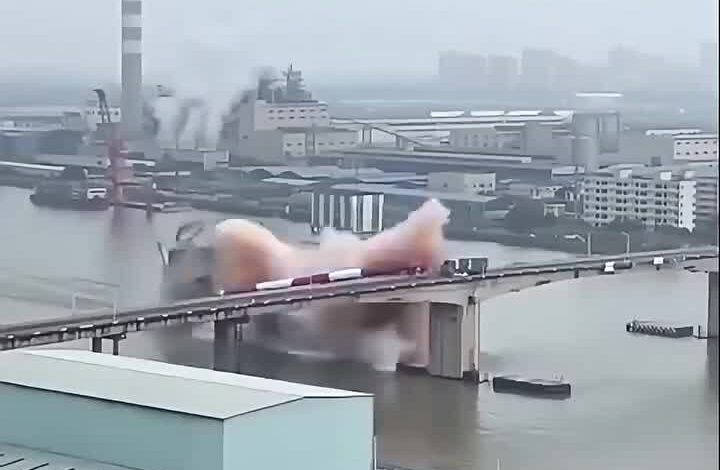

The first crack echoed across the construction site like a gunshot, abruptly silencing conversations and stopping workers in their tracks. Moments later, the ground beneath their feet began to move in a way that was impossible to dismiss as an ordinary vibration. Within seconds, everyone understood the danger: the highway structure they had been working on was no longer stable.
Training and instinct took over. Workers abandoned equipment, shouted warnings, and rushed toward safer ground, knowing that a single wrong step could have devastating consequences.
Long after the danger had passed, many workers would remember the sound before they remembered the fear. It started with the sharp snap of overstressed concrete, followed by the deep metallic groan of steel being pushed beyond its limits. A faint tremor quickly became a violent shudder that traveled through the structure. In only a matter of seconds, an ordinary workday had turned into a desperate fight to escape.
Construction crews reacted immediately. Men and women in orange safety vests dropped their tools and focused entirely on getting away from the unstable structure. Some scrambled down scaffolding as quickly as their shaking legs could carry them. Others jumped from machinery and temporary platforms, relying on instinct as they tried to reach safety.
Warnings and urgent commands filled the air as workers called out to one another, making sure everyone nearby understood the seriousness of what was happening.
Every second mattered. Dust filled the air as sections of the structure shifted and groaned. The familiar sounds of construction were replaced by chaos and uncertainty. Workers who had spent years operating around heavy machinery suddenly faced a threat that experience alone could not eliminate.
When the final workers reached safer ground, the atmosphere changed. Relief mixed with disbelief as people stood silently, staring at the structure they had occupied only moments earlier. Many struggled to comprehend how quickly an ordinary workday had come so close to becoming a disaster.
For some, the incident inevitably brought back memories of one of America’s most devastating infrastructure failures: the collapse of the I-35W bridge in Minneapolis in 2007. That tragedy killed 13 people and injured 145 others, leaving a lasting mark on the community and raising serious questions about infrastructure inspection and maintenance.
The comparison was difficult to avoid. The sudden instability, the terrifying sounds of failing materials, and the realization that a structure could give way without warning created an unsettling sense of familiarity.
This time, however, the outcome was different. Warning signs were recognized in time. Workers responded quickly, and the site was evacuated before the structural failure could result in fatalities. What might have become another devastating tragedy instead became a narrow escape—and a powerful reminder of the importance of vigilance and preparedness.
But beneath the relief lies a more troubling question: how do infrastructure failures reach the point where collapse becomes possible?
Major failures rarely happen because of a single overlooked detail. Cracks, maintenance concerns, aging materials, delayed inspections, design problems, and unanswered reports can accumulate over time. Each ignored warning can increase the risk. Each postponed repair can raise the stakes. Eventually, what began as a manageable problem can become a serious threat to both workers and the public.
The incident serves as a reminder that infrastructure safety is not simply an engineering issue. It is a human responsibility.
Behind every bridge, highway, overpass, and construction project are people who depend on those structures being properly designed, inspected, maintained, and monitored. Workers trust that the environment around them is safe enough to do their jobs. When that trust is compromised, the consequences can be measured not in damaged concrete or twisted steel, but in human lives.
As investigators examine the cause of the structural failure, attention will likely turn to engineering assessments, inspection records, construction procedures, and maintenance history. Those details will be essential to understanding what went wrong.
But for the workers who experienced the collapse firsthand, the memory will be far more immediate.
They will remember the sound.
They will remember the ground moving beneath their feet.
They will remember running.
And they will remember the realization that survival depended on acting within seconds.
Most of all, they will remember how close they came to becoming victims of a tragedy rather than witnesses to a warning.
That warning is impossible to ignore: when safety concerns are dismissed, inspections are delayed, or maintenance is neglected, the risk is never limited to concrete and steel. The true stakes are measured in human lives.