
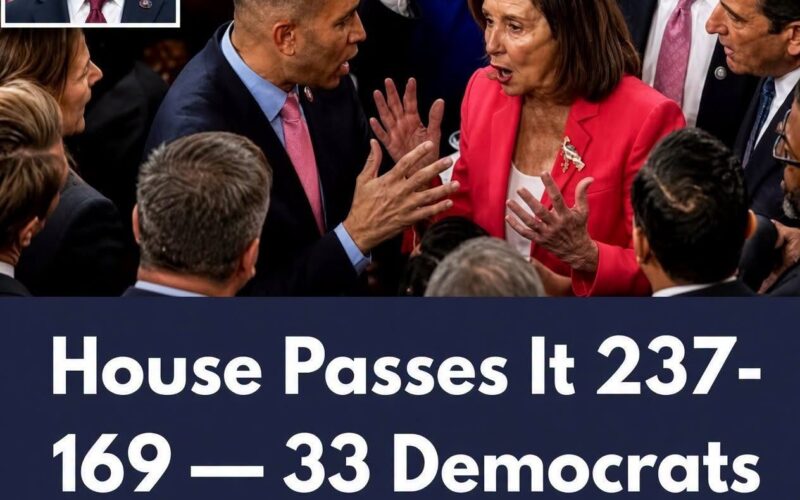

What the House Vote Shows
The vote demonstrated bipartisan support for the bill, although most Democrats opposed it.
According to the official House record, 203 Republicans and 33 Democrats voted in favor. Two Republicans voted against the legislation, while one independent member also supported it. A total of 27 representatives did not vote. citeturn768502search0
The result highlights a disagreement within the Democratic Party over how institutions should respond to boycotts of Israel.
Some lawmakers argue that universities should not engage in certain forms of commercial discrimination against Israel. Others contend that government funding restrictions could discourage institutions and individuals from participating in political advocacy.
The vote count establishes how representatives voted, but it does not, by itself, explain every lawmaker’s reasoning or the broader political consequences.
What Would the Legislation Do?
The bill would amend the Higher Education Act of 1965 to make institutions participating in specified nonexpressive commercial boycotts of Israel ineligible for certain federal higher-education funds.
It would also introduce certification requirements concerning students’ participation in certain academic programs in Israel. citeturn768502search25
Supporters describe the proposal as a way to address discriminatory institutional practices and protect equal access to educational opportunities.
The legislation focuses on particular institutional activities and funding conditions. It should not automatically be interpreted as a general prohibition on students expressing political opinions or criticizing the Israeli government.
The exact scope of any restrictions would depend on the bill’s language and how the provisions are implemented.
Supporters Emphasize Discrimination and Campus Safety
Supporters argue that universities have a responsibility to protect students from discrimination and ensure that educational opportunities remain accessible.
They contend that institutional boycotts targeting Israel can create barriers to academic cooperation and contribute to concerns about unequal treatment of Jewish students.
Representative Virginia Foxx, the Republican sponsor, led the effort to advance the legislation. Representative Josh Gottheimer, a Democrat, also supported the bill, illustrating that backing for the measure crossed party lines. citeturn768502search4turn768502search5
For supporters, the central question is whether federal funding should remain available to institutions that engage in the kinds of commercial boycotts covered by the proposal.
They view funding conditions as a potential tool for encouraging universities to follow standards they consider fair and nondiscriminatory.
Critics Raise Concerns About Free Speech
Opponents argue that restricting federal funding because of an institution’s participation in a political boycott could discourage protected expression and interfere with academic independence.
They also distinguish between opposing the Boycott, Divestment and Sanctions movement, commonly known as BDS, and supporting the right to advocate for or against a political position.
Some lawmakers maintain that political speech should not lose constitutional protection simply because it is controversial or unpopular.
These concerns raise questions about how the legislation would apply to different institutional activities and whether its funding conditions could have consequences beyond the conduct its supporters intend to address.
The constitutional questions are significant, but the existence of a First Amendment concern does not by itself determine how a court would rule. Any legal assessment would depend on the statutory language, the circumstances of its application, and relevant constitutional precedent.
Why Democrats Disagree on Israel Policy
The vote reflects a broader debate over U.S. policy toward Israel, Palestinian rights, campus protests, and the role of federal government in higher education.
Democrats who supported the bill may place greater emphasis on combating antisemitism, opposing institutional boycotts, or maintaining educational ties with Israel.
Those who opposed it may place greater emphasis on freedom of political expression, university autonomy, or concerns about using federal funding to influence institutional positions.
These explanations are not mutually exclusive, and individual lawmakers may have more than one reason for their votes.
It is therefore more accurate to describe the result as a disagreement over policy and constitutional principles than to assume that it represents a single, uniform position within either party.
What Happens Next?
After passing the House, H.R. 4795 was referred to the Senate Committee on Health, Education, Labor, and Pensions on September 14, 2026. It has not yet completed the legislative process. citeturn768502search25
The Senate’s consideration will determine whether the proposal advances further. Lawmakers may debate its scope, examine its potential effects on universities, and consider the relationship between federal funding requirements and constitutional protections.
Until further legislative action occurs, the House vote should not be described as a nationwide ban that is already in force.
A Debate With Consequences for Higher Education
The legislation presents lawmakers with competing concerns: preventing discrimination, maintaining academic cooperation, protecting political expression, and preserving institutional independence.
Supporters believe the proposed funding restrictions could discourage discriminatory practices. Critics warn that they could also create pressure against political advocacy.
The outcome of the debate will depend on how Congress weighs those concerns and whether the legislation advances through the Senate.
For now, the House vote is a clear indication that the issue has bipartisan support as well as substantial opposition. The next stage will show whether that coalition can translate its House victory into further legislative action.