Then I stepped inside.
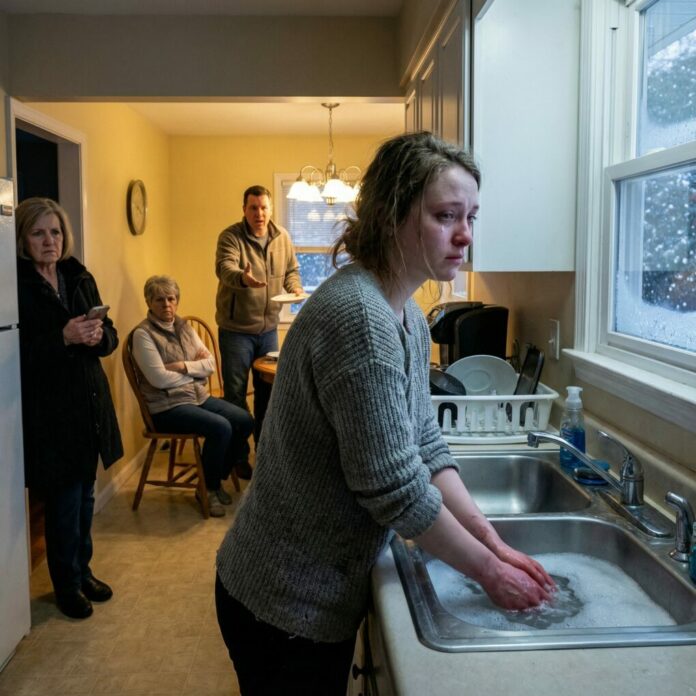
Claire was standing at the sink.
Her hands were submerged in cold water, red and trembling. She wore a thin sweater, the sleeves damp. Her shoulders were tense, her posture small, as though she was trying not to take up space. A stack of dirty dishes waited beside her.
Behind her, at the kitchen table, her husband Mark and his mother Susan were sitting comfortably, eating a hot meal. Susan was chatting casually while Mark scrolled on his phone.
“Mom?” Claire said softly when she noticed me, startled.
Before I could respond, Mark stood up abruptly. He took the plate from his mother and held it out toward Claire.
“Stop washing those,” he said sharply. “Bring more food. My mom’s still hungry.”
Susan didn’t protest. She simply leaned back in her chair.
My heart tightened. My daughter was cold, shaking, and working — while they ate.
I wanted to react immediately. Instead, I took a breath.
“I need to make a quick phone call,” I said calmly.
Claire looked at me, confused. I stepped outside, my hands shaking as I dialed a number I’d saved years ago for serious situations.
“I need help,” I said. “Right now.”
The response was brief. “We’ll be there in five minutes.”
When I ended the call, I stood in the cold air, steadying myself. Behind me, inside that house, my daughter was still at the sink.
Five minutes later, headlights filled the driveway. The doorbell rang.
Mark opened the door, irritation on his face — which quickly disappeared.
Standing there were two professionals and a man in a tailored coat. One introduced himself as a social services investigator. The woman beside him was a family law attorney. The third man stepped forward.
“Mark,” he said evenly, “I’m Daniel Brooks. I’m a senior director at your company.”
Susan stood abruptly. “What is going on?”
The investigator looked directly at Claire. “We received a report concerning potential mistreatment in the home.”
Claire froze. Her hands were still wet. I walked to her and placed my coat around her shoulders. Only then did she begin to tremble openly.
“This is absurd,” Mark said. “She’s my wife.”
The attorney spoke calmly. “Being married does not remove someone’s legal rights.”
Mark frowned. “What rights?”
I met his eyes. “Claire owns this house. It was purchased through a family trust established before your marriage.”
Susan’s face went pale. “A trust?”
“Yes,” I said quietly. “One we never discussed. We wanted to see how she would be treated without finances influencing behavior.”
The room went silent.
Daniel Brooks cleared his throat. “Mark, effective immediately, you are suspended pending an internal review.”
Susan began raising her voice, accusing Claire of exaggeration. The investigator raised his hand.
“Ma’am, you will need to leave the property tonight.”
Mark turned to Claire, his voice unsteady. “You can’t do this. I provide for this family.”
Claire lifted her head. Her voice was calm, but firm.
“You gave instructions,” she said. “Not support.”
Within the hour, Susan left the house. Mark packed a bag. At the door, he paused.
“Claire… please.”
She didn’t respond.
When the door closed, the house felt painfully quiet. Claire sat down and began to cry — the kind of crying that comes from holding everything in for far too long.
“I thought this was my fault,” she said. “I thought I just wasn’t good enough.”
I held her tightly. “You were never the problem.”
Claire came home with me that night. The next morning, she slept later than she had in months. The legal process began soon after. Mark tried reaching out — messages, apologies, explanations — but Claire chose not to respond.
Healing didn’t happen all at once. Some days were quiet. Some days were heavy. But slowly, she began to regain her confidence.
One afternoon, she asked me, “Why didn’t you confront them right away?”
I thought for a moment. “Because I wanted real change — not just an argument.”
Mark eventually lost his job following the investigation. Susan moved away. Claire later sold the house and chose a smaller place of her own — one she decorated herself, one where the heater stayed on.
Before leaving the old house for the last time, she stood in the kitchen.
“I forgot who I was here,” she said softly.
“You remembered,” I replied. “That’s what matters.”
Stories like this don’t always look dramatic from the outside. Sometimes they hide in routines. In silence. In small moments no one questions.
If this story made you reflect, that’s a good thing.
Talk about it. Share your thoughts.
Because somewhere, someone may be standing in the cold, believing this is normal — when all it takes is one person to notice and act.
What would you have done in my place?