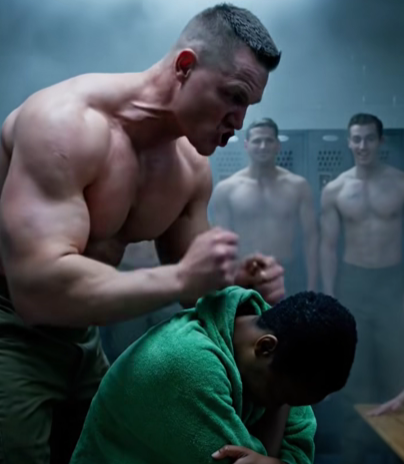
The men shifted uncomfortably, the weight of the General’s gaze pressing down on them. Silence reigned. Even Sergeant Miller’s bravado had evaporated.
General Vance took a deep breath and began, his voice steady but carrying the authority of every command he had ever issued.
“These scars,” he said, pointing to my back, “aren’t the result of carelessness or weakness. They are the marks of courage. The marks of a soldier who faced danger when others would have run.”
The room felt impossibly small. I could hear my own heartbeat echoing in my ears.
“Two years ago,” the General continued, “this soldier volunteered for a mission that none of you would have touched. A fire had broken out in a civilian housing area. Children were trapped inside. She went in. Alone.”
A murmur ran through the room, quickly silenced by the General’s piercing stare.
“She carried one child out, then another. She was burned in the process. These scars,” he said again, letting his words sink in, “are proof that she saved lives that day. Every mark you see is a life she preserved.”
The men’s expressions shifted from confusion to shame. Some lowered their eyes, others clenched their fists. Sergeant Miller looked like he might crumble into the floor.
General Vance’s gaze swept the room once more. “And you,” he said, pointing at Miller, “mocked her? Laughed at someone who risked her life while you stayed safe? That is not strength. That is cowardice.”
I stood frozen, half in disbelief, half in relief. I had never imagined anyone would see those scars the way they were meant to be seen—not as a flaw, but as a symbol of resilience, bravery, and honor.
The General’s voice softened slightly, his focus finally on me. “Reed, you have shown all of us what it means to be a soldier. Let this be a lesson to everyone here: courage isn’t loud. It doesn’t need to be noticed. But when it shows itself, it commands respect.”
The silence lingered for a moment longer, then, one by one, the soldiers began to stand straighter, their faces registering understanding and shame. Miller swallowed hard, no longer daring to speak.
I pulled my shirt over my back, the fabric light against my scars that suddenly felt lighter, too. Not invisible, but respected. The weight of ridicule had lifted, replaced by the acknowledgment I had always deserved.
That day, the barracks changed. Not because anyone else suddenly became a hero—but because they had learned to recognize one when she was standing right in front of them.
And me? I walked taller than I ever had, knowing my scars were not a mark of weakness—they were proof of strength, courage, and the kind of bravery that cannot be mocked.