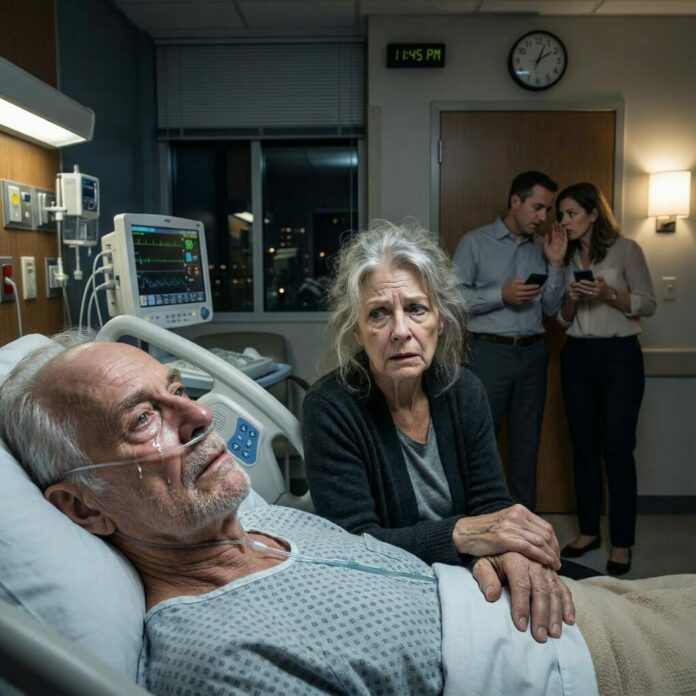
“Once he’s gone,” he said quietly, with the kind of calm that comes from planning ahead, “we’ll move Mom into assisted living. Sell the house. Divide whatever’s left.”
For a moment, I thought I had misunderstood. But then my daughter responded, her voice steady, almost practical.
“Dad hasn’t really been present for years anyway. This is just the inevitable.”
I lay there, completely still.
The doctors had warned my wife, Linda, that even if I regained consciousness, recovery could be slow and uncertain. I let them believe I was still unaware. I kept my eyes closed. I didn’t move.
Linda was sitting beside me, holding my hand. I felt her grip tighten. She had heard it too.
For decades, Linda and I had built our lives around our family. I had grown a small logistics business into something stable and successful. We helped with education costs, housing, emergencies—always stepping in when needed. We believed that being present and supportive mattered.
That moment in the hospital made it clear how differently our efforts had been understood.
The following morning, I heard my children again in the hallway, speaking in hushed voices—rehearsing what they would say to doctors and extended family. Concerned tones. Carefully chosen words. It felt less like worry and more like preparation.
I realized then that waking up and confronting them immediately wouldn’t change much. Apologies might come, but trust would not be restored by words alone.
So Linda and I made a quiet decision.
When the medical team described my condition as “responsive but fragile” and recommended continued observation, Linda nodded. Later that day, she completed discharge paperwork after consulting privately with the doctor—and with me, in the only way we could communicate at the time.
By the next morning, the hospital room was empty.
Our phones were turned off. Our attorney followed instructions we had discussed long before this incident. Financial matters were handled calmly and legally. The business was sold. Assets were reorganized.
To anyone looking in from the outside, it may have appeared sudden. To us, it was deliberate.
When our children returned to the hospital, they found only a cleared room and a brief note left with the nursing staff:
We heard everything.
We relocated quietly, choosing a place where no one knew our history. The change was restorative. My health improved steadily. Linda and I found ourselves walking more, talking more, rediscovering who we were when our lives weren’t centered on obligations.
Back home, the consequences unfolded naturally. Plans our children had assumed would fall into place did not. Calls and messages followed—some confused, some angry, some emotional. We didn’t respond right away.
Eventually, we sent one letter through our attorney. It wasn’t detailed or emotional. It simply explained that we had made informed decisions while fully aware, and that we needed distance.
There were no accusations. No arguments.
Just boundaries.
Life in our new home was quieter. We built routines slowly—shared meals, new friendships, volunteering locally. We stopped measuring our value by what we provided for others and started appreciating what we could still build for ourselves.
From time to time, updates reached us indirectly. Our children were adjusting to lives without the safety net they had taken for granted. It wasn’t punishment—it was reality.
One evening, a letter arrived from our daughter. It was brief and imperfect, but it acknowledged what had been said in that hospital hallway. It didn’t ask for anything.
We haven’t decided how—or if—we’ll respond.
What we’ve learned is this: love doesn’t mean tolerating disregard, and setting boundaries isn’t an act of cruelty. Sometimes, stepping back is the only way to protect what remains of yourself.
If you were in our position—hearing your future discussed as if you were already gone—what would you do? Would you confront it directly, or choose distance and peace?
There’s no single right answer. There’s only the one that allows you to live honestly afterward.