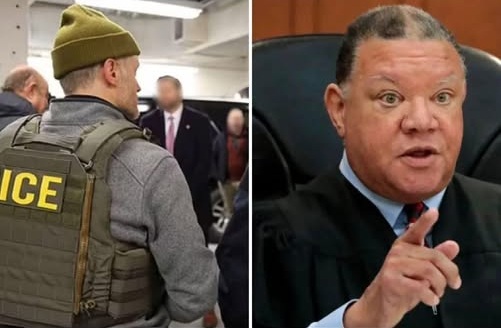
According to court records and witness accounts, federal immigration agents detained Martell-Lebron as he exited the courthouse while his trial was still underway. Testimony had already begun, and the defendant had not been informed that an immigration arrest would occur during the proceedings.
ICE Agent Brian Sullivan carried out the arrest without prior notification to the judge. Martell-Lebron was taken into federal custody and transported to a detention facility in Plymouth, Massachusetts, disrupting the ongoing trial.
Judge’s Ruling and Contempt Finding
Boston Municipal Court Judge Mark Summerville responded by ruling that the arrest violated the defendant’s constitutional rights, including the right to be present during trial and to confront witnesses, protections guaranteed under the Sixth Amendment.
In open court, Judge Summerville stated that removing a defendant mid-trial compromised the fairness of the proceedings. As a result, he dismissed the state charges against Martell-Lebron and issued a contempt finding against Agent Sullivan — a rare judicial action involving a federal officer.
The judge’s ruling does not determine immigration status but focuses solely on the integrity of the court process and the defendant’s rights under state and federal law.
Legal Perspectives
Legal experts note that courthouse arrests during active trials are uncommon and legally sensitive. Defendants must be present to participate fully in their defense, and interference can invalidate proceedings.
One of Martell-Lebron’s attorneys criticized the arrest, arguing that it undermined the justice system by preventing the defendant from exercising his right to a fair trial. Legal scholars say the case highlights the challenges that arise when federal enforcement actions overlap with local judicial authority.
ICE and Law Enforcement Response
During a subsequent hearing, Agent Sullivan testified that he believed he had sufficient information regarding Martell-Lebron’s immigration status and that other agencies were aware of the planned enforcement action. However, the court ruled that prior coordination did not justify disrupting an active trial.
The Massachusetts State Police issued a statement clarifying that troopers neither assisted nor interfered with the federal action, consistent with state and local policies.
ICE has not commented publicly on the contempt ruling but has previously stated that it retains authority to make arrests in public places, including courthouses, when permitted under federal policy.
Broader Context: Immigration Enforcement in Boston
Boston has adopted policies that limit cooperation between local law enforcement and federal immigration authorities, often referred to as sanctuary policies. These measures are intended to encourage community trust and ensure that residents feel safe accessing public services, including courts.
Federal officials have criticized such policies in the past, arguing they complicate immigration enforcement. Local leaders, including Boston Mayor Michelle Wu, have defended the city’s approach, emphasizing constitutional protections and public safety priorities.
Implications and Next Steps
The contempt finding may prompt further review by the Suffolk County District Attorney’s office, though no additional charges have been announced. Martell-Lebron remains in federal custody while his immigration case proceeds separately from the dismissed state charges.
Legal analysts say the case could influence how courts nationwide respond if federal enforcement actions interfere with active judicial proceedings. It may also shape future guidance on courthouse arrests and coordination between federal and local authorities.
Conclusion
The Boston courthouse arrest underscores the complex balance between immigration enforcement and constitutional rights. While federal agencies have authority to enforce immigration laws, courts retain responsibility for safeguarding due process within judicial proceedings.
Judge Summerville’s ruling serves as a reminder that even lawful enforcement actions can face legal consequences if they disrupt the fairness of a trial. As debates over immigration policy and local autonomy continue, this case is likely to remain a reference point for discussions about justice, authority, and the rule of law.