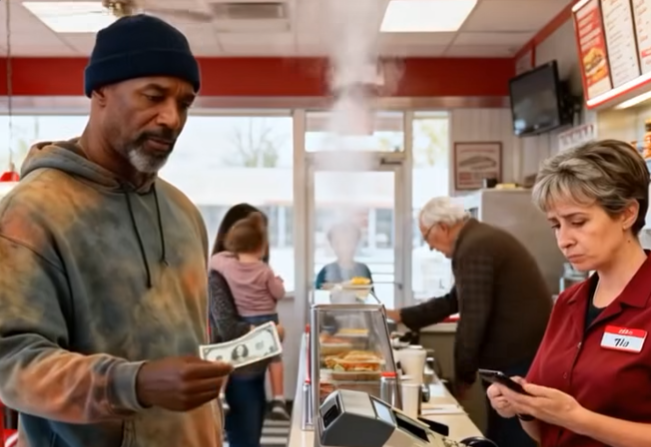
He crossed the street toward the diner he had opened years ago—the very first location. Back then, success felt like a distant dream. His mother had stood beside him in the cramped kitchen, rolling pie dough and humming quietly as they worked side by side. This place carried memories of long nights, borrowed money, and belief when belief was all they had.
The air smelled of sizzling bacon, fresh coffee, and warm bread. Scents that once filled him with pride now made his chest tighten. For months, customer complaints had been piling up—slow service, careless attitudes, people treated like inconveniences instead of guests. It wasn’t an isolated issue. It was a pattern.
Jordan knew the only way to understand what was happening was to walk in unnoticed.
Inside, the diner looked the same—red vinyl booths, black-and-white checkered floors, chrome fixtures—but the atmosphere felt cold. Two cashiers stood behind the counter. One, a young woman in a pink apron, scrolled through her phone while chewing gum. The other, older, wore a name tag that read “Denise.” Neither acknowledged him.
Jordan waited quietly until Denise finally said, “Next,” without looking up.
“Good morning,” he said.
No response. He ordered a breakfast sandwich and black coffee. Denise sighed, rang him up, and dropped his change on the counter without a word.
Jordan sat at a corner booth, observing. The staff wasn’t overwhelmed—they were disengaged. A tired mother struggled to place an order while wrangling two small children. An elderly man asking about a discount was waved off. A worker dropped utensils and muttered loudly.
Then he heard laughter behind the counter.
“Did you smell that guy who ordered the sandwich?” the younger cashier whispered.
“Probably complains about prices,” Denise replied with a snort.
Jordan stayed still. What bothered him wasn’t that they judged him—it was realizing this was how they treated anyone they thought didn’t matter.
Moments later, a construction worker came in and politely asked for a cup of water while waiting for his food. Denise snapped that he shouldn’t linger.
That was enough.
Jordan stood and walked toward the counter. Denise barely glanced up.
“Customer service number’s on the receipt,” she said flatly.
“I’m not calling anyone,” Jordan replied calmly. “I just want to know—do you treat everyone like this, or only people you think don’t have money?”
Denise frowned. “We didn’t do anything.”
“You mocked customers. You ignored people who needed patience. That’s not service—that’s disrespect.”
The younger cashier crossed her arms. “You’re exaggerating.”
Jordan removed his cap. “No. I’m Jordan Ellis.”
The diner fell silent.
The cook froze. Customers turned. Denise stepped back.
“I built this place with the belief that everyone deserves kindness,” Jordan said evenly. “That hasn’t changed.”
The manager rushed out. “Mr. Ellis—I didn’t know—”
“That was intentional,” Jordan said.
He turned back to the counter. “You’re both suspended pending retraining. If you can’t respect customers, you can’t work here.”
The younger cashier’s eyes filled with tears. Jordan remained steady. “Being caught isn’t the same as being sorry.”
They left quietly.
Jordan tied on an apron and stepped behind the counter. He poured coffee for the construction worker and apologized. He helped the mother carry her tray. He wiped tables, greeted guests, and checked on orders. Whispers spread. Smiles returned. An elderly woman clapped softly.
For the first time in years, Jordan felt grounded.
After a while, he stepped outside, took a breath, and sent a message to HR:
“Mandatory empathy and service training at all locations. Managers work one floor shift per month.”
He went back inside, tightened his apron, and took the next order.
Not as an owner.
Not as a millionaire.
But as someone who still believed kindness should never go out of style.