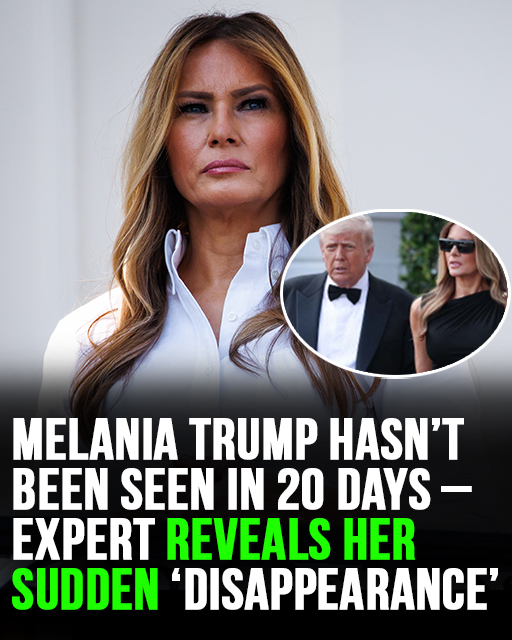
The office of the American presidency is often likened to a transparent enclosure—one that exposes its occupant to an intensity of public attention few individuals ever endure. Yet even by the exceptional standards of the Oval Office, the atmosphere surrounding Donald Trump has escalated to remarkable levels. As of early 2026, the administration is operating amid a maze of sensitive foreign policy calculations and heated domestic disputes, transforming the White House into a nonstop generator of headlines. While President Trump continues to dominate television panels, news sites, and social media feeds, a notable quiet has settled over the East Wing. For more than twenty days, First Lady Melania Trump has been absent from public view, igniting widespread speculation that spans everything from deliberate political positioning to personal retreat.
This silence unfolds against a backdrop of rising international strain. In recent weeks, President Trump has renewed his push to pursue control or acquisition of Greenland—an idea first floated during his initial term but now framed as a cornerstone of national security strategy. The administration has argued that increased U.S. influence over the Arctic region is critical for defense and geopolitical leverage. The response from abroad, however, has been swift and unyielding. Danish officials, supported by Greenland’s own leadership, have firmly rejected the notion, emphasizing that the territory is not for sale. Across Europe, the rhetoric has been labeled inflammatory, while critics at home have gone so far as to openly discuss the possibility of invoking the 25th Amendment—an indication of growing discomfort with the President’s unconventional diplomatic approach.
Amid this political turbulence, Melania Trump’s absence has become a narrative in its own right. While the President appears energized by constant media attention, the First Lady has seemingly chosen complete withdrawal. Her last verified public appearance with Donald Trump was at the lavish New Year’s Eve festivities at Mar-a-Lago. Since then, her only confirmed communication came in the form of a brief post on X (formerly Twitter) on January 20, marking the anniversary of her return to the role of First Lady. Beyond that solitary message, she has remained entirely offstage, leaving commentators and analysts to fill the vacuum with conjecture.
Political observer Sigrid Rege Gårdsvoll has described Melania Trump as being “remarkably absent.” She argues that the difficulty in evaluating Melania’s role stems from her near-invisibility. Unlike previous First Ladies who often stepped forward during moments of crisis to humanize the presidency or advocate for specific causes, Melania appears to have opted for deliberate disengagement. This approach is especially striking given the intensity of the Greenland dispute and the mounting domestic criticism facing her husband.
Not all analysts interpret her disappearance as a sign of trouble. Eirik Løkke, a U.S. politics expert and adviser at the think tank Civita, contends that Melania’s low profile aligns perfectly with the image she has cultivated for years. According to Løkke, she has never shown much interest in embracing the traditional, highly visible role associated with the First Lady. During the 2024 campaign, she was noticeably less present than the spouses of other candidates, suggesting early on that her second term in the White House would follow a similar pattern.
“She has never sought a public-facing role and prefers to remain in the background,” Løkke noted. He further suggested that her retreat may serve a strategic purpose: avoiding being eclipsed by the President’s overwhelming media presence. In an environment where Donald Trump’s statements—particularly on Greenland and foreign policy—consume nearly all available attention, there is little space for parallel narratives. Løkke added that Trump himself may favor this singular focus, with Melania willingly stepping aside. “Nothing competes with Donald Trump’s presence as president,” he remarked, implying that this arrangement may suit both parties.
This controlled distance mirrors her conduct during her first term from 2017 to 2021. During that period, Melania Trump maintained a carefully curated image—appearing at major ceremonies, diplomatic events, and holiday functions, while largely avoiding daily political debates. When she did engage publicly, it was through tightly managed statements or focused initiatives such as the “Be Best” campaign, centered on children’s welfare and online behavior. In 2026, that selective visibility appears to have evolved into near-complete withdrawal during moments of peak controversy.
The contrast between President Trump’s outspoken, attention-commanding style and Melania’s reserved silence has become one of the administration’s defining dynamics. As Trump confronts international criticism and dissent within his own political ranks, the First Lady’s absence functions as a quiet counterbalance. Supporters view her discretion as a mark of grace and independence, while detractors argue that it represents a failure to fulfill the symbolic responsibilities of her position.
As debates over Arctic policy and other contentious issues continue, an open question remains: how long can the First Lady remain unseen before her absence begins to carry political consequences? Historically, Americans have expected a visible First Family during periods of global uncertainty. Whether Melania Trump will eventually reemerge to offer a softer public presence—or continue to remain behind closed doors—remains a subject of intense curiosity.
In the end, Melania Trump’s twenty-day disappearance reflects her broader relationship with public life. It is an assertion of control and personal choice, signaling that she will not be shaped by media pressure or political expectations. Whether this retreat is a carefully calculated strategy or simply the preference of someone who never sought public attention is left to interpretation. In an administration defined by constant noise and spectacle, her silence may be the most striking message of all.