
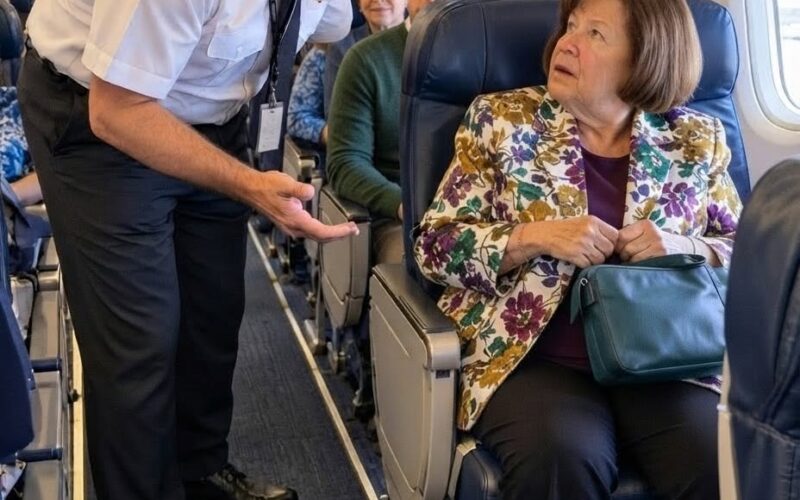

About two hours into the flight, I finally walked back to row 34.
Grandma sat by the window.
Beside her was a nervous-looking red-haired boy, perhaps eight or nine years old. An airline badge hung around his neck.
He was traveling alone.
His name was Oliver.
His knee bounced nervously as he stared at the tray table.
“Are you okay?” I asked Grandma.
She smiled.
“I’m fine.”
But her hands were trembling.
As a nurse, I knew what nervousness looked like.
This was something deeper.
Then Oliver spoke.
“I don’t like when the airplane shakes.”
Grandma looked at him.
“Neither do I.”
The boy looked surprised.
“But my husband used to repair airplanes,” she continued. “He taught me that turbulence is a little like driving over bumps in the road. The airplane is built to handle it.”
“Did he fix this airplane?”
Grandma looked out the window.
“Maybe.”
Then she smiled.
“Maybe he did.”
I watched them for another moment before returning to first class.
Twenty minutes later, a younger pilot stepped out of the cockpit.
He spoke quietly to a flight attendant.
Then he started walking toward the rear of the aircraft.
He passed row twenty.
Then twenty-five.
Thirty.
At row 34, he stopped.
He looked at Grandma.
Then at her purse.
More specifically, at the little silver wings attached to it.
His expression changed completely.
He crouched beside her.
“Where did you get those?”
Grandma stared at him.
The pilot swallowed.
“Mrs. Walsh,” he said, “why did you choose seat 34A?”
I froze several rows away.
Grandma’s lips trembled.
“Because that’s where he told me to sit.”
The pilot went still.
“Who?”
Grandma opened her purse.
She pulled out the yellowed paper I had noticed at the gate.
An old boarding pass.
The thick cardstock was worn at the edges.
She handed it to him.
I could see the faded printing.
Flight 212. Boston — San Francisco. March 14, 1999. Seat 34A. Passenger: Frank Walsh.
The pilot stared at it.
Then he turned the card over.
There was writing on the back.
His face changed.
“Carol,” he called to the flight attendant. “Please get the captain.”
The flight attendant hurried over.
She looked at the boarding pass.
Then at Grandma.
Then back at the pilot.
“It’s her,” he whispered.
“She’s in 34A.”
Grandma looked at him carefully.
“You were the little boy.”
The pilot’s eyes filled with tears.
He nodded.
“The boy who sat beside him.”
Then he reached into his pocket.
He opened his hand.
Inside was another tiny pair of silver wings.
Exactly like Grandma’s.
“He gave these to me,” the pilot whispered.
Grandma touched the wings on her purse.
“He had two.”
The pilot nodded.
“He told me.”
For twenty-seven years, Grandma had wondered where that second pin had gone.
Now she finally knew.
The pilot introduced himself as Danny.
And then he told us why he had spent years looking for her.
In 1999, Danny had been an eight-year-old traveling alone from Boston to San Francisco.
Frank Walsh had been assigned seat 34A.
Danny had been seated beside him.
During the flight, Frank suffered a medical emergency.
The crew tried to help while the pilots prepared to divert the aircraft.
But even while he was struggling, Frank kept asking about the frightened boy beside him.
He wanted to make sure Danny was okay.
Then Frank reached into his jacket.
He took out one of his silver aviation pins.
He gave it to Danny.
“Be brave,” he told him.
Danny kept it.
He carried it through childhood.
Through school.
Through flight training.
Eventually, he became a pilot.
And every March 14, he requested Flight 212.
For Frank.
I could barely speak.
Then Grandma handed me the old boarding pass.
There was another message written on the back in faded pencil.
Ruthie — We’re above the Rockies. Snow everywhere. Sun across the peaks. You should see this. Best view I’ve ever seen. I’m keeping the seat warm for you. Next time we sit here together. Promise me. — F.
I read it twice.
Then I looked at Grandma.
“You kept this all these years?”
“Every day.”
“And you never flew again?”
She shook her head.
“I couldn’t.”
Then she finally told me the part of the story nobody had ever explained.
In 1999, Grandma had been supposed to travel with Frank.
They were going to California because Frank wanted to meet his newborn granddaughter.
Me.
But the night before the flight, Grandma became ill.
Frank went alone.
He called her before boarding.
He told her about the little boy sitting beside him.
He promised to keep an eye on him.
Then he boarded Flight 212.
And never came home.
For twenty-seven years, Grandma had imagined him dying alone.
Now she learned that he hadn’t.
The captain eventually came out of the cockpit.
His name was Gene Holt.
He had been the first officer on Flight 212 in 1999.
He removed his hat when he reached row 34.
“Mrs. Walsh,” he said softly, “I’ve wanted to meet you for twenty-seven years.”
Grandma gripped my hand.
“Tell me what happened.”
Gene sat beside her.
He explained that Frank had become ill while the aircraft was crossing Colorado.
The crew and a medical professional on board tried to help him.
But Frank’s concern remained focused on Danny.
“He kept asking whether the boy was okay,” Gene said.
Then he told Grandma something she had never heard.
Before Frank lost consciousness, he asked the crew to make sure Danny was taken care of.
And he gave the boy his silver wings.
“He wasn’t alone,” Gene said.
Grandma began to cry.
Gene continued.
“He had people with him.”
Then he looked toward Danny.
“And he had a frightened little boy holding his hand.”
For twenty-seven years, Grandma had carried one painful image.
Frank alone in seat 34A.
Now she had another.
Frank comforting a frightened child.
Giving away something precious.
Making sure someone else wasn’t afraid.
Gene pointed toward the cockpit.
“And that little boy is now flying the airplane carrying you.”
Grandma looked at Danny.
He smiled through tears.
Gene then turned to Oliver, the young passenger sitting beside Grandma.
“You traveling alone?”
Oliver nodded.
“First time?”
Another nod.
Gene pulled a small junior-pilot pin from his pocket and attached it to Oliver’s shirt.
“These aren’t quite as old-fashioned as the ones Frank gave Danny,” he said.
Oliver smiled.
“Be brave.”
Then Gene returned to the cockpit.
I never went back to first class.
I stayed in row 34.
Grandma sat by the window.
Oliver sat between us.
Soon, the captain’s voice came over the speakers.
He told the passengers they were approaching the Rocky Mountains.
Then he told them about Frank Walsh.
An aircraft mechanic who had spent decades helping keep airplanes safe.
A husband traveling to meet his newborn granddaughter.
And a man who had spent his final moments comforting a frightened child.
Then Gene said something that made the entire cabin silent.
“That frightened child is my first officer today.”
Danny looked toward Grandma.
“And Mrs. Ruth Walsh is sitting in 34A today for the first time.”
Grandma pressed her hand against the window.
The Rocky Mountains stretched across the horizon.
Snow covered the peaks.
Sunlight spilled across them.
For the first time, she was seeing the view Frank had described in his final message.
“This is the view he wanted you to see,” Gene said.
Grandma stared outside.
Then something unexpected happened.
She moved slightly toward the aisle.
“Come here,” she told Oliver.
The boy leaned closer.
“We can share.”
So they did.
An eighty-year-old woman and a nervous little boy sat together beside the window in 34A.
And suddenly, the seat that had carried so much sadness felt different.
After we landed, Danny and Gene came back to see Grandma.
Danny opened his hand.
The silver wings rested in his palm.
“These belong to you.”
Grandma smiled.
“No.”
Danny looked confused.
“Frank gave them to you,” she said. “He told you to be brave.”
She touched his pilot’s uniform.
“And you were.”
Then she touched the matching wings on her purse.
“We’ll each keep one.”
Danny looked down.
“He would have been proud of you,” Grandma said.
Then Gene asked whether she wanted to see the cockpit.
Grandma laughed.
“I’m eighty years old.”
“That sounds like a yes.”
“It is.”
At baggage claim, my mother was waiting.
When she saw Grandma’s tearful face, she rushed toward us.
“Mom? What happened?”
Grandma placed both hands on her daughter’s face.
“I sat in his seat.”
Mom froze.
“34A.”
Then Grandma smiled.
“I saw the mountains.”
She told her everything.
The pilot.
The little boy.
The silver wings.
And finally, the words she had needed to hear for twenty-seven years.
“He wasn’t alone.”
My mother began crying.
Then Grandma did something I will never forget.
She hugged her daughter.
And I joined them.
For years, my mother had been afraid to tell me the full story because she didn’t want me to believe that Grandpa’s death was somehow connected to my birth.
But standing there in the airport, the truth felt strangely simple.
Nobody had caused it.
Nobody needed to carry the blame.
As Grandma said quietly:
“It was just his heart.”
We spent a week in California.
On our final evening, Grandma unfolded the old boarding pass again.
My mother asked her why she had finally decided to fly.
Grandma touched the silver wings on her purse.
Then she told us something I had never heard.
In 1966, when she was twenty, she took her first airplane flight.
She was terrified.
A young sailor named Frank Walsh sat beside her.
He noticed she was shaking.
He pulled two small silver wings from his pocket.
His father had given them to him.
Frank handed one to her.
“I’ll wear one,” he told her. “You wear the other. If you get scared, remember that somebody has the matching wings. You aren’t alone.”
Grandma carried hers for sixty years.
Frank carried his for decades.
And when his final journey came, he gave his to a frightened child.
That child carried them into adulthood.
Until, twenty-seven years later, he met the woman who had given him the first pair.
“I think I was waiting for someone to tell me he wasn’t alone,” Grandma said.
She looked toward the lights across the Bay.
“I just didn’t know that was what I needed.”
A week later, we flew back to Boston.
This time, I didn’t book first class.
I booked economy.
Row 34.
Seats A and B.
At the gate, an airline employee recognized Grandma’s name.
Captain Holt had left something for her.
An envelope.
Inside was a photograph of Gene and Danny standing beside an airplane.
On the back was a handwritten message:
Ruth — Still keeping the seat warm. Always. — Gene & Danny.
Grandma kept the photograph on her lap for the entire flight.
A year has passed.
Gene retired.
His final flight was Flight 212 from Boston to San Francisco.
Grandma and I were aboard.
Row 34.
Danny flew beside him.
When the plane landed, the airport welcomed Gene’s final flight with a water salute.
Passengers applauded.
Grandma cried.
I cried too.
Danny later became a captain.
When he received his fourth stripe, he mailed Grandma a photograph.
The old silver wings were tucked inside his captain’s hat.
Grandma turned eighty-one recently.
When I asked what she wanted for her birthday, she gave me the same answer.
“San Francisco.”
“March fourteenth.”
“Flight 212.”
I booked the tickets immediately.
Economy.
Row 34.
I didn’t even look at first class.
Because I finally understood something.
I hadn’t wasted the money on Grandma’s original first-class ticket.
It simply wasn’t the seat she needed.
For twenty-seven years, she had been afraid to return to the sky.
Afraid to see the mountains.
Afraid to face 34A.
Afraid of the memories waiting there.
What she needed wasn’t luxury.
She needed courage.
She needed to fulfill a promise written in fading pencil.
And she needed to discover that the man she loved had not spent his final moments alone.
I never met my grandfather.
But now, I think about him often.
I think about an aircraft mechanic traveling across the country to meet his newborn granddaughter.
I think about a man who knew he was in trouble and still reached into his pocket to give courage to a frightened child.
I think about that child growing up to become a pilot.
And I think about my grandmother returning to the same window twenty-seven years later.
Then moving aside so another nervous child could share it.
Airlines divide cabins into classes.
First.
Business.
Economy.
Some seats are wider.
Some recline farther.
Some come with better food and nicer glasses.
But I learned something on Flight 212.
The best seat on an airplane isn’t always the one that costs the most.
Sometimes, it’s simply the place where someone makes sure you don’t have to be afraid alone.
My grandfather understood that.
Eventually, Grandma did too.
It just took me thirty-four rows to understand it.