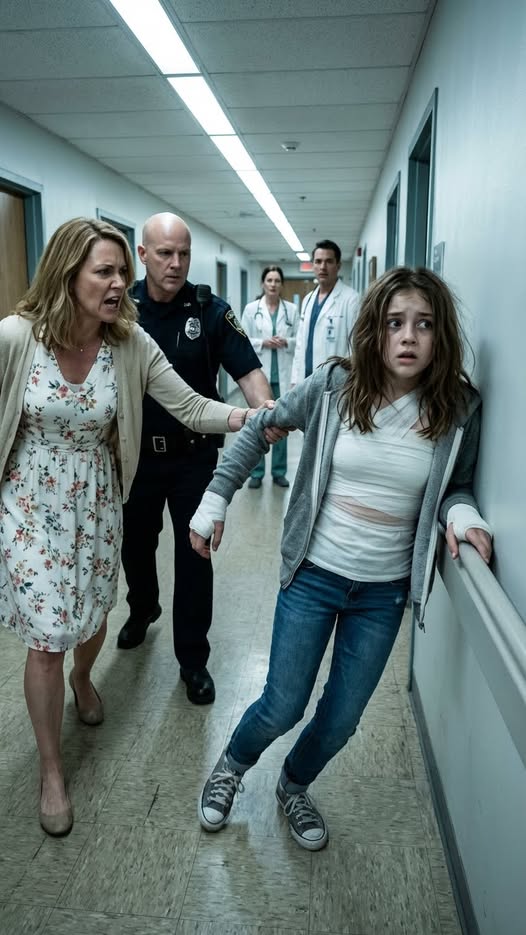
The first sign that everything was about to change came in the nurse’s eyes. It wasn’t shock or panic—just a brief tightening of her expression, a crack in her professional calm that let real concern show through. For most of my life, I had accepted my mother’s version of “discipline” as something I deserved. The bruises hidden beneath long sleeves in the middle of summer felt like proof that I was careless, ungrateful, or simply hard to love. But in that sterile exam room, as the nurse studied my scans, the air grew heavy. For the first time, my pain had a name, and it wasn’t my fault.
Child Protective Services arrived the next day. There were no sirens, no drama, yet their presence felt like an earthquake. Two agents stood at our door: a woman clutching a thick notebook and a man whose gaze missed nothing. My mother greeted them in her finest performance—hair perfect, clothes immaculate, voice warm and sweet. She smiled the smile that had fooled teachers and neighbors for years and insisted there had been some terrible misunderstanding.
I stayed behind her, silent in the way I had been trained to be. In our house, quiet wasn’t just normal—it was survival. Every corner was spotless, every object in place. Our home was less a shelter and more a stage built for my mother’s control. She was the director and the star. I was either decoration or inconvenience, depending on her mood.
When they asked to speak with me alone, her mask slipped. For a moment, the loving parent disappeared, revealing something cold and empty beneath. Her fingers dug into my shoulder. “She’s shy,” she laughed, brittle and forced. “Strangers make her nervous.” The agent didn’t budge. For the first time, someone else held authority.
As she retreated to the kitchen, I sat on the carpet, staring at a faint stain near the couch—a reminder of an “accident” that had left me limping for days. The woman knelt in front of me, her voice soft, her clothes carrying the clean scent of lavender. “We saw your scans,” she said gently. “We need you to tell us what really happened.”
Truth had always been dangerous in that house. I wanted to lie, to cling to the familiar misery rather than step into the unknown. I almost told her I had fallen. But I remembered the nurse’s face, the quiet recognition in her eyes. I was tired of living in fear.
“My ribs,” I whispered. “She hit me with a broom handle.”
The words opened a floodgate. I spoke calmly about years of punishment—the burns, the belt, the locked doors, the way her voice changed the moment no one else was around. When I finished, the agents were silent, not in doubt but in understanding. Everything had shifted.
They took me that night. My life fit into one backpack: a few clothes, two worn books, and a sketchpad I had hidden for years. As we drove away, I saw my mother on the porch, her face tight with rage. She wasn’t grieving. She was furious that I had finally spoken.
Foster care felt unreal at first. I slept lightly, waiting for footsteps, for shouting that never came. In my new home, broken dishes were met with shrugs instead of screams. Peace felt like a trick. One afternoon I dropped a bowl of soup and collapsed, covering my head.
A hand touched my shoulder—gently. “Are you burned?” my foster mother asked. I begged her not to hit me. She pulled me close. “We don’t do that here,” she said. “It’s only soup.” I cried for twenty minutes, overwhelmed by the strange kindness of safety.
Months later, the case went to court. My mother’s lawyer tried to paint me as a liar. The night before, I received a note that read, “The ungrateful child loses everything.” But I had learned to speak.
In the courtroom, doctors explained my injuries—fractured ribs, broken bones, damage that could not come from accidents. I testified, shaking but steady, telling the jury about the punishments and the words meant to break me. Two hours later, the verdict came back: guilty on all counts. As she was led away, my mother wept—not for me, but for the control she had lost.
Outside, the nurse who had first noticed found me and handed me a small scarf. “You saved me,” I told her. She smiled softly. “You saved yourself. I just listened.”
Today, I live in a home with open doors and warm lights. My scars are reminders of survival, not shame. I volunteer in clinics and shelters, watching children for the same silence I once carried. And when I see it, I remember the nurse’s eyes and tell them what changed my life: someone sees you, and you are not alone.