
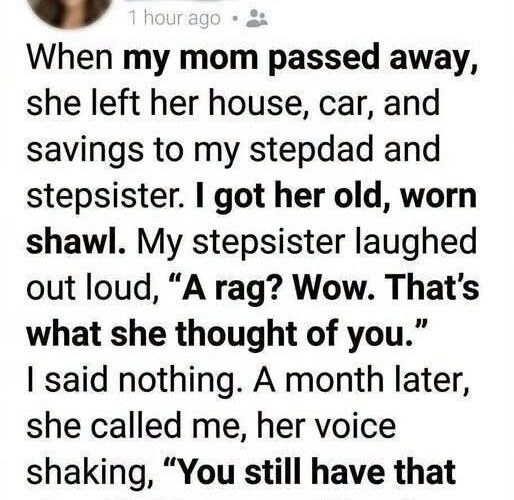

At first, I couldn’t hide my disappointment.
It wasn’t expensive. It wasn’t particularly fashionable. The fabric had faded with age, and there were small signs that it had been used for years.
I remember holding it and wondering why my mother had chosen this for me.
I almost put it away and forgot about it.
Then I noticed something unusual.
A Familiar Piece of Fabric
The shawl had always been around when I was growing up.
I remembered seeing my mother wear it on chilly mornings and wrap it around her shoulders while sitting near the window.
As a child, I never thought much about it.
To me, it was simply something she owned.
But as I held it after her death, those ordinary memories suddenly felt much more important.
I could almost picture her sitting in the same chair, reading or drinking tea.
For the first time, I understood that the shawl wasn’t valuable because of what it cost.
It was valuable because it belonged to her.
Something Didn’t Feel Right
A few days later, while carefully folding the shawl, I noticed that one section of the stitching looked different.
There was a small seam inside the fabric that I had never noticed before.
I hesitated.
Part of me wondered whether I should leave it alone.
Another part of me couldn’t stop thinking about it.
So I examined the stitching more closely.
Inside was a small folded envelope.
My hands began to shake.
I had no idea what could possibly be inside.
A Message From My Mother
The envelope contained a handwritten letter.
It wasn’t a legal document or a list of valuables.
It was simply a letter addressed to me.
My mother explained that she knew the shawl might seem like an insignificant gift compared with everything else.
But that was precisely why she had chosen it.
She wanted me to have something that had been part of her everyday life.
The letter brought back memories I hadn’t thought about in years.
She wrote about mornings when she had wrapped the shawl around herself while taking care of me.
She mentioned the first time I had borrowed it as a child because I was cold.
She even remembered a rainy afternoon when we had sat together by the window, listening to the weather outside.
None of those moments had seemed important at the time.
To her, apparently, they were.
The Gift Wasn’t About Money
I sat quietly for a long time after reading the letter.
Suddenly, the shawl didn’t seem like a disappointing inheritance.
It felt like a piece of my childhood.
My mother couldn’t leave me the house or the most valuable possessions.
But she had left me something that carried memories neither money nor property could replace.
The shawl had been there through countless ordinary moments.
And perhaps that was exactly what she wanted me to remember.
What We Sometimes Overlook
Grief can make people focus on the things that disappear.
The house.
The belongings.
The routines.
The person who used to be there.
But sometimes, the smallest objects become the things we treasure most.
A photograph.
A handwritten note.
An old recipe.
A piece of clothing.
Or, in my case, a faded shawl.
The value of those objects isn’t necessarily financial. Their meaning comes from the memories attached to them.
I Finally Understood
I still have the shawl.
It isn’t kept in a display case.
Sometimes I still use it on cold evenings.
And whenever I do, I think about my mother.
I think about the ordinary mornings, the quiet conversations, and all the moments that seemed unimportant at the time.
I also think about the letter hidden inside it.
For years, I believed my mother had left me the least valuable thing.
Now I understand that she may have left me the one thing she knew I would eventually understand.
Some inheritances aren’t measured by their price. Sometimes, the smallest gift carries the biggest part of someone’s story.