
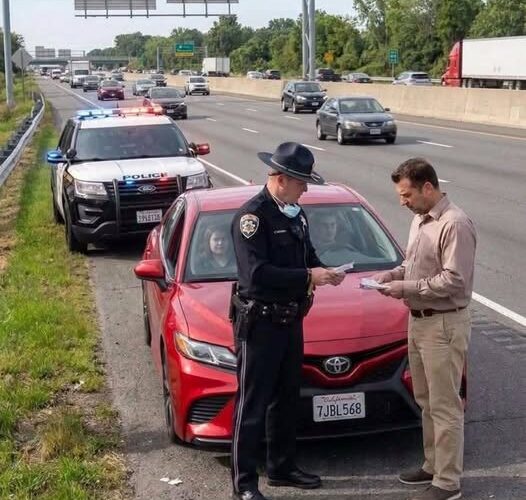

Sarah had always told people she worked in marketing for a pharmaceutical company called Meridian.
I had never visited her office.
I couldn’t name a single coworker.
There had been no holiday parties, no office stories, no casual conversations about people she worked with.
When I asked about her job, she gave polished answers that never contained quite enough detail to invite another question.
For years, I had considered that normal.
Now it looked different.
The next morning, Sarah left for what she described as a client meeting.
I waited until she was gone.
Then I called the number on the note.
A man answered.
“Detective Adam Reynolds,” he said.
He told me he worked with an organized-crime investigation.
Then he asked a question that made my stomach tighten.
“Are you somewhere alone?”
I said yes.
What he told me next changed everything.
“Your wife has been under surveillance for eight months.”
I almost laughed.
Not because it was funny.
Because the alternative was too difficult to believe.
The Secret Behind Her Job
According to Reynolds, investigators believed Sarah was involved in a large financial-crime operation.
The company she claimed to work for didn’t appear to exist.
Her business credentials, travel schedule, and professional identity were allegedly part of a carefully constructed cover.
The investigation centered on money being moved through shell businesses and accounts designed to make illicit funds appear legitimate.
Millions of dollars were involved.
And Reynolds believed my marriage had helped make Sarah look trustworthy.
Stable.
Ordinary.
Exactly the kind of person nobody would think twice about.
“You’re telling me I’ve been used as cover?” I asked.
“I’m telling you your wife appears to have been living two lives,” Reynolds said.
The words were devastating.
But then he told me something even worse.
Investigators believed Sarah was preparing to disappear.
Money had allegedly been redirected.
A second financial identity had surfaced.
There were indications of offshore accounts and plans for relocation.
She wasn’t simply hiding her past.
She appeared to be preparing for a future I wasn’t supposed to be part of.
Becoming a Stranger in My Own Home
Reynolds gave me a choice.
I could walk away.
The investigation would continue without me, and I could find somewhere safe to stay while authorities handled the case.
Or I could cooperate.
If I did, investigators could potentially document what Sarah was doing inside our home and strengthen the case against the wider operation.
Neither option felt safe.
But I agreed to help.
For the next six weeks, my home became something I barely recognized.
Investigators guided me on how to preserve relevant information and document conversations and files without confronting Sarah.
I continued going through the motions of our marriage.
We ate dinner together.
We watched television.
We talked about ordinary things.
And all the while, I knew something she didn’t.
I was helping investigators build a case against her.
The hardest part wasn’t the evidence.
It was pretending.
I would kiss my wife goodnight after spending hours processing information that made me question almost every memory we had shared.
I listened while she talked about work, knowing that the job she described appeared to be fictional.
I found records and messages that suggested I wasn’t the partner I thought I was.
I was part of the cover.
A piece of the image she had constructed.
That realization hurt more than I can explain.
The Night Everything Changed
The investigation eventually reached its final stage.
Reynolds called me one afternoon.
They were ready to act.
I was told to behave normally.
One more ordinary evening.
One more dinner.
One more conversation.
Sarah had no idea that her carefully protected secret was about to collapse.
That night, we sat across from each other at the kitchen table.
She laughed at something small.
I watched her and realized that I was looking at someone I had loved for ten years and understood far less than I had believed.
Three days later, authorities came for her.
I wasn’t there.
For my safety, I had been asked to stay elsewhere.
I sat alone in a diner several towns away, drinking coffee I barely tasted, waiting for the phone to ring.
When it finally did, Reynolds was on the other end.
“They have her.”
The operation had moved forward.
Other arrests followed.
The financial investigation extended far beyond Sarah, reaching people investigators believed were higher up in the organization.
For the first time in weeks, I could breathe.
But I couldn’t go home.
Not yet.
The Aftermath
I spent that night at my brother’s house.
He didn’t ask many questions.
He simply sat beside me while the television played in the background.
The following weeks were filled with statements, meetings, financial records, and conversations with prosecutors.
Eventually, I saw Sarah again.
Not across our kitchen table.
Across a courtroom.
The distance between us felt strangely appropriate.
She didn’t look at me.
I didn’t need her to.
I had spent months hoping that somehow there would be an explanation that made the last decade make sense.
There wasn’t.
Some questions never receive satisfying answers.
Eventually, Sarah was sentenced to federal prison, while other people connected to the investigation received their own sentences.
Afterward, Detective Reynolds called me.
“You did the right thing,” he said.
At the time, I wasn’t sure I believed him.
Starting Over
It took nearly a year before I began feeling like myself again.
I sold the house.
I couldn’t stay there.
Every room carried memories that had suddenly become impossible to interpret without doubt.
Instead, I moved into a smaller place.
Something simple.
Something that was entirely mine.
I started therapy, despite having spent years insisting I didn’t need it.
Slowly, I began to understand something important.
What happened wasn’t proof that I was foolish.
It wasn’t proof that trusting someone was a weakness.
I had simply trusted a person who had deliberately chosen to hide an enormous part of her life.
There is a difference.
Eventually, I met someone new.
Her name is Claire.
She teaches middle school, laughs easily, and lives a life that seems wonderfully ordinary.
After everything I had experienced, ordinary became something I valued more than I ever expected.
One evening, Claire noticed me staring into space.
“Where did you go?” she asked gently.
I told her some of the truth.
I told her that I had once been married to someone I believed I knew completely.
Then I told her that I had learned the hard way that love and truth aren’t always the same thing.
She didn’t pull away.
She simply reached across the table and took my hand.
There was nothing complicated about the gesture.
No hidden message.
No second purpose.
Just kindness.
And somehow, that meant more to me than she could have known.
The Seven Words I Still Keep
It’s been two years since the traffic stop on Route 35.
I still have the note.
It’s folded inside an old wallet in a drawer I rarely open.
Seven words written in a stranger’s handwriting.
She isn’t who she says she is.
I used to think those words destroyed my life.
Now I see them differently.
They ended the life I thought I had.
But they also gave me the chance to build one that was honest.
I’ve learned that trust isn’t foolish.
Loving someone isn’t foolish.
Sometimes, the person you trust may betray that trust.
And sometimes, the truth arrives in the most unexpected way—a phone call, a document, a conversation, or even a folded piece of paper handed to you on the side of a highway.
I never expected a speeding stop to change the course of my life.
But it did.
And these days, when I sit across the table from someone I care about, I don’t look for guarantees.
I simply appreciate the ordinary truth of the moment.
Because after living beside a secret for ten years, I’ve learned something I never understood before:
There is nothing ordinary about being able to trust that the person sitting across from you is exactly who they say they are.