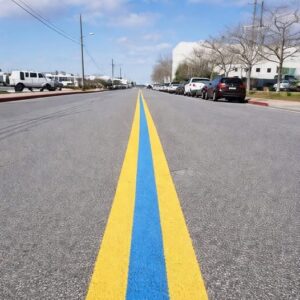
The “thin blue line” has long existed as a symbolic image, commonly seen on flags, decals, and uniforms, where it traditionally represents law enforcement as a stabilizing presence between order and disorder. Transferring this symbol onto public streets integrates that meaning into the physical structure of the town itself. Supporters believe that at a time when conversations around policing are often complex and emotionally charged, a visible sign of respect can help strengthen trust. Community leaders frequently describe the goal as fostering civic unity—reinforcing the idea that cooperation between citizens and public servants is essential for a functioning society.
Beyond symbolism, planners have also pointed to a practical benefit. Even in an era dominated by digital navigation, physical cues remain important. The blue line functions as a subtle wayfinding tool, offering a clear visual route to the police station for residents or visitors who may need assistance. For those unfamiliar with the area, the distinctive color creates an intuitive guide toward a place of help. This combination of meaning and utility has made the concept appealing to other municipalities looking for low-cost ways to enhance both identity and function.
Interest in the idea has spread. In city council discussions across the country, Ocean City’s approach is increasingly referenced as a model. Advocates emphasize that the blue stripe does not replace or interfere with existing traffic markings. Instead, it fits neatly within established road standards, allowing communities to personalize their streets without violating transportation regulations. The result is a standardized roadway with a distinctly local voice.
 Up Next: Page 3 of 3
Urban design experts note that this development aligns with a wider trend...
The long-term effects of such initiatives are still being observed, but early optimism is strong. Some researchers suggest that visible appreciation may...
Continue Reading