The mystery of what happens after death is perhaps humanity’s most enduring question. Across time and cultures, we’ve crafted myths, spiritual frameworks, and religious narratives to explain the transition from life to the unknown: the gates of heaven, karmic cycles, or the scales of judgment. Yet, despite centuries of speculation and debate, the true nature of the afterlife remains hidden—except for those rare individuals, like Brian Miller, who claim to have crossed over and returned to share their experiences.
Brian Miller, a 41-year-old truck driver from Ohio, had always lived a life rooted in the tangible. His days were measured by miles on the highway and the hum of his rig. But in 2014, that grounded reality was suddenly upended. While performing a simple household task—struggling with a stubborn container lid—he felt an overwhelming, blinding pressure in his chest. Recognizing the warning signs of a severe heart attack, he dialed 911: “I think I’m having a heart attack,” he told the dispatcher, his voice strained by pain.
Rushed to the hospital, doctors worked swiftly to clear a total arterial blockage. For a fleeting moment, it seemed he had survived the crisis. But the attack triggered a fatal complication: ventricular fibrillation. In this state, the heart ceases effective pumping, descending into chaotic quivering, leaving vital organs starved of blood. Brian flatlined.
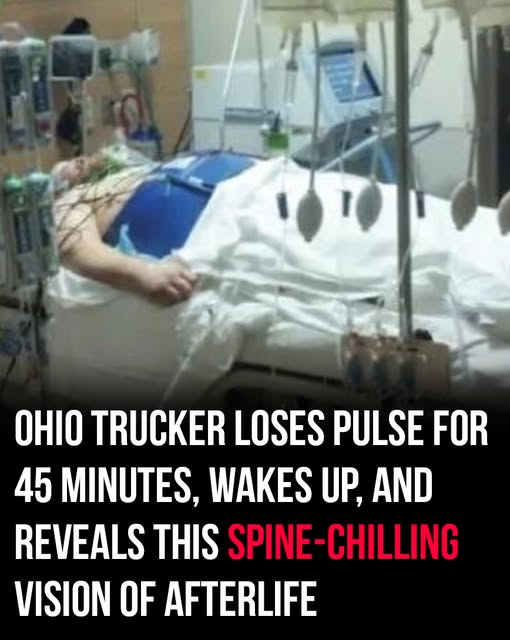
ICU nurse Emily Bishop recalls the scene as one of stark finality. By every medical measure, he was gone—no pulse, no blood pressure, no heartbeat. Emergency teams performed CPR relentlessly, even breaking ribs to manually circulate blood. Defibrillators delivered four shocks in an attempt to restart his heart, yet nothing succeeded. After nearly 45 minutes of continuous resuscitation, the team had no choice but to pronounce him dead.
For nearly three-quarters of an hour, Brian’s body remained lifeless, his brain deprived of oxygen for a period that usually guarantees permanent damage. Yet, Brian recounts that he was elsewhere entirely.
He describes his near-death experience not as fading into darkness, but as entering a radiant, vibrant realm. “I remember a light ahead and walking toward it,” he recalled. He found himself in a place beyond earthly comprehension, a corridor filled with impossibly vivid flowers, where he encountered his late stepmother.
Their reunion was anything but sorrowful. He described her as glowing, youthful, and joyful—exactly as she had been in life. Without philosophical lectures, she held his arm and told him firmly, “It’s not your time. You have things left to do. We need to take you back.”
Back in the hospital, as the staff prepared for the inevitable, something extraordinary occurred. Without intervention, his pulse returned spontaneously. Nurse Bishop noted that, in rare cases where the heart restarts after extended clinical death, patients are usually left in a vegetative state. Brian, however, emerged fully conscious—sitting, laughing, and speaking with those who had witnessed his death.
Since then, Brian’s story has become a reference point for near-death experience (NDE) research. Skeptics often attribute such experiences to chemical and neurological activity in a dying brain, like the release of DMT or hypoxia-induced neuron firing. But for Brian, the experience offered profound clarity and a simple truth: he believes in the afterlife. “There’s something beyond this life,” he insists.
Beyond the medical marvel of his survival, Brian’s account provides hope to those grappling with loss. The vision of reunion with a loved one offers comfort that scientific explanations cannot replace. Brian now lives in Ohio with a transformed perspective: he has stood at the threshold of death and discovered it was not an empty void, but a luminous, welcoming place.
His journey reminds us that even when all signs point to finality—when monitors are silent and hearts cease—there may exist a path beyond, lined with light, flowers, and perhaps a familiar hand ready to guide us, whether forward or back.