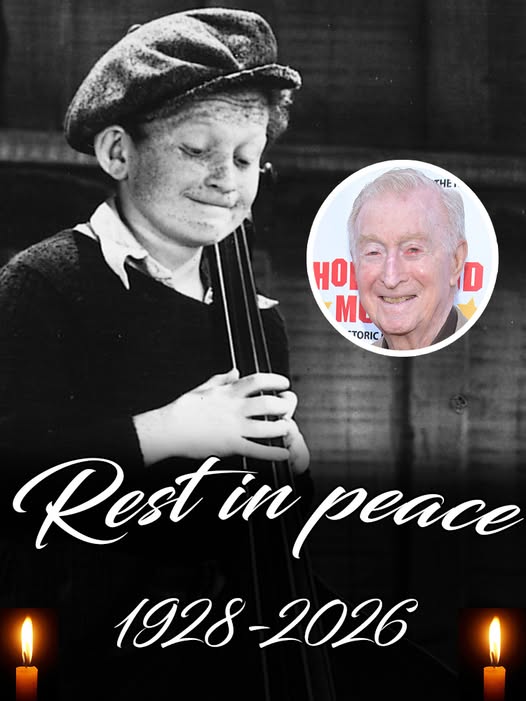
Sidney Kibrick, a familiar face from Hollywood’s early sound era and the final surviving member of the original Our Gang cast, has passed away at 97. With his death, a quiet but meaningful chapter of film history comes to a close—one that shaped generations of humor, innocence, and childhood imagination. His family confirmed that Kibrick died on January 3 at a hospital in Northridge, California, after a long life that stretched far beyond his brief yet memorable years in front of the camera.
Born in Minneapolis in 1928, Kibrick moved to Los Angeles with his family while still very young. His entry into the film world was less a planned journey and more a matter of circumstance. In an era when studios constantly searched for expressive young faces, he was discovered almost by chance—a child in the right place at the right time.
He became widely known through his appearances in the short comedy series Our Gang, later branded as The Little Rascals. Created by producer Hal Roach, the series began in 1922 and ran for more than two decades, portraying the everyday adventures of children in working-class neighborhoods. What set the shorts apart was their authenticity: kids behaved like kids—arguing, plotting, failing, and trying again—without the polished sentimentality typical of studio productions.
Kibrick joined the cast in 1935 at just five years old. His character, “Woim,” named after a Brooklyn-style pronunciation of “worm,” was small in size but memorable in presence. Over the next four years, he appeared in roughly two dozen shorts, sharing the screen with icons such as Carl Switzer, George “Spanky” McFarland, Darla Hood, and Tommy Bond. Together, they formed an ensemble that became woven into American pop culture.
Behind the lighthearted humor, however, was demanding work. In later interviews, Kibrick spoke openly about the long hours child actors endured during that period, before modern labor protections were fully in place. Days often began with a brief school session, followed by filming that could last anywhere from six to sixteen hours. Despite the intensity, he credited director Gordon Douglas with fostering an atmosphere that allowed children to perform naturally.
The pay was remarkable for its time. Kibrick later revealed he earned around $750 per week—an extraordinary amount during the Great Depression. Yet the income came with expectations and pressure that only became clear to him in adulthood. Like many former child stars, he carried both warm memories and complicated feelings about those years.
Beyond Our Gang, Kibrick appeared in feature films, including Just Around the Corner (1938) alongside Shirley Temple and Jesse James (1939) with Tyrone Power. These roles broadened his experience but also confirmed what he had begun to feel: acting was not meant to be his life’s path.
By age fifteen, after nearly a decade in the industry, he chose to leave Hollywood. Convincing his parents was difficult—his career was thriving by any measure—but Kibrick was determined to pursue an ordinary life. His final screen appearance came in 1943’s Keep ’Em Slugging. After that, he stepped away from show business for good.
Though he left the spotlight early, his connection to Our Gang never truly faded. Fans continued to recognize him and reach out for decades. In 1981, he organized a reunion of the cast, helping preserve the memory and legacy of the series. He remained generous with admirers, sharing his experiences with honesty rather than rose-colored nostalgia.
In later years, Kibrick frequently appeared at events honoring classic cinema. In 2022, he attended the 100th anniversary celebration of Our Gang at The Hollywood Museum, welcomed as a living bridge to a nearly vanished era. By then, he was the last surviving cast member from the 1930s shorts—a distinction that highlighted both his longevity and the relentless passage of time.
Those close to him describe Kibrick as private and grounded, a man who valued life beyond fame. He never sought to reclaim stardom or heavily monetize his past. Instead, he seemed content knowing his work had brought joy to millions, even if it represented only a small chapter of his life.
Sidney Kibrick’s passing is more than the loss of an individual; it marks the end of a living connection to early American screen comedy. Our Gang continues through archives and reruns, but the people who created it now belong fully to history. Kibrick carried that history with humility, offering perspective rather than spectacle.
He is survived by his family and by generations who grew up laughing at black-and-white shorts that captured something timeless about childhood. His legacy is not measured by how long he lived, but by how enduring his work remains. With his passing, an era finally comes to rest—remembered for its simplicity, warmth, and heart.